Loading...
Strategies
Ratio Spread — Options Strategy Explained
A ratio spread buys one option and sells more options of the same type at a different strike in the same expiration, most often 1x2.
By Aigars PilmanisLast updated
Educational content. Not financial, investment, tax, or legal advice. Options involve risk and are not suitable for all investors. How we write & review this glossary.
A ratio spread is an options position that buys one option and sells a larger number of options of the same type at a different strike in the same expiration, most often in a 1x2 ratio. It can be opened for a small credit or a debit, depending on strikes and implied volatility. It earns the most if the underlying finishes at the short strike, but past the breakeven beyond the short strike the extra short option is uncovered: the loss is unlimited for a call ratio and runs down to a price of zero for a put ratio.
The position
Structure
A ratio spread uses an unequal number of bought versus sold options at different strikes, creating asymmetric risk and reward.
- Drives outcome
- Where price settles relative to the strikes and the ratio; depending on the ratio, a short leg can be uncovered.
- Risk type
- Depends on ratio and strikes
VolRadar Lens
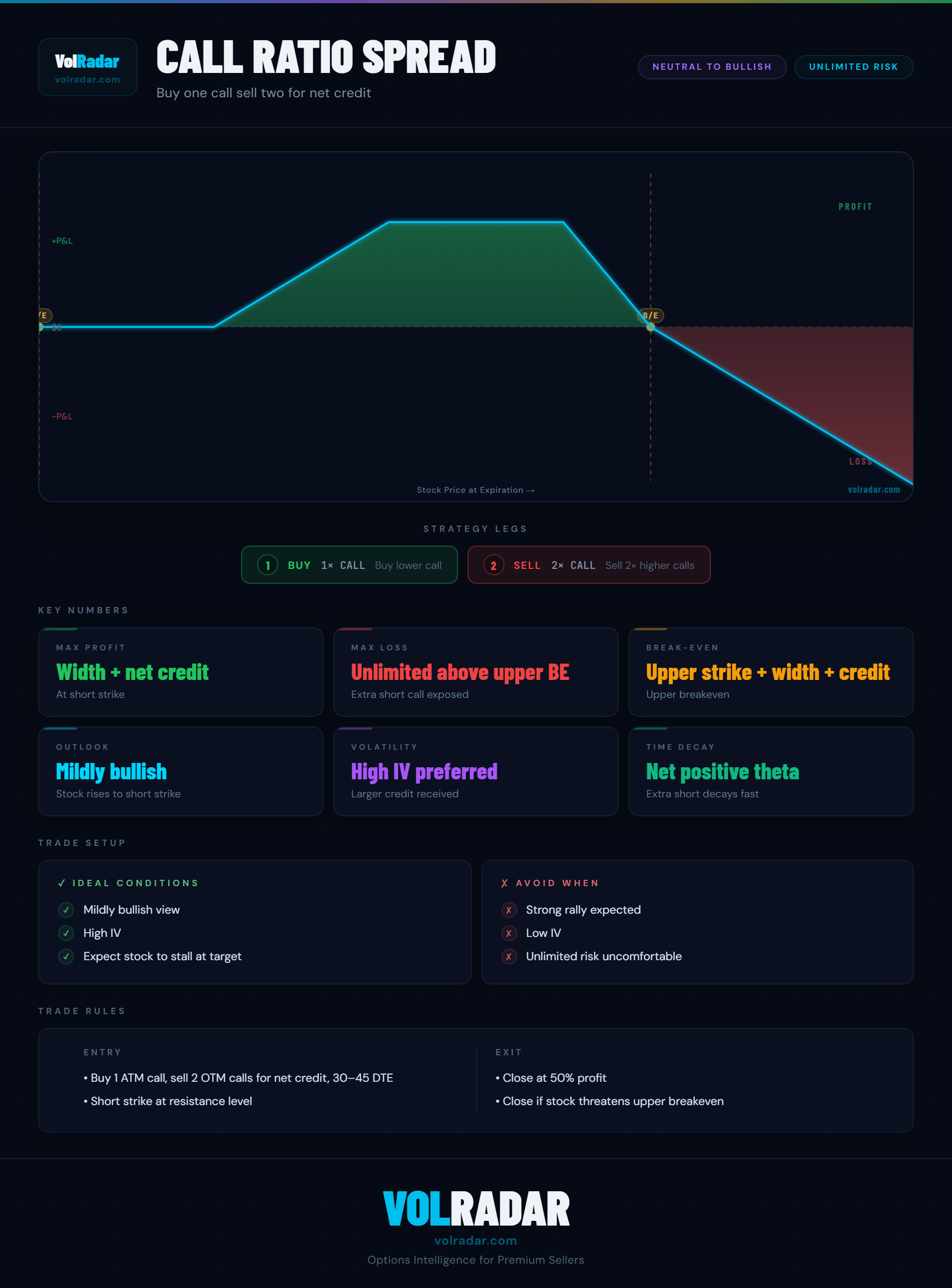
A 1x2 ratio spread peaks at the short strike and loses beyond its breakeven. For a call ratio, the loss above the upper breakeven is unlimited; for a put ratio, it is large but capped because the underlying cannot fall below zero.
Visual ReferencePayoff structure and strike placementShowHide
Why It Matters
Ratio spreads let a trader express a view that the price will move toward a target but not far past it, often at little or no upfront cost. Common ratios are 1x2 and 1x3. Front ratios (selling more than buying) can open for a credit or a debit and profit most from a limited move toward the short strike; backspreads (buying more than selling) can be opened for a small credit or debit and profit from a large enough move in the direction of the extra long options, up for a call backspread and down for a put backspread, while a debit backspread loses the debit if the price moves the other way. The payoff can be shaped to peak at a specific price. The cost of that shape is the uncovered extra short option, which creates tail risk beyond the breakeven.
How It Works
In a 1x2 call ratio, you buy one call at a lower strike and sell two calls at a higher strike, often for a small credit. Below the long strike, all options expire worthless and you keep any credit. Between the strikes, the long call gains value. The maximum profit comes at the short strike at expiration: strike width + net credit. Above the short strike, the second short call is uncovered, so each $1 rise costs $100 per spread on standard 100-share contracts until the upper breakeven is crossed and losses keep growing. A put ratio mirrors this below the price: buy one higher-strike put, sell two lower-strike puts. Breakevens and Greeks (1x2, opened for a credit): call ratio upper breakeven = short strike + (short strike - long strike) + credit; put ratio lower breakeven = short strike - (long strike - short strike) - credit. When opened for a credit there is no breakeven on the other side, because the credit is kept if all options expire worthless. Net vega = the long option's vega - 2 x the short option's vega, so its sign depends on the strikes: when the two short options carry more vega than the long one, the position is net short vega and a rise in implied volatility hurts it before expiration. The sign can change as price, time and volatility move. At expiration, the payoff slope of a 1x2 call ratio flips at the short strike from +$100 to -$100 per $1 move per spread; before expiration, where net delta crosses zero depends on price, time and volatility, and losses can accelerate as expiration nears.
Example
Hypothetical 1x2 call ratio on a $580 stock, 30 days to expiration, standard 100-share contracts: buy 1 $580 call, sell 2 $585 calls, net credit $0.80 ($80). At expiration: below $580, everything expires worthless and you keep +$80. At $585, the long call is worth ($585 - $580) x 100 = $500 and the short calls are worth $0, so the result is $500 + $80 = +$580, the maximum. Upper breakeven = $585 + $5 + $0.80 = $590.80. At $592: long call +$1,200, two short calls -$1,400, credit +$80, for -$120; each further $1 rise adds another -$100.
Common Mistakes
Treating the credit as the risk. The credit is the most you keep if the price stays away; the loss beyond the breakeven can be many times larger. Ignoring the direction of the uncovered leg: a call ratio has unlimited risk above the upper breakeven, and a put ratio has large risk down to a price of zero. Forgetting volatility: when the position is net short vega, a rise in implied volatility can show a loss before expiration even if the price has not moved. Confusing a ratio spread with a backspread, which reverses the ratio and the risk profile.
Is the market paying premium sellers today?
The SPY Premium Window study tracks when systematic option selling has historically been compensated — recomputed daily from market close. Free to read, no account needed.
Frequently Asked Questions
What is a ratio spread in option trading?
A ratio spread buys and sells unequal numbers of options of the same type at different strikes in the same expiration. A typical 1x2 call ratio buys one call and sells two higher-strike calls, often for a small credit, depending on strikes and implied volatility. It combines a directional view with a capped profit zone; its net vega can be short or long depending on the strikes, and it carries large risk on the over-sold side: unlimited for a call ratio, and down to a price of zero for a put ratio.
How does a ratio spread differ from a backspread?
A ratio spread sells more options than it buys (for example, 1 long and 2 short), so profit is capped and the tail is uncovered. A backspread buys more than it sells (for example, 1 short and 2 long), is often opened for a small credit or debit, and profits from a large enough move in the direction of its extra long options. A ratio spread fits a muted move; a backspread fits a large one.
What is the maximum profit on a ratio spread?
For a 1x2 ratio, the maximum profit at expiration comes when the underlying finishes exactly at the short strike: the long option is worth the strike width and both short options expire worthless. Hypothetical, standard 100-share contracts: long $100 call and two short $105 calls give ($105 - $100) x 100 = $500, plus any net credit received or minus any net debit paid.
Where is the breakeven on a 1x2 ratio spread?
For a 1x2 opened for a credit, a call ratio's upper breakeven is the short strike + the strike width + the credit, and a put ratio's lower breakeven is the short strike - the strike width - the credit. Hypothetical: long $580 call, two short $585 calls, $0.80 credit gives $585 + $5 + $0.80 = $590.80.
How can the risk of a ratio spread be capped?
Buying one further out-of-the-money option of the same type covers the extra short leg. For a 1x2 call ratio, adding a long call above the short strike turns it into a 1-2-1 butterfly (a broken-wing butterfly if the strikes are unevenly spaced), which caps the loss beyond the short strike. The added option costs premium and lowers the maximum profit.
General references
General references for this topic area, not citations for the specific figures above. VolRadar is not affiliated with these organizations.
The information about Ratio Spread above is for educational purposes only and is not financial advice. Read our full investment disclaimer.
Understand options faster.
One term, one worked example, one real ticker. Every Sunday. No jargon.
One email per week, no drip campaigns · Unsubscribe anytime