Loading...
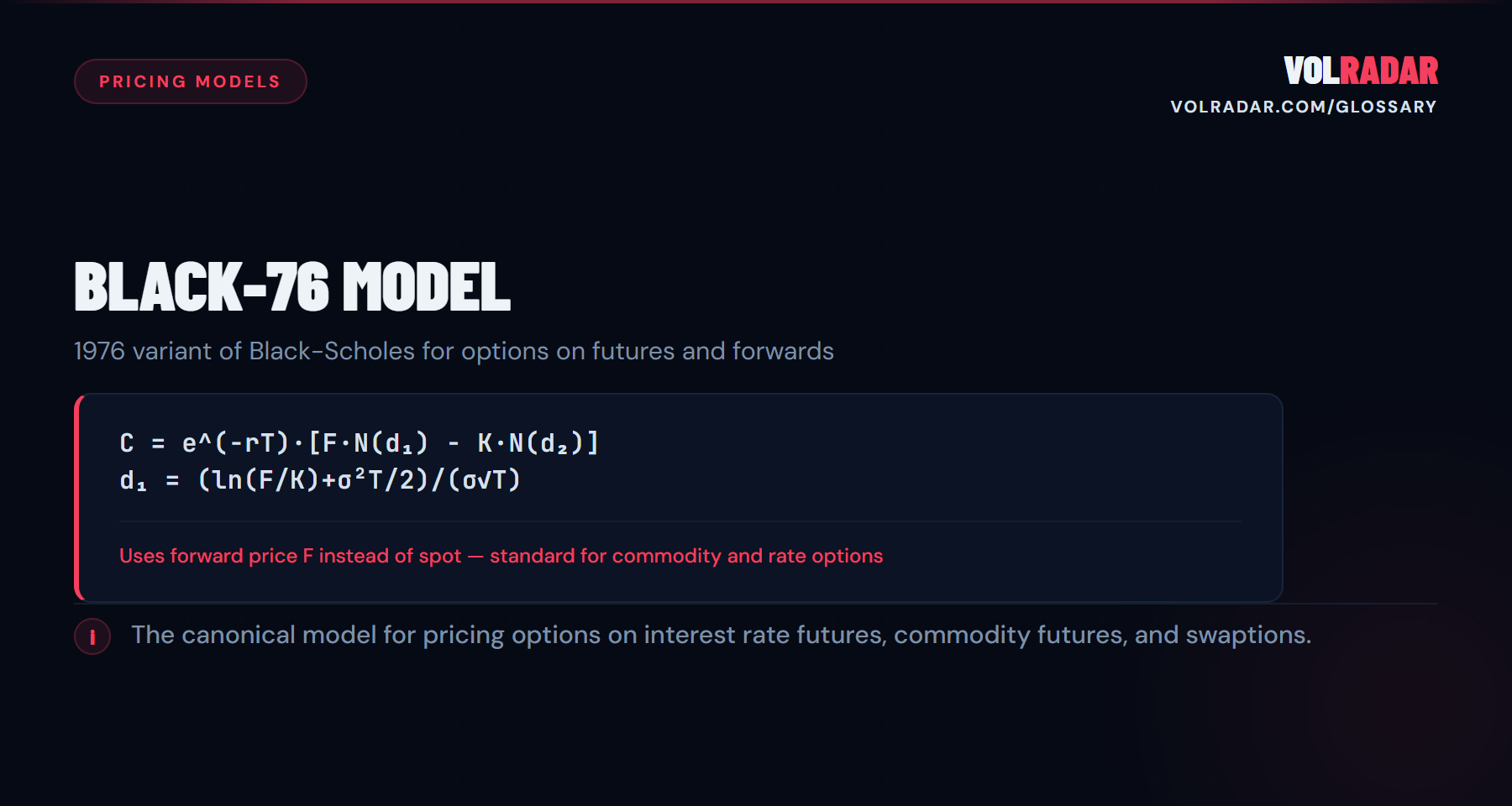
The Black-76 model adapts Black-Scholes for pricing options on futures contracts by replacing the spot price with the futures price and removing the cost-of-carry term. It is the standard model for pricing options on commodities, interest rate futures, and VIX futures.
⚡
Key takeawayVIX options are priced using Black-76 with VIX futures as the underlying, not spot VIX. Premium sellers must compare VIX option strikes to the corresponding VIX future, not spot VIX, to accurately assess whether premium is rich or cheap.
💡 Why It Matters
Black-76 is the correct model for pricing VIX options, commodity options, and any option where the underlying is a futures contract. Using Black-Scholes (which assumes a spot underlying) to price futures options introduces systematic pricing errors.
⚙ How It Works
Black-76 replaces the spot price in the Black-Scholes formula with the futures price and removes the risk-free rate drift (since futures require no upfront investment). The formula is: C = exp(-rT) * [F*N(d1) - K*N(d2)], where F is the futures price rather than spot price S.
📋 Example
VIX is at 15 (spot) and the May VIX future is at 18. A VIX May 20 call should be priced using Black-76 with F = 18 as the underlying, not S = 15. With F = 18, the call is only 2 points OTM. Using spot VIX would show it as 5 points OTM, dramatically underpricing the option.
⚠ Common Mistakes
Traders use spot VIX to evaluate VIX option positions. This is the number one mistake in VIX options trading. VIX 20 calls are not 5 points OTM when VIX is at 15 if the corresponding future is at 18. Always use the relevant future as the underlying for VIX option analysis.
❓ FAQ
What is Black-76 Model?
The Black-76 model adapts Black-Scholes for pricing options on futures contracts by replacing the spot price with the futures price and removing the cost-of-carry term. It is the standard model for pricing options on commodities, interest rate futures, and VIX futures.
Why does Black-76 Model matter for premium sellers?
VIX options are priced using Black-76 with VIX futures as the underlying, not spot VIX. Premium sellers must compare VIX option strikes to the corresponding VIX future, not spot VIX, to accurately assess whether premium is rich or cheap.
How does Black-76 Model work?
Black-76 replaces the spot price in the Black-Scholes formula with the futures price and removes the risk-free rate drift (since futures require no upfront investment). The formula is: C = exp(-rT) * [F*N(d1) - K*N(d2)], where F is the futures price rather than spot price S.
What are common mistakes with Black-76 Model?
Traders use spot VIX to evaluate VIX option positions. This is the number one mistake in VIX options trading. VIX 20 calls are not 5 points OTM when VIX is at 15 if the corresponding future is at 18. Always use the relevant future as the underlying for VIX option analysis.
Related Terms
Bachelier Model
The Bachelier model (normal model) assumes the underlying follows an arithmetic Brownian motion with normally distributed returns, rather than the lognormal ...
Barone-Adesi-Whaley Model
The Barone-Adesi-Whaley (BAW) model is a quadratic approximation for pricing American options that decomposes the American option price into its European val...
Binomial Option Pricing
A discrete-time pricing model that builds a recombining tree of possible price paths.
Bjerksund-Stensland Model
The Bjerksund-Stensland model provides a closed-form approximation for pricing American options by treating early exercise as a flat barrier problem.
This is not financial advice. Read our full investment disclaimer.