Loading...
Strategies
Broken Wing Butterfly — Options Strategy Explained
A broken wing butterfly is an options butterfly spread with one wing wider than the other, shifting most of the risk to the wide-wing side.
By Aigars PilmanisLast updated
Educational content. Not financial, investment, tax, or legal advice. Options involve risk and are not suitable for all investors. How we write & review this glossary.
A broken wing butterfly is an options butterfly spread with one wing wider than the other, which shifts most of the risk to the wide-wing side, and all of it when the trade opens for zero cost or a credit. Its maximum loss is (wide wing - narrow wing - net credit) x 100, with a debit counted as a negative credit, and its maximum profit is at the short (body) strike. When it is opened for a net credit, it has no loss at expiration if the price finishes beyond the narrow wing; if it is opened for a debit, that side loses the debit paid.
The position
Direction
Directional, neutral, or skewed
- Max profit
- At body strike
- Risk type
- Defined (asymmetric wings)
VolRadar Lens
- Key feature
- Can remove risk on one side, depending on strikes and credit.
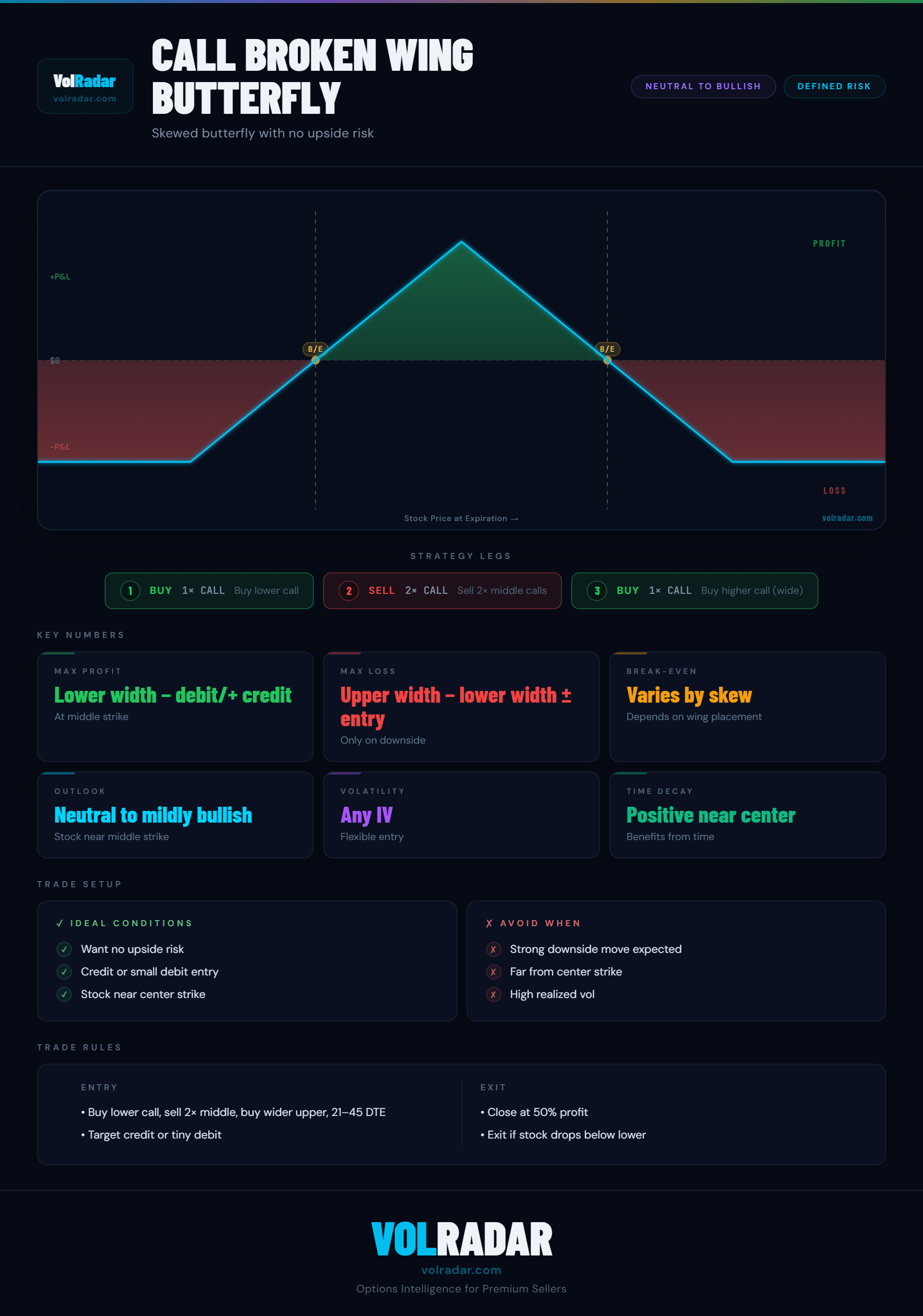
A broken wing butterfly turns a neutral butterfly into a directional, defined-risk position: the wider wing is where the extra exposure sits, and the narrow-wing side is loss-free at expiration only when the trade opens for a credit or zero debit.
Visual ReferencePayoff structure and strike placementShowHide
Why It Matters
A broken wing butterfly lets a trader express a directional lean while keeping a butterfly's defined risk. A symmetric long butterfly is paid for with a debit that is lost if the price moves far away in either direction; widening one wing can remove the loss on one side, at the cost of a larger capped loss on the other. Opened for a credit, the narrow-wing side has no loss at expiration, and the capped loss appears only beyond the wide wing. Some traders use it instead of a naked short option, because the long wide-wing option caps the loss that a naked position would leave open.
How It Works
A standard butterfly uses equal wings, for example strikes 100-110-120: buy one 100, sell two 110s, buy one 120. A broken wing butterfly moves one long strike further out, for example 100-110-125, so the upper wing is 15 points wide and the lower wing 10. That change lowers the cost, sometimes to a net credit, and moves the risk to the wide side. Max profit = (narrow wing + net credit) x 100, reached at the body strike at expiration. Max loss = (wide wing - narrow wing - net credit) x 100, reached beyond the wide wing. A put broken wing butterfly with the wide wing below the body has its risk to the downside and suits a neutral-to-bullish view; a call version with the wide wing above the body has its risk to the upside and suits a neutral-to-bearish view.
Example
Hypothetical put broken wing butterfly, stock at $500: buy 1 $490 put, sell 2 $480 puts, buy 1 $465 put, for a net credit of $0.50 ($50). The narrow wing is 490 - 480 = 10 points; the wide wing is 480 - 465 = 15 points. At expiration: above $490, all puts expire worthless and the $50 credit is kept. At $480, the $490 put is worth $10, so the profit is ($10 + $0.50) x 100 = $1,050, the maximum. Below $465, the legs net to (490 - 480) - (480 - 465) = -5 points, so the loss is (15 - 10 - 0.50) x 100 = $450, the maximum. Between $465 and $480 the payoff is (price - 470) + 0.50, so the lower breakeven is 480 - (10 + 0.50) = $469.50. VolRadar's options profit calculator includes a Broken Wing Butterfly preset that plots this kind of payoff.
Common Mistakes
Assuming there is no risk on one side regardless of price paid. The narrow-wing side is loss-free only when the trade opens for a credit or zero debit; after a debit, that side loses the debit. Using the wide-wing width as the max loss. The correct figure is (wide wing - narrow wing - net credit) x 100, which in the example is $450, not (15 - 0.50) x 100 = $1,450. Putting the wide wing on the wrong side. For a put version with downside risk, the wide wing sits below the body; mixing the strikes up produces a different position with a different payoff. Expecting the max profit to be reached before expiration. The full value at the body strike is usually realized only close to expiration.
Is the market paying premium sellers today?
The SPY Premium Window study tracks when systematic option selling has historically been compensated — recomputed daily from market close. Free to read, no account needed.
Frequently Asked Questions
How is a broken wing butterfly different from a standard butterfly?
A standard butterfly uses equal wing widths, costs a debit and loses that debit if the price moves far away in either direction. A broken wing butterfly makes one wing wider, which lowers the cost, sometimes to zero or a credit. The narrow-wing side then loses only the debit that remains (nothing if the trade opened for zero or a credit), while the wide-wing side takes on a larger capped loss.
What is the maximum loss on a broken wing butterfly?
Max loss = (wide wing - narrow wing - net credit) x 100, reached beyond the wide wing at expiration. With a 10-point narrow wing, a 15-point wide wing and a $0.50 credit, the max loss is (15 - 10 - 0.50) x 100 = $450.
What decides whether a broken wing butterfly opens for a credit?
The prices of the four options. The two short body options must bring in more than the two long wings cost, which depends on the strikes chosen, the width of the wide wing and how the volatility skew prices each strike. A wider wide wing usually lowers the cost but raises the max loss.
How does time to expiration affect a broken wing butterfly?
Shorter expirations change value faster through time decay and gamma near the body strike; longer ones change more slowly, and the max profit at the body is usually reached only close to expiration.
General references
General references for this topic area, not citations for the specific figures above. VolRadar is not affiliated with these organizations.
The information about Broken Wing Butterfly above is for educational purposes only and is not financial advice. Read our full investment disclaimer.
Understand options faster.
One term, one worked example, one real ticker. Every Sunday. No jargon.
One email per week, no drip campaigns · Unsubscribe anytime