Loading...
Strategies
Butterfly Spread — Options Strategy Explained
A butterfly spread buys one lower-strike option, sells two middle-strike options, and buys one upper-strike option, all at the same expiration.
By Aigars PilmanisLast updated
Educational content. Not financial, investment, tax, or legal advice. Options involve risk and are not suitable for all investors. How we write & review this glossary.
A butterfly spread is a three-strike options position with limited risk and limited reward: buy one option at a lower strike, sell two options at the middle strike and buy one option at an upper strike, all of the same type and expiration, with the outer strikes (the wings) equally distant from the middle strike (the body). The standard long butterfly is opened for a net debit and reaches its maximum gain if the underlying finishes exactly at the middle strike at expiration.
The position
Direction
Neutral, narrow
- Drives outcome
- Price settling near the middle strike at expiration.
- Max profit
- At middle strike pin
- Max loss
- Debit paid
- Risk type
- Defined (debit)
VolRadar Lens
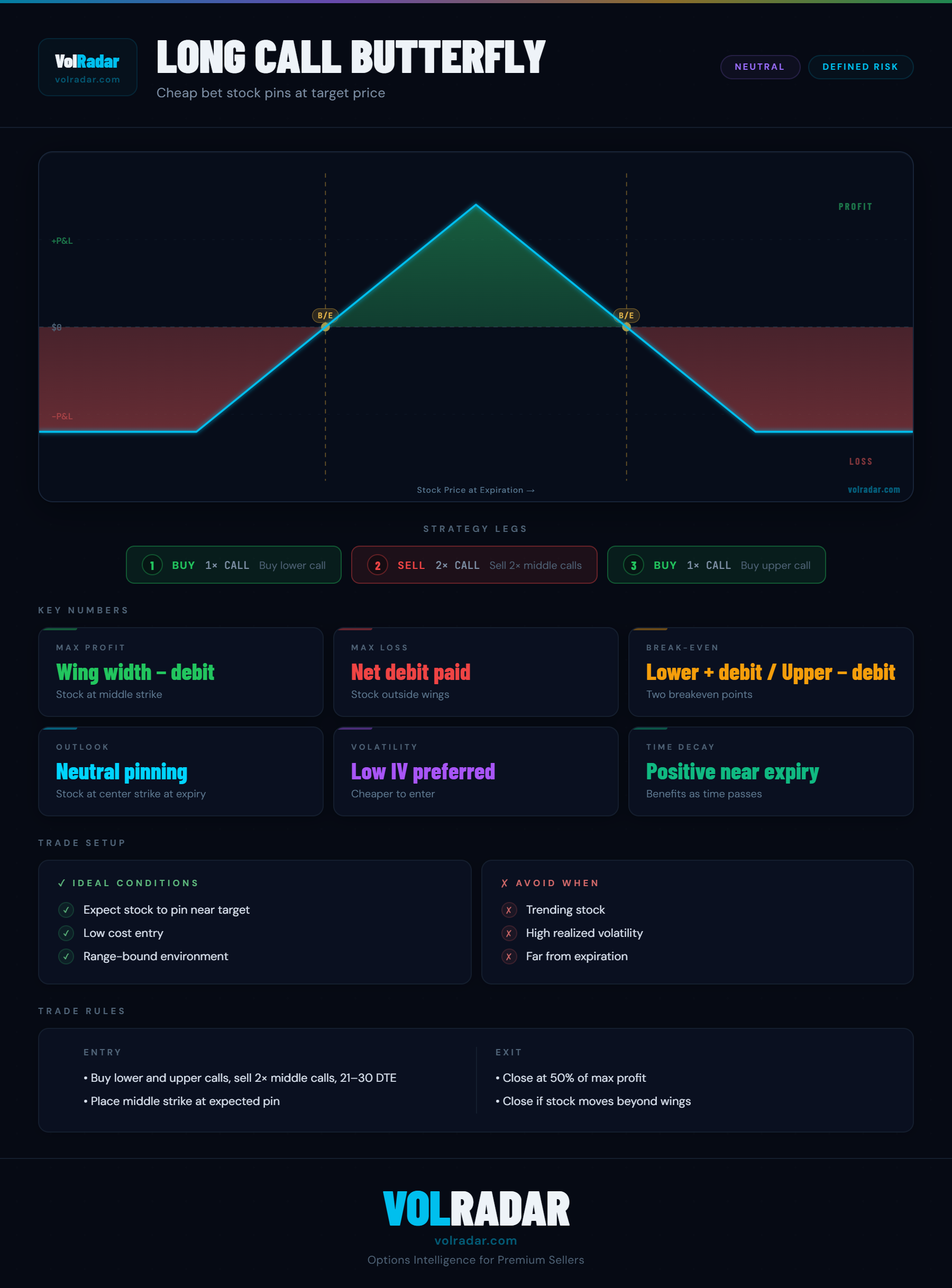
A long butterfly is worth zero outside its wings and rises to the wing width only at the middle strike, so the debit paid is the most that can be lost and the maximum gain needs a precise finish.
Visual ReferencePayoff structure and strike placementShowHide
Why It Matters
The butterfly is a position whose gain is concentrated around one price. Both the gain and the loss are limited and known when the position is opened: the loss is the debit, and the gain is the wing width minus the debit. The Options Industry Council describes the outlook as looking for the underlying to achieve a specific price target at expiration, so the structure expresses a view about where the stock will finish rather than which direction it will move.
How It Works
Take the long call butterfly: buy one call at the lower strike, sell two calls at the middle strike and buy one call at the upper strike, same expiration, with the wings equidistant from the body. The Options Industry Council notes that the long put butterfly, with the same strikes and expiration, has the same payoff at expiration, though the two may differ in the likelihood of early exercise if the options go in the money or the stock pays a dividend. At expiration the position is worth zero if the stock finishes at or below the lower strike or at or above the upper strike, and rises to the wing width (middle strike minus lower strike) when the stock finishes at the middle strike. Maximum gain is the middle strike minus the lower strike minus the net debit, reached only at the middle strike. Maximum loss is the net debit, reached anywhere outside the wings. The breakevens are the lower strike plus the debit and the upper strike minus the debit. The Options Industry Council says time decay usually has a positive effect if the body is at the money and a negative effect if it is away from the money, and that an increase in implied volatility, all else equal, usually has a slightly negative effect. It also says the strategy has an extremely high expiration risk: at the body it is not known whether none, one or both of the short options will be exercised, so the stock can open sharply higher or lower after the expiration weekend. A short iron butterfly, which is a short call and a short put at the middle strike with a long call above and a long put below, has a similar risk and reward shape but differs in that the long butterfly usually requires a debit to enter its four legs.
Example
Hypothetical, per share, with standard 100-share contracts: buy one 95 call at 6.90, sell two 100 calls at 3.60 and buy one 105 call at 1.60, same expiration. Net debit = 6.90 - 2 x 3.60 + 1.60 = 1.30 ($130 per butterfly). The wings are 5.00 wide. At expiration: at 100 the value is 5.00, so the maximum gain is 5.00 - 1.30 = 3.70 ($370). At 102 the value is (102 - 95) - 2 x (102 - 100) = 3.00, so the gain is 3.00 - 1.30 = 1.70 ($170). The breakevens are 95 + 1.30 = 96.30 and 105 - 1.30 = 103.70. At or below 95, or at or above 105, the value is zero and the loss is the 1.30 debit (-$130). Commissions on four contracts are not included.
Common Mistakes
Using unequal wings and still applying the standard formulas: the maximum-gain and breakeven formulas here assume the wings are equidistant from the middle strike. Expecting the maximum gain anywhere but at the middle strike: the value falls to zero at the wings. Overlooking the extremely high expiration risk the Options Industry Council describes when the stock finishes near the middle strike, where the exercise of the short options is uncertain. Treating call and put butterflies as interchangeable for early exercise: the expiration payoff is the same but early-exercise risk can differ. Ignoring four sets of commissions and bid-ask spreads, which reduce a result that is already limited by the wing width.
Is the market paying premium sellers today?
The SPY Premium Window study tracks when systematic option selling has historically been compensated — recomputed daily from market close. Free to read, no account needed.
Frequently Asked Questions
What is the structure of a butterfly spread?
One option bought at a lower strike, two sold at the middle strike and one bought at an upper strike, all of the same type (all calls or all puts) and expiration, with the wings equidistant from the middle strike. A long butterfly usually costs a net debit.
How are the maximum gain and maximum loss of a butterfly calculated?
Maximum gain is the middle strike minus the lower strike minus the net debit, reached only if the stock finishes at the middle strike at expiration. Maximum loss is the net debit, reached outside the wings. In the example these are 3.70 and 1.30 per share, or $370 and $130.
Where are the breakevens of a butterfly?
At expiration, the lower strike plus the net debit and the upper strike minus the net debit. In the example, 96.30 and 103.70. Between them the butterfly is profitable and outside them it loses.
How does a long butterfly differ from an iron butterfly?
A long butterfly uses options of one type and usually requires a debit. A short iron butterfly sells a call and a put at the middle strike and buys a call above and a put below. The Options Industry Council says the long butterfly differs from the short iron butterfly in that it usually requires a debit to enter all four legs.
What are the exercise and assignment risks of a butterfly?
The short options at the middle strike can be exercised at any time for American-style options, and the Options Industry Council says the strategy has an extremely high expiration risk when the stock finishes near the middle strike, because it is not known which of the short options will be exercised.
General references
General references for this topic area, not citations for the specific figures above. VolRadar is not affiliated with these organizations.
The information about Butterfly Spread above is for educational purposes only and is not financial advice. Read our full investment disclaimer.
Understand options faster.
One term, one worked example, one real ticker. Every Sunday. No jargon.
One email per week, no drip campaigns · Unsubscribe anytime