Loading...
Mechanics
Bid-Ask Spread — Options Order Mechanics Explained
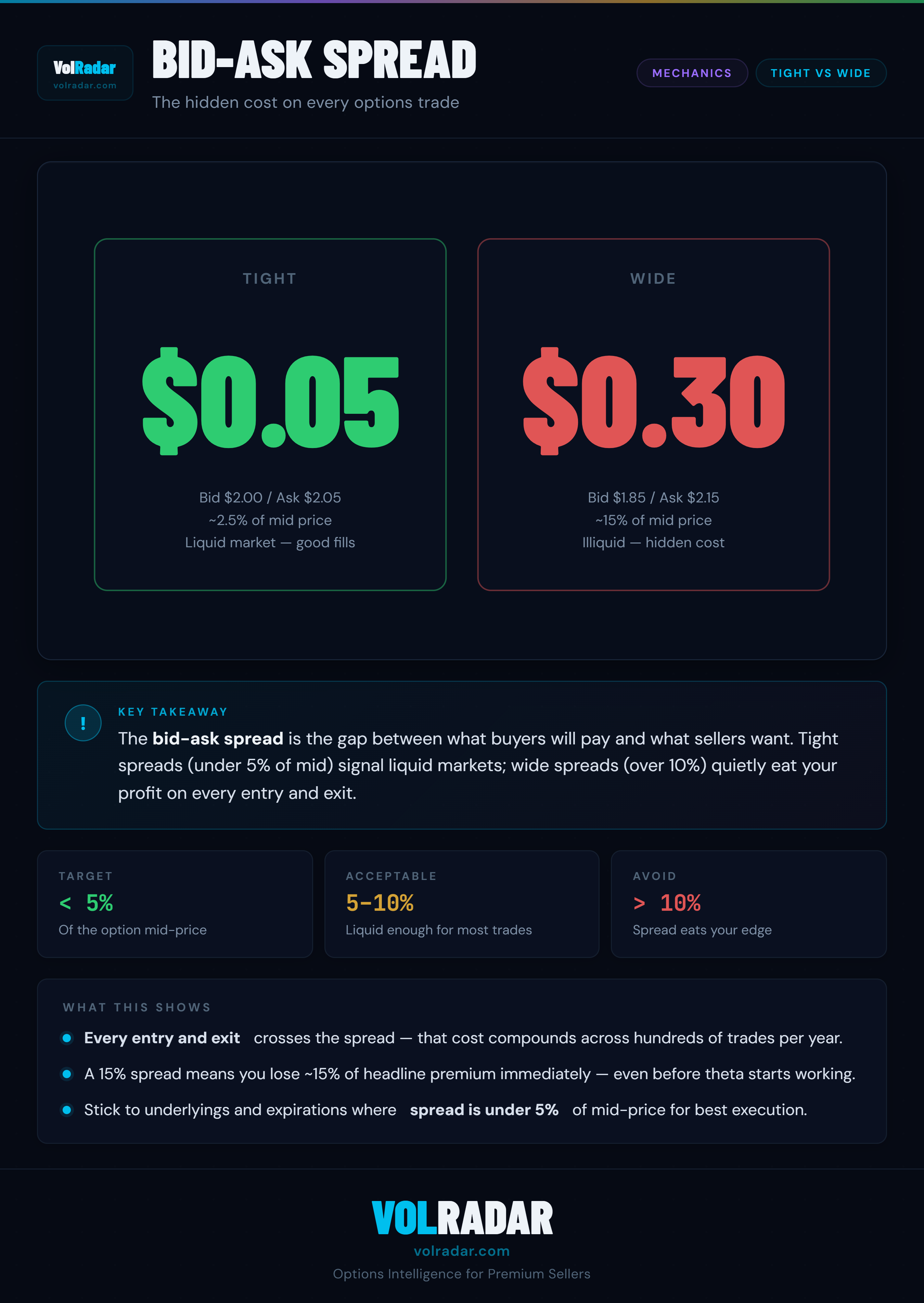
The bid-ask spread is the difference between the highest price a buyer will pay (bid) and the lowest price a seller will accept (ask) for an option.
By Aigars PilmanisLast updated
Educational content. Not financial, investment, tax, or legal advice. Options involve risk and are not suitable for all investors. How we write & review this glossary.
Bid-ask spread formula
Bid-Ask Spread = Ask Price − Bid Price. Spread as % of midpoint = (Ask − Bid) ÷ ((Ask + Bid) ÷ 2) × 100.Variables
- Bid
- — Highest price a buyer is willing to pay
- Ask
- — Lowest price a seller is willing to accept
- Midpoint
- — (Bid + Ask) ÷ 2 — a quoting reference between bid and ask, not an executable price
Example
An option is quoted 1.45 bid / 1.55 ask. Spread = 1.55 − 1.45 = $0.10, or roughly 6.7% of the $1.50 midpoint. A spread this wide relative to the midpoint can mean a market order fills worse than the midpoint; size and liquidity matter.
The bid-ask spread is the difference between the bid, the highest price a buyer is currently willing to pay, and the ask (or offer), the lowest price a seller is currently willing to accept. Option quotes are per share, so a $0.10 spread on an equity option that covers 100 shares is $10 per contract, and a trader pays part of it, measured against the midpoint, whenever an order buys at the ask or sells at the bid.
VolRadar Lens
- Definition
- Ask price minus bid price
- Effect
- Implicit trading cost
- Why it matters
- Wide spreads cut directly into collected premium.
A spread only means something relative to the option's price: $0.10 is 1% of a $10.00 option but 20% of a $0.50 option, so the same few cents can be a trivial cost or a large one.
Visual ReferenceVisual reference for Bid-Ask SpreadShowHide
Why It Matters
The spread is a trading cost that never appears as a fee: an order that buys at the ask or sells at the bid gives up half the spread against the midpoint, on the way in and again on the way out. In a multi-leg order, such as a credit spread or an iron condor, every leg has its own quoted spread; added together, the legs' quotes give the package's natural market, which is as wide as the legs' spreads combined, and how much of that width is actually paid depends on the net price at which the order is filled. For a short-premium position the cost comes out of the credit received, so on a low-priced option it can be a large share of the maximum possible profit.
How It Works
Market makers and other participants post the prices at which they will buy (bids) and sell (asks or offers); the quote a trader sees shows the best of each. The midpoint, halfway between bid and ask, is the usual reference point for measuring that cost. A market order to buy is typically executed at the quoted ask and a market order to sell at the quoted bid, so it gives up half the spread relative to the midpoint. A limit order sets the highest price a buyer will pay or the lowest a seller will accept, which can reduce that cost, but the order may not be executed at all if the market never reaches the limit. Several things make an option's spread wider or narrower: the spread of the underlying stock (a wide stock quote can produce a wide option quote), upcoming events such as earnings announcements, perceived trading risk, and how many participants compete to quote the series. When a spread is wider than usual, market makers may be unsure where they can buy or sell the underlying to hedge. The displayed size at the bid and ask shows how many contracts are available at those prices.
Example
Hypothetical. Option A is quoted $4.85 bid, $4.90 ask: the spread is $0.05, the midpoint is $4.875, and the spread is 0.05 / 4.875 = about 1.0% of the midpoint. Option B is quoted $1.20 bid, $1.55 ask: the spread is $0.35, the midpoint is $1.375, and the spread is 0.35 / 1.375 = about 25.5% of the midpoint. Buying B at the ask costs $1.55 - $1.375 = $0.175 per share more than the midpoint, or $17.50 per 100-share contract. Buying B at the ask and selling it straight back at the bid, with no change in the quote, loses $1.55 - $1.20 = $0.35 per share, or $35 per contract, before commissions.
Common Mistakes
Judging liquidity by volume or open interest alone instead of looking at the quoted spread and the displayed size. Comparing spreads in cents across options with very different prices. Using a market order in a wide or fast-moving market: a market order secures execution but not the price. Treating a quote seen outside trading hours as tradable: options on equities generally trade from 9:30 a.m. to 4:00 p.m. ET, some broad-based ETF and index options until 4:15 p.m., and the exchange's product specifications give the exact hours. Judging a multi-leg order by one leg's quote: the package's natural market adds up the spreads of all its legs.
Frequently Asked Questions
What does a wide bid-ask spread mean for an option?
It usually signals less liquidity at that moment: fewer participants competing to quote the series, a wide quote in the underlying stock, an upcoming event such as earnings, or market makers being unsure where they can hedge in the underlying. It raises the cost of entering and exiting at the quoted prices.
How do you calculate the bid-ask spread as a percentage?
Divide the spread by the midpoint: (ask - bid) / ((ask + bid) / 2). For a $2.00 bid and a $2.10 ask, the spread is $0.10 and the midpoint $2.05, so the spread is about 4.9% of the midpoint.
How do market and limit orders interact with the spread?
A market order to buy is typically filled at the ask and a market order to sell at the bid, and its price is not fixed in advance. A limit order sets the maximum purchase price or minimum sale price, which can reduce the cost of crossing the spread, but it may not be filled if the market never reaches the limit.
Do high volume and open interest mean a tight spread?
Not necessarily. The Options Industry Council calls it a common misconception that volume and open interest equal liquidity: more trading can add liquidity through competition, but market makers normally quote the series they cover even when volume is low. The quoted spread and the size shown at the bid and ask are the direct measures.
General references
General references for this topic area, not citations for the specific figures above. VolRadar is not affiliated with these organizations.
The information about Bid-Ask Spread above is for educational purposes only and is not financial advice. Read our full investment disclaimer.
Understand options faster.
One term, one worked example, one real ticker. Every Sunday. No jargon.
One email per week, no drip campaigns · Unsubscribe anytime