Loading...
Mechanics
DTE (Days to Expiration) — Options Order Mechanics Explained
DTE is the number of calendar days remaining until an option expires.
By Aigars PilmanisLast updated
Educational content. Not financial, investment, tax, or legal advice. Options involve risk and are not suitable for all investors. How we write & review this glossary.
DTE (days to expiration) is the number of calendar days left until an option's expiration date, counting weekends and holidays. An option that expires 30 calendar days from today has 30 DTE, and an option that expires today has 0 DTE. Pricing models also treat time in their own ways; OIC notes there is no industry-wide method for handling decay over weekends.
VolRadar Lens
- Definition
- Calendar days to expiration
- Theta
- Often accelerates for at-the-money options near expiration
- Gamma
- Often rises for at-the-money options in the final weeks
Calendar days and trading days diverge quickly: an option 32 calendar days from expiration that spans four weekends has at most 24 trading sessions after today, and OIC notes there is no industry-wide method for spreading time decay over weekends.
Visual ReferenceVisual reference for DTE (Days to Expiration)ShowHide
Why It Matters
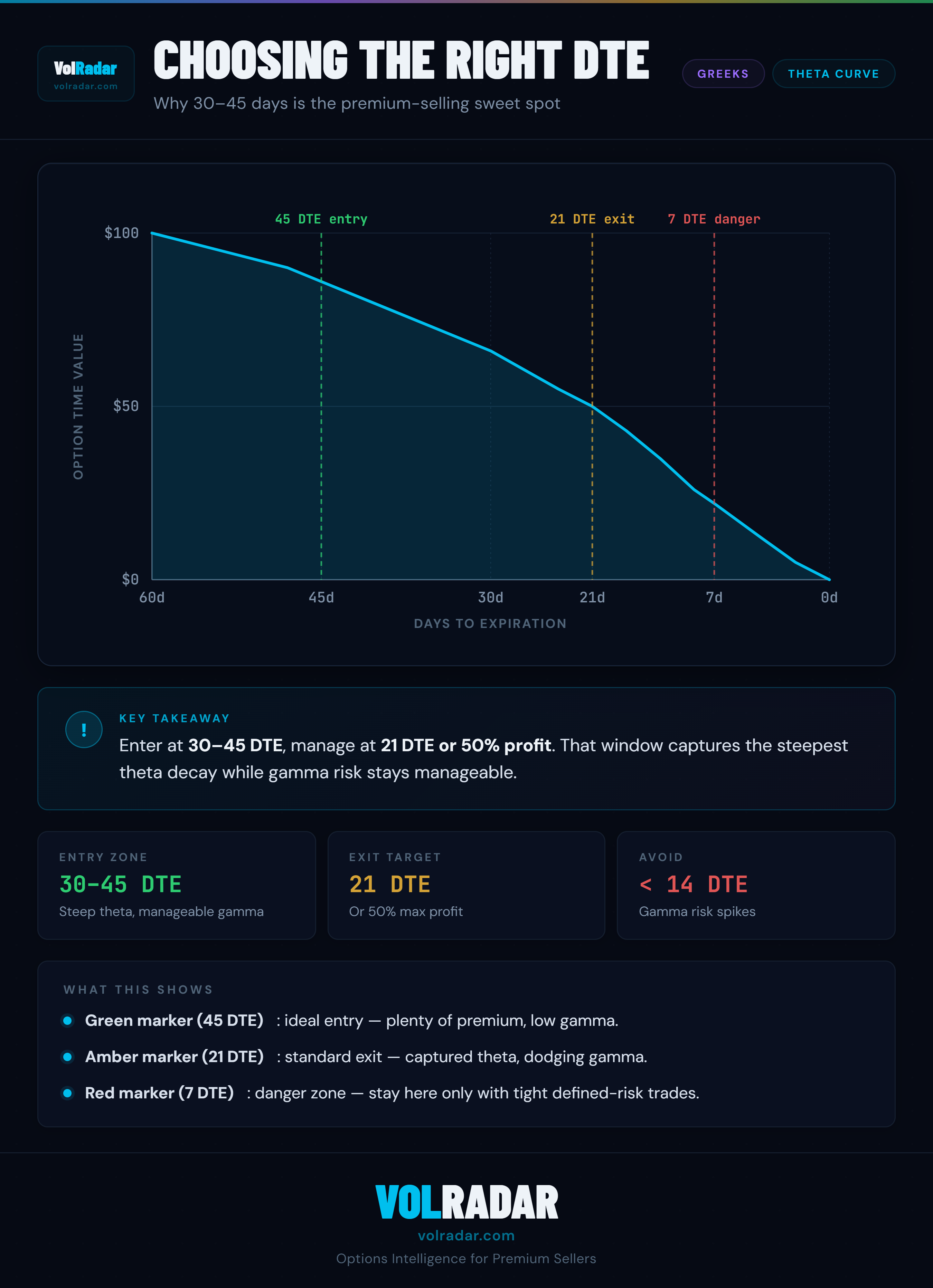
Time to expiration is one of the inputs that drives an option's price and its Greeks. OIC notes that time decay tends to be gradual at first and to accelerate as expiration approaches, especially for at-the-money options; that gamma is higher for at-the-money options closer to expiration; and that longer-term options tend to have higher vega than near-term options. DTE is the everyday measure of where an option sits on that timeline.
How It Works
DTE is counted from today to the expiration date. Standard monthly equity options generally have their last exercise day on the third Friday of the expiration month. Weekly equity and ETF options are listed on a Thursday and in most cases expire the following Friday; if that Friday is an OCC holiday, they expire on the Thursday before. Index options vary: for standard SPX options, trading ordinarily stops on the business day (usually a Thursday) before the day the exercise-settlement value is calculated, while SPXW options ordinarily trade until 4:00 p.m. ET on their expiration day. Because the date in an option symbol is the authoritative one, DTE is only as accurate as the expiration date it is counted to.
Example
Hypothetical: today is a Monday and an option expires on the Friday four weeks and four days away. Counting calendar days: 4 x 7 = 28 days to the Monday four weeks later, plus 4 days to Friday = 32 DTE. Counting trading days from tomorrow: the four full weeks contain 4 x 5 = 20 weekdays, plus Tuesday to Friday of the final week = 4, for 24 weekdays, fewer if a market holiday falls in the period.
Common Mistakes
Mixing calendar days and trading days when comparing options or reading a model's output. Assuming every option expires on a Friday: weeklies can expire on a Thursday before a holiday, and index products have their own schedules. Assuming the last trading day is always the expiration date: for standard SPX options, trading ordinarily ends the business day before the settlement value is calculated. Treating DTE as a measure of an option's value: two options with the same DTE can carry very different time value depending on moneyness and implied volatility.
Which expiration is worth the risk today?
The DTE Optimizer compares expirations on the same underlying so the calendar choice is a measured one.
Frequently Asked Questions
Does DTE count weekends and holidays?
Yes. DTE as used on this page counts calendar days, so weekends and holidays are included. A count of trading days is smaller; for example, 32 calendar days spanning four weekends contain at most 24 trading sessions after today.
What does 0 DTE mean?
An option with 0 DTE expires today. Whether it can still be traded during the day depends on the product: equity and ETF weekly options can trade on their expiration day (usually a Friday, or the Thursday before an OCC holiday), while for standard SPX options trading ordinarily ends the business day before the settlement value is calculated.
When do standard monthly options expire?
For standard monthly American-style equity options, the last day to exercise is usually the third Friday of the expiration month. Weekly options and index options follow their own schedules, so check the expiration date in the option symbol and the product's specifications.
How does DTE relate to theta and gamma?
As DTE falls, time decay tends to accelerate, most noticeably for at-the-money options, and the gamma of at-the-money options rises, so their delta can change sharply with small moves in the underlying near expiration. Longer-dated options tend to have higher vega.
General references
General references for this topic area, not citations for the specific figures above. VolRadar is not affiliated with these organizations.
The information about DTE (Days to Expiration) above is for educational purposes only and is not financial advice. Read our full investment disclaimer.
Understand options faster.
One term, one worked example, one real ticker. Every Sunday. No jargon.
One email per week, no drip campaigns · Unsubscribe anytime