Loading...
Mechanics
At-the-Money (ATM) — Options Order Mechanics Explained
An at-the-money option has a strike equal to, or the listed strike closest to, the underlying's current price.
By Aigars PilmanisLast updated
Educational content. Not financial, investment, tax, or legal advice. Options involve risk and are not suitable for all investors. How we write & review this glossary.
An at-the-money (ATM) option is one whose strike price equals, or is the listed strike closest to, the current price of the underlying. With a stock at $100, the $100 call and the $100 put are both at the money. An option struck exactly at the underlying price has no intrinsic value, so its whole premium is time value; the nearest listed strike can be slightly in the money and carry a little intrinsic value. An ATM option's delta is close to 0.50 for a call and -0.50 for a put.
VolRadar Lens
- Definition
- Strike near spot price
- Delta
- ~0.50 absolute
- Theta
- Typically high
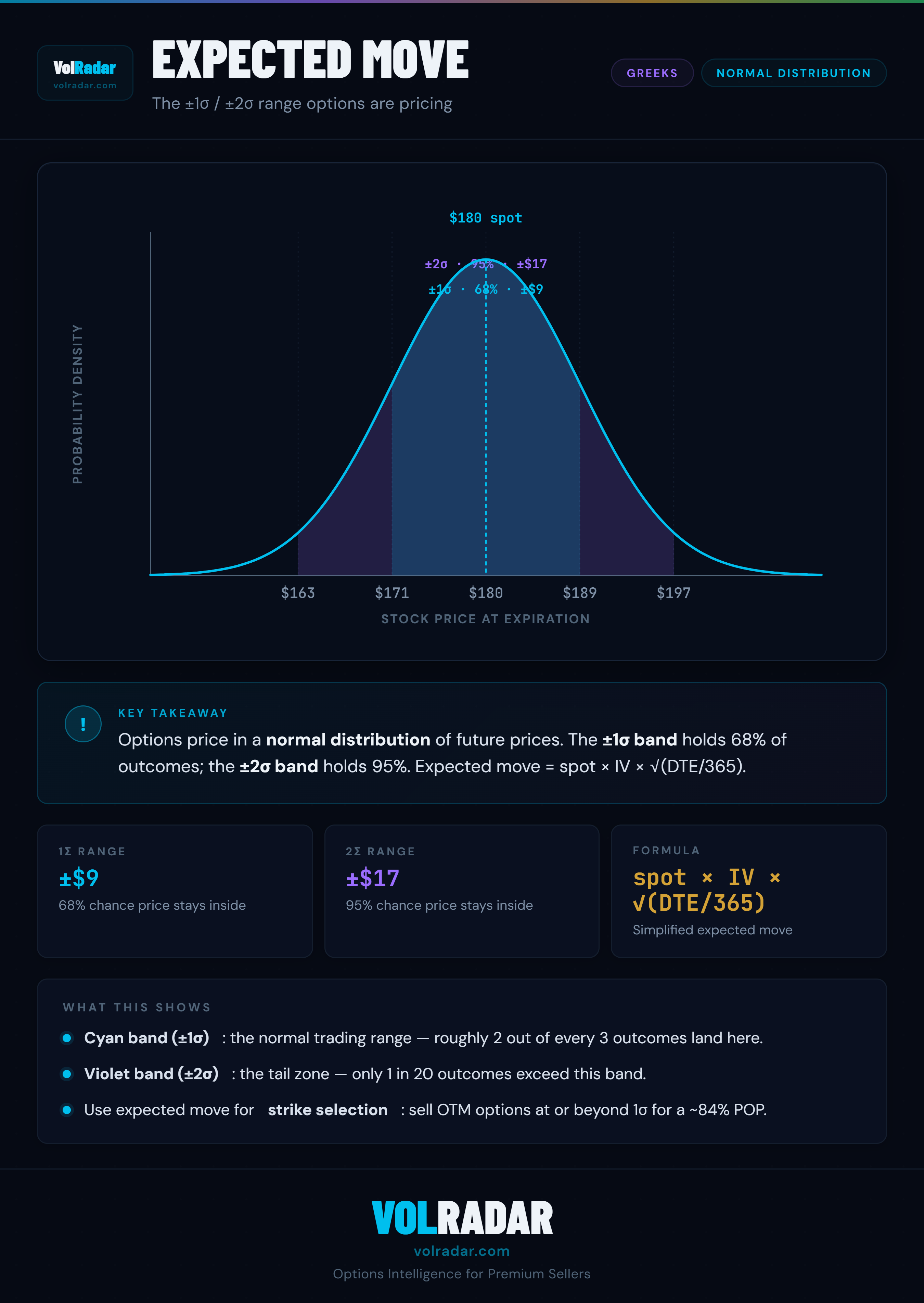
At the money is where an option has little or no intrinsic value, time value at or near its largest, and gamma at or near its highest. The ATM straddle price is a quick read of the move the market is pricing, at roughly 0.8 of a one-standard-deviation move.
Visual ReferenceVisual reference for At-the-Money (ATM)ShowHide
Why It Matters
ATM options carry time value at or near the largest in the chain, so they are among the most sensitive to time decay and to changes in implied volatility, and their delta changes fastest when the underlying moves. That makes them the reference point for implied volatility quotes and for expected-move estimates built from the ATM straddle. For an option seller, the trade-off is direct: an ATM strike collects time value at or near the most in the chain, but it has little or no cushion before intrinsic value starts to accrue and gamma at or near its highest, so the position's delta changes fastest when the stock moves. An out-of-the-money strike collects less premium and gives more distance. Strategies that deliberately sell the ATM strike include short straddles and iron butterflies.
How It Works
Moneyness compares the strike with the underlying price. A call is in the money when the stock is above the strike and out of the money when it is below; a put is the reverse. At the money sits between them. Because listed strikes are spaced (for example $1, $2.50 or $5 apart), the stock rarely equals a strike exactly, so the nearest listed strike is treated as ATM; some traders instead call the strike with delta closest to 0.50 the ATM strike, which can be a different strike. Near the money, an option's time value, gamma and, for a given expiration, dollar theta and vega are at or close to their largest in the chain. Delta near 0.50 means the option price moves about $0.50 per $1 move in the stock. Delta is not an exact probability: in the Black-Scholes model with zero interest rates and no dividends, a call struck at the stock price has a delta slightly above 0.50, while the model's risk-neutral probability of finishing in the money is slightly below 0.50.
Example
Hypothetical: a stock at $100, implied volatility 20%, 30 days to expiration. The time factor is sqrt(30 / 365) = 0.2867. A common approximation for an ATM option (Brenner and Subrahmanyam, 1988) is price = 0.4 x stock x IV x sqrt(T) = 0.4 x 100 x 0.20 x 0.2867 = $2.29 for the call, and about the same for the put. The ATM straddle is therefore about $4.59, or 4.6% of the stock price. A one-standard-deviation move over the same period is 100 x 0.20 x 0.2867 = $5.73. The straddle price is 4.59 / 5.73 = 0.80 of that move, which is why the ATM straddle is read as roughly 0.8 standard deviations, not a full one. The approximation ignores interest rates and dividends.
Common Mistakes
Treating delta 0.50 as an exact 50% probability of expiring in the money; it is a rough heuristic, not a real-world probability. Assuming the ATM straddle equals a one-standard-deviation move; under the approximation above it is about 0.8 of one. Assuming the dollar-nearest strike and the 0.50-delta strike are always the same. Choosing an ATM short strike for its premium without accounting for the higher gamma and the lack of distance to the strike.
Frequently Asked Questions
What does at the money mean in options?
The option's strike equals, or is the listed strike closest to, the current underlying price. With a stock at $100, the $100 call and put are at the money.
What is the delta of an at-the-money option?
About 0.50 for a call and about -0.50 for a put. In the Black-Scholes model with zero interest rates and no dividends, the call delta at a strike equal to the stock price is slightly above 0.50, and delta is only a rough trading heuristic for the chance of finishing in the money: it is not the model's risk-neutral probability (N(d2)), and neither is a real-world probability.
Why do at-the-money options have the most time value?
An option struck at the underlying price has no intrinsic value, so its entire premium is time value, and it is near the strike where the outcome at expiration is most uncertain. Deep in-the-money and far out-of-the-money options have less time value.
What does the ATM straddle tell you?
The combined price of the ATM call and put is a quick estimate of the move the market is pricing by expiration. Under the Brenner-Subrahmanyam approximation it is about 0.8 of a one-standard-deviation move: a $4.59 straddle against a $5.73 one-standard-deviation move in the example above.
Is ATM the exact strike or the nearest strike?
In practice, the nearest listed strike. Some traders use the strike with delta closest to 0.50 instead, which can differ from the dollar-nearest strike.
General references
General references for this topic area, not citations for the specific figures above. VolRadar is not affiliated with these organizations.
The information about At-the-Money (ATM) above is for educational purposes only and is not financial advice. Read our full investment disclaimer.
Understand options faster.
One term, one worked example, one real ticker. Every Sunday. No jargon.
One email per week, no drip campaigns · Unsubscribe anytime