Loading...
Strategies
Straddle — Options Strategy Explained
A straddle is a call and a put with the same strike and expiration, bought together (long) or sold together (short).
By Aigars PilmanisLast updated
Educational content. Not financial, investment, tax, or legal advice. Options involve risk and are not suitable for all investors. How we write & review this glossary.
Long Straddle vs Long Strangle
Long Straddle buys a call and a put at the same at-the-money strike, betting on a large move in either direction. Long Strangle buys an out-of-the-money call and put at different strikes, lowering the cost but requiring a bigger move to break even.
| Feature | Long Straddle | Long Strangle |
|---|---|---|
| Strike selection | Both legs at the same at-the-money strike | Out-of-the-money call and put at different strikes |
| Entry cost | Higher debit because both legs are at the money | Lower debit because both legs are out of the money |
| Breakeven distance | Strike plus or minus total premium paid | Wider breakeven, requires larger move |
| Vega exposure | Strongly positive, benefits from rising IV | Positive, sensitive to IV changes |
| Theta exposure | Strongly negative, time decay bites quickly | Negative; the size depends on strikes and premiums |
| Used to express | A large move in either direction, bought at one strike | A larger move in either direction, bought at two out-of-the-money strikes for less premium |
Key trade-off
A long straddle buys the call and the put at one strike, so at expiration it profits once the move exceeds the combined premium. A long strangle buys out-of-the-money strikes, which costs less and needs a larger move to pay. Both lose value to time decay, and to falling implied volatility, while waiting for the move.
A straddle is an options position made of a call and a put on the same underlying with the same strike price and the same expiration. A long straddle buys both options and, at expiration, profits if the underlying finishes further from the strike than the total premium paid; a short straddle sells both and, at expiration, profits if the underlying finishes closer to the strike than the total premium received.
The position
Direction
Volatility play
- Drives outcome
- Short straddles collect more premium than a short strangle on the same expiration but carry loss on both sides if the stock moves far from the strike.
- Risk type
- See structure
VolRadar Lens
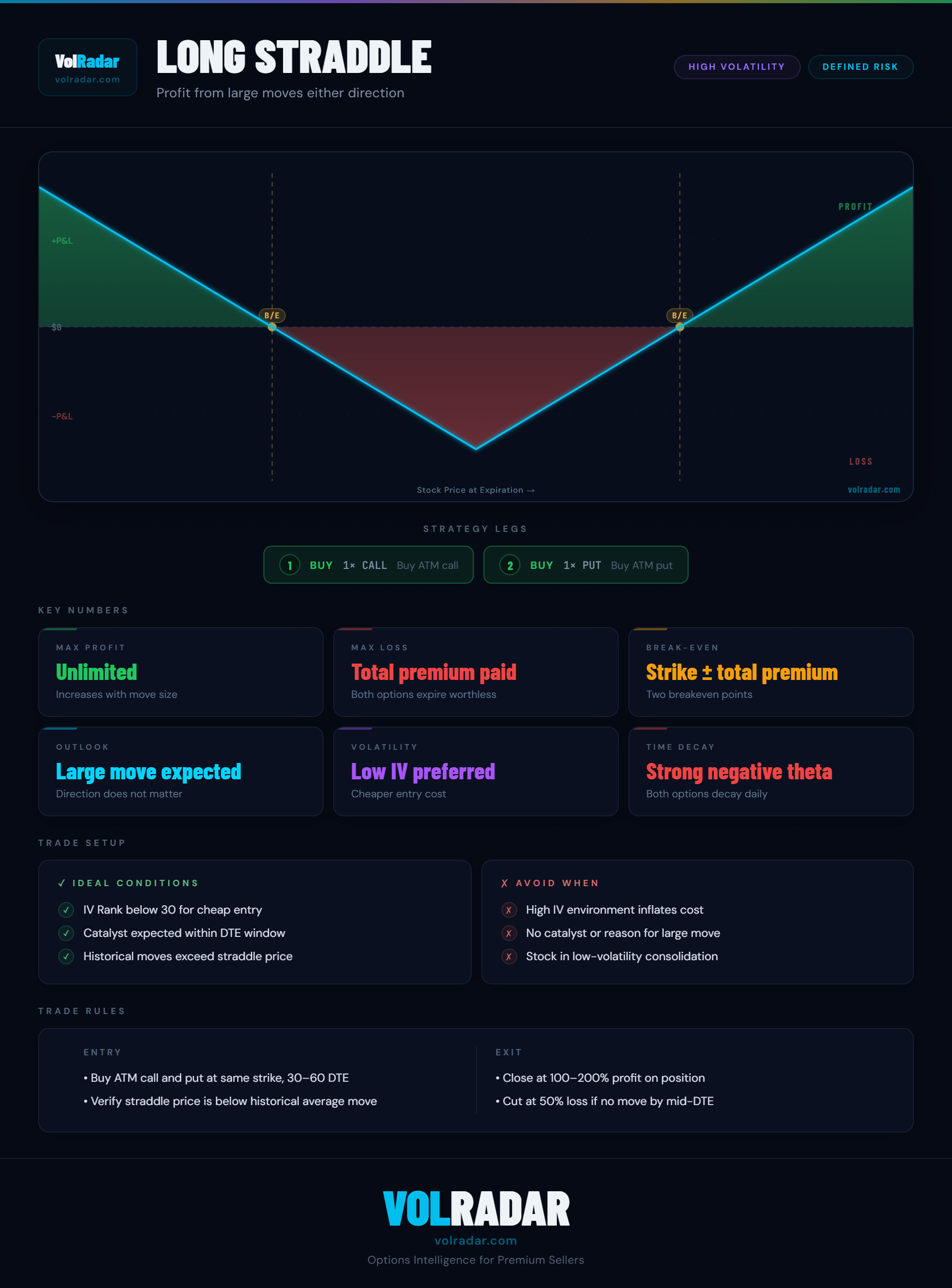
A long straddle risks only the two premiums paid and, at expiration, profits only if the stock finishes beyond the strike plus or minus that total. A short straddle keeps at most the two premiums received and carries unlimited upside risk and large downside risk, plus early-assignment risk on either leg when the options are American-style.
Visual ReferencePayoff structure and strike placementShowHide
Why It Matters
A straddle is the simplest way to take a view on the size of a move rather than its direction, which is why it is often discussed around scheduled events such as earnings. When the stock trades exactly at the strike, the straddle's price is the distance the stock must move by expiration before a buyer profits; in general the breakevens are the strike plus and minus the total premium. Around earnings, implied volatility often rises beforehand and falls once the news is out (IV crush), so a long straddle can lose value even after a sizeable move if the drop in implied volatility outweighs it. For the short side, the limited maximum gain set against unlimited upside risk is the central trade-off. Related structures include the strangle (different call and put strikes) and the calendar straddle.
How It Works
Long straddle: buy one call and one put at the same strike and expiration. The breakevens at expiration are the strike plus the total premium paid and the strike minus the total premium paid. The maximum loss is the two premiums, reached if the stock is at the strike at expiration; the gain is unlimited on the upside. Short straddle: sell the same call and put. The breakevens are the strike plus and minus the total premium received, the maximum gain is that premium, and the risk is unlimited on the upside and, on the downside, the strike price less the premium received. Implied volatility and time decay act in opposite directions for the two sides: a long straddle benefits from rising implied volatility and loses value as time passes; a short straddle benefits from falling implied volatility and from time decay. Straddles are usually built at the money, so the position starts with little directional exposure; as the stock moves away from the strike, one leg dominates and delta builds in that direction.
Example
Hypothetical, at expiration: stock XYZ at $80. The 80-strike call costs $2.80 and the 80-strike put $2.60, so the long straddle costs $5.40 per share, or $540 for one standard 100-share contract of each. Breakevens: 80 + 5.40 = $85.40 and 80 − 5.40 = $74.60. If XYZ ends at $87, the call is worth $7.00 and the put $0: profit = 7.00 − 5.40 = $1.60 per share ($160). If XYZ ends at $83, the call is worth $3.00: loss = 5.40 − 3.00 = $2.40 per share ($240). If XYZ ends at $80, both expire worthless: loss = $5.40 per share ($540), the maximum. The short straddle seller has the opposite result in each case, before commissions.
Common Mistakes
Judging a long straddle only by direction: it needs the stock to finish beyond the strike plus or minus the total premium to profit at expiration. Ignoring the effect of implied volatility: a fall in implied volatility after an event can reduce the value of both legs. Treating a short straddle as limited-risk; it is uncovered on the call side. Forgetting that with American-style options either short leg can be assigned early, independently of the other. Comparing a straddle's cost with a strangle's without accounting for the different breakevens.
Is the market paying premium sellers today?
The SPY Premium Window study tracks when systematic option selling has historically been compensated — recomputed daily from market close. Free to read, no account needed.
Frequently Asked Questions
What is a straddle in options?
A call and a put on the same underlying with the same strike and expiration. Buying both is a long straddle; selling both is a short straddle.
How do you calculate straddle breakevens?
At expiration, the upper breakeven is the strike plus the total premium and the lower breakeven is the strike minus the total premium. Hypothetical: an 80-strike straddle costing $5.40 breaks even at $85.40 and $74.60.
What is the maximum loss on a straddle?
For a long straddle, the two premiums paid. For a short straddle, the loss is unlimited if the stock rises and, if it falls, can reach the strike price minus the premium received.
What is the difference between a straddle and a strangle?
A straddle uses one strike for both the call and the put; a strangle uses a higher call strike and a lower put strike. At the same expiration a strangle usually costs less but needs a bigger move to reach its breakevens.
How does IV crush affect a long straddle?
Implied volatility often falls after an earnings announcement. Because a long straddle owns two options, a drop in implied volatility lowers the value of both legs and can offset part or all of the gain from the price move.
General references
General references for this topic area, not citations for the specific figures above. VolRadar is not affiliated with these organizations.
The information about Straddle above is for educational purposes only and is not financial advice. Read our full investment disclaimer.
Understand options faster.
One term, one worked example, one real ticker. Every Sunday. No jargon.
One email per week, no drip campaigns · Unsubscribe anytime