Loading...
Strategies
Short Straddle — Options Strategy Explained
A short straddle sells a call and a put with the same strike and expiration, and the seller receives the premium from both.
By Aigars PilmanisLast updated
Educational content. Not financial, investment, tax, or legal advice. Options involve risk and are not suitable for all investors. How we write & review this glossary.
Short Straddle vs Short Strangle vs Iron Butterfly
Short Straddle sells a call and put at the same at-the-money strike for maximum premium and unlimited call-side risk. Short Strangle widens the strikes to expand the profit zone with less premium and still carries unlimited call-side risk. Iron Butterfly adds long protective wings around a short straddle to define the risk.
| Feature | Short Straddle | Short Strangle | Iron Butterfly |
|---|---|---|---|
| Strike layout | Both short legs at the same at-the-money strike | Short call and short put at different OTM strikes | Short straddle with long protective wings |
| Risk profile | Unlimited call side; put side bounded only by the underlying reaching zero | Unlimited call side, put side bounded only at zero; wider profit zone | Defined risk, capped by the wing distance |
| Premium collected | Highest of the three structures | Lower than the straddle because of wider strikes | Lower than the straddle because of wing cost |
| Profit zone shape | Narrow tent around the strike | Flat plateau between the short strikes | Sharp tent capped by the wings |
| Capital and margin | Margin set by the broker's formula; no long wings to cap risk | Margin set by the broker's formula; no long wings to cap risk | Margin is often based on the wider wing width minus credit; varies by broker |
| Used to express | A pin at one strike, with the most premium and no long wings | A neutral range between two strikes, with less premium and no long wings | A pin at one strike with the loss capped by long wings |
Key trade-off
A short straddle collects the most premium at one strike with no long wings to cap the loss. A short strangle moves the strikes apart, collecting less for a wider range, still with no long wings. An iron butterfly adds long wings to the short straddle, capping the loss at the wing width minus the credit when the wings are equal width.
Read the full guide
Short Straddle — Collect Maximum Premium, Profit from Low Volatility
A short straddle sells the ATM call and ATM put together for the richest premium per cycle — and the most exposure if the stock moves. When the trade works, when iron butterflies make more sense, and how to manage.
Read the guide→A short straddle is an options position made by selling a call and a put on the same underlying with the same strike price and the same expiration, so the seller receives a premium for both options. The call leg carries a loss with no upper limit if the underlying rises, and the put leg carries a loss of up to the strike price (less the premium received) per share if the underlying falls to zero.
The position
Direction
Neutral, narrow
- Drives outcome
- Price pinning near the strike at expiration.
- Max profit
- Combined credit at the strike
- Max loss
- Theoretically unlimited
- Risk type
- Undefined (naked)
VolRadar Lens
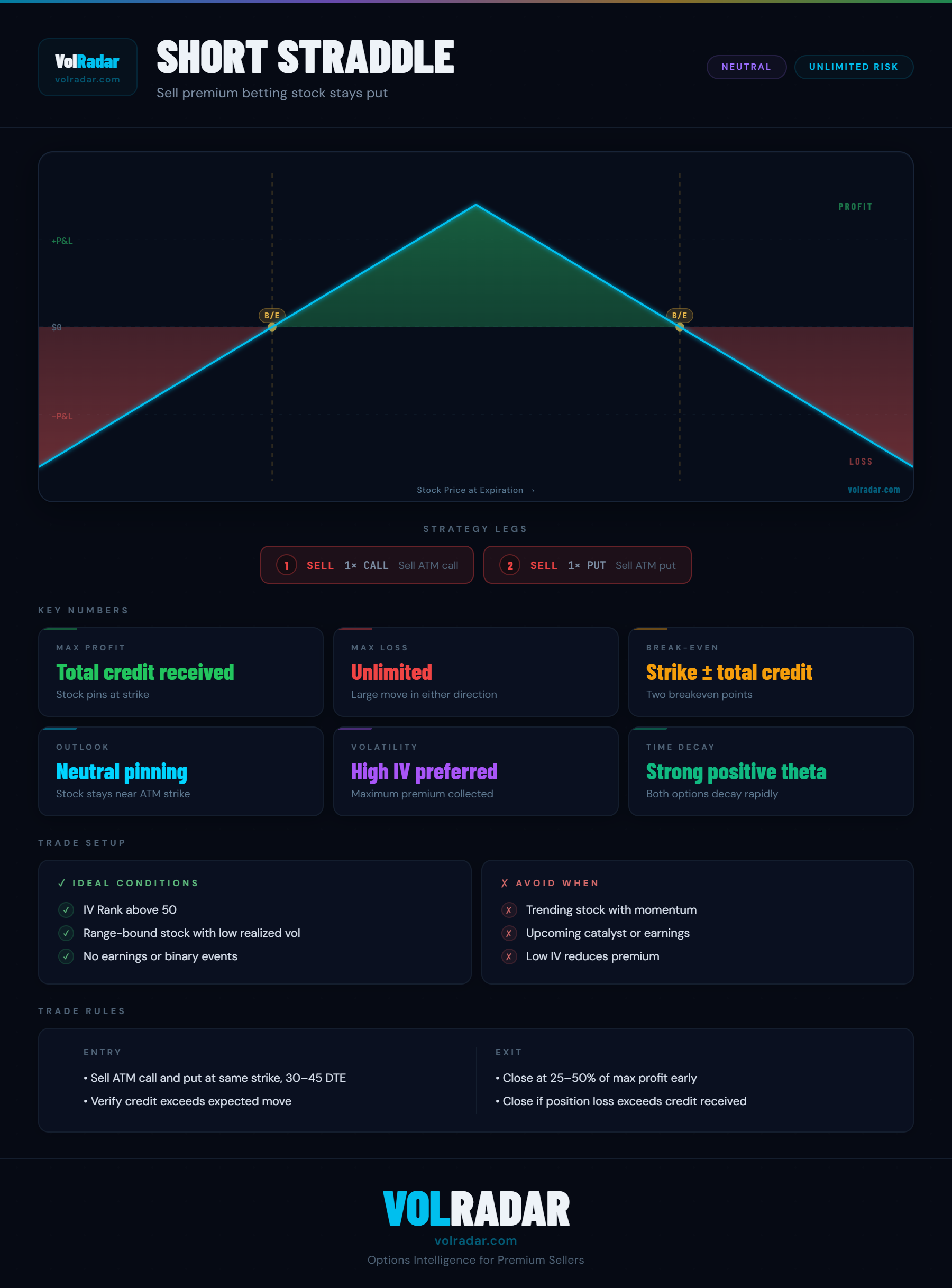
Maximum gain is the combined premium received, reached only if the underlying finishes exactly at the strike at expiration; at any other price one leg is in the money.
Visual ReferencePayoff structure and strike placementShowHide
Why It Matters
A short straddle shows how selling both a call and a put brings in a premium on each side while leaving the loss open on both sides. Its result depends on how far the underlying finishes from the strike relative to the premium received, and on changes in implied volatility along the way. It is also the starting point for defined-risk structures such as the iron butterfly, which add purchased options beyond the short strikes.
How It Works
Selling one call and one put at the same strike and expiration creates a position that is short both sides of the underlying. The strike is often at or near the current price, although the definition only requires one shared strike. Figures here are per share; for standard US equity options (100 shares per contract) multiply by 100. At expiration the position breaks even where the underlying is above or below the strike by the total premium received: upper breakeven = strike + premium received, lower breakeven = strike - premium received. The maximum gain is the premium received, reached when the underlying finishes exactly at the strike and both options expire worthless. Any other outcome means one option finishes in the money, and the seller may be assigned. If the underlying rises, the loss has no upper limit. If it falls to zero, the loss is the strike price less the premium received, per share. Before expiration, time decay generally works in the seller's favor and a rise in implied volatility generally works against the position. American-style options can also be assigned before expiration.
Example
Hypothetical example (per share, at expiration, before commissions and fees). XYZ trades at $100. A trader sells one 30-day XYZ 100 call for $3.20 and one XYZ 100 put for $2.80, receiving $6.00 per share, or $600 for one call and one put on standard US equity options (100 shares). Breakevens are $106 (100 + 6) and $94 (100 - 6). If XYZ finishes at $100, both options expire worthless and the result is +$6.00 per share (+$600). At $106 or $94 the result is $0. At $110 the call is worth $10, so the result is 6 - 10 = -$4.00 per share (-$400); at $90 the put is worth $10 and the result is also -$4.00. If XYZ fell to $0 the put would be worth $100, a result of -$94.00 per share (-$9,400). If XYZ rises, there is no upper limit to the loss.
Common Mistakes
Treating the premium received as already secured: it is kept in full only if both options expire worthless. Overlooking assignment: with a shared strike, the call finishes in the money above the strike and the put below it, and American-style options can be assigned before expiration. Underestimating event risk: a large move in either direction, for example around a scheduled announcement, can produce a loss much larger than the premium received. Treating the position as defined-risk: only adding purchased options caps the loss. Assuming margin is the same everywhere: requirements for undefined-risk positions are set by the broker and exchange rules and can change.
Comparison
Short straddle vs short strangle vs iron butterfly. A short strangle sells the call at a higher strike than the put, so the range between the strikes is wider and the premium received is typically smaller; its risk is still undefined. An iron butterfly is a short straddle plus a purchased call above and a purchased put below the short strike, which caps the loss at the distance between a short strike and its purchased option's strike, less the net premium received, per share, at the cost of a lower net premium. A long straddle is the opposite position: buying the call and the put.
Is the market paying premium sellers today?
The SPY Premium Window study tracks when systematic option selling has historically been compensated — recomputed daily from market close. Free to read, no account needed.
Frequently Asked Questions
What is the breakeven on a short straddle?
At expiration, the upper breakeven is the strike plus the total premium received and the lower breakeven is the strike minus the total premium received, per share. In the hypothetical example above, a $100 strike with $6.00 received gives breakevens of $106 and $94.
What is the maximum loss on a short straddle?
On the upside the loss has no upper limit, because the short call has no cap on how far the underlying can rise. On the downside the loss is the strike price less the premium received, per share, reached if the underlying falls to zero.
Is a short straddle the same as a short strangle?
No. A short straddle uses one strike for both options. A short strangle sells the call at a higher strike than the put, which widens the range between the strikes and changes the premium received. Both leave the loss undefined.
What happens at expiration if the underlying finishes exactly at the strike?
Both options expire worthless and the seller keeps the full premium received, which is the maximum gain. At any other price one option finishes in the money and may be assigned, so the result is a smaller gain or a loss.
General references
General references for this topic area, not citations for the specific figures above. VolRadar is not affiliated with these organizations.
The information about Short Straddle above is for educational purposes only and is not financial advice. Read our full investment disclaimer.
Understand options faster.
One term, one worked example, one real ticker. Every Sunday. No jargon.
One email per week, no drip campaigns · Unsubscribe anytime