Loading...
Mechanics
In-the-Money (ITM) — Options Order Mechanics Explained
An in-the-money option has intrinsic value: a call when the stock is above the strike, a put when it is below.
By Aigars PilmanisLast updated
Educational content. Not financial, investment, tax, or legal advice. Options involve risk and are not suitable for all investors. How we write & review this glossary.
An in-the-money (ITM) option is one that has intrinsic value: a call is in the money when the underlying price is above the strike price, and a put is in the money when the underlying price is below the strike price. The amount by which it is in the money is its intrinsic value; any premium above that is time value.
Video explainer6:18
Watch: In-the-Money (ITM) Explained
6:18 walkthrough — definition, mechanics, worked example, and common mistakes for In-the-Money (ITM).
What to remember from this video
An in-the-money option has intrinsic value because the stock price has breached the strike, making it behave more like a stock position (long stock for a call, short stock for a put) as it goes deeper in the money.
Key Insights From The Video
- A call is ITM when stock trades above the strike.
- A put is ITM when stock trades below the strike.
- ITM options have intrinsic value that doesn't decay.
- Deep ITM calls have delta near +1.0 and deep ITM puts near -1.0, moving with the stock.
- Short ITM American-style options face early assignment risk, especially near expiration.
Read the complete video explanation~290 words · 1 min read
An in-the-money (ITM) option occurs when the stock price moves past the strike, giving the option intrinsic value. For a call option, this happens when the stock trades above the strike price. Conversely, a put option becomes ITM when the stock price falls below the strike price.
When an option goes ITM, it holds real, executable value in the market, moving beyond theoretical potential. For premium sellers, this is a critical point as the option now has a buyback value equal to its intrinsic value plus any remaining extrinsic value, and the unrealized result is the premium received minus that value.
As an option goes deeper ITM, the absolute value of its delta approaches 1.0 (positive for calls, negative for puts), meaning it starts to move nearly dollar-for-dollar with the underlying stock. This shift means a call behaves more like holding the stock, and a put more like being short the stock.
As a purely hypothetical example, suppose you sold a $220 put on a $230 stock, collecting a $3.50 premium, and the stock drops to $215, so the put is $5 ITM. If the option then trades at $6.80, made up of $5 intrinsic value plus $1.80 extrinsic value, the buyback value is above the premium received, so the position shows an unrealized loss before fees.
Managing ITM options involves understanding that intrinsic value doesn't decay over time, unlike extrinsic value, which decays via theta. If a short American-style option remains ITM near expiration, assignment risk becomes significant, potentially leading to buying 100 shares at the strike price for a short put.
Traders holding short options that go ITM commonly evaluate whether the move looks temporary or structural, and rolling or closing are among the alternatives some traders consider.
VolRadar Lens
- Definition
- Option has intrinsic value
- Call ITM
- Stock above strike
- Put ITM
- Stock below strike
Only the time-value part of an in-the-money option decays; the intrinsic part moves with the stock, so a short option that is deep in the money behaves more like a stock position than like a decaying premium.
Why It Matters
For option sellers, an in-the-money short option means the underlying has moved through the strike: the intrinsic value is part of the cost of buying the option back that time decay cannot remove, and only the remaining time value still decays. Whether the position shows a loss depends on the premium collected and, for a covered position, on the stock held. A short put in the money means the stock is below the strike; its unrealized profit or loss is the premium collected minus the option's current value, a loss when the option now costs more than was collected. The deeper in the money, the closer delta gets to 1.0 in absolute terms and the more the position moves dollar-for-dollar with the stock. A gap through the strike, for example overnight, can move a short option from out of the money to in the money without a chance to react.
How It Works
In the money means the strike has been crossed. For calls: stock at $110, strike at $100, the call has $10 of intrinsic value. For puts: stock at $90, strike at $100, the put has $10 of intrinsic value. Total option value = intrinsic value + time value. At expiration time value is zero, so an in-the-money option is worth its intrinsic value. Deep in-the-money options have deltas near 1.0 (in absolute terms) and, for shorter-dated contracts, usually little time value; options just in the money still carry meaningful time value and deltas only moderately above 0.50. The further in the money, the more the option behaves like the stock.
Example
Hypothetical: a stock trades at $425 and a 30-day $420 call is offered at $9.50. Intrinsic value is $425 - $420 = $5.00, so time value is $9.50 - $5.00 = $4.50. If the call's delta is 0.72, a $1 rise in the stock to $426 lifts the call by roughly $0.72. If the stock closes at $428 at expiration, the call is $8 in the money and is exercised: the holder buys 100 shares at $420, for a total cost basis of $420 + $9.50 = $429.50 per share including the premium.
Common Mistakes
Holding a deep in-the-money short option in the expectation that time decay will help: most of its value is usually intrinsic, which does not decay, so the position mainly tracks the stock. Forgetting that short in-the-money options face assignment: a short put that is in the money at expiration will usually be assigned, which means buying 100 shares per contract at the strike. With a spread, an assigned short leg leaves a stock position until that stock is closed or the long leg is exercised to offset it.
Frequently Asked Questions
What does in-the-money mean for options?
A call is in the money when the underlying trades above the strike; a put is in the money when the underlying trades below the strike. The option's premium is its intrinsic value (the in-the-money amount) plus its time value. At expiration only intrinsic value remains, and an option that is not in the money is assumed worthless.
How does option moneyness relate to delta?
Deep in-the-money options have delta close to 1.00 for calls and -1.00 for puts, at-the-money options are around 0.50 in absolute terms, and out-of-the-money options have lower deltas that approach zero far from the strike. Delta is sometimes used as a rough guide to the chance of finishing in the money, but it is a model sensitivity, not an exact probability.
Why does ITM matter for assignment risk?
At expiration, OCC automatically exercises equity options that are in the money by $0.01 or more unless the holder instructs otherwise, so short in-the-money options are likely to be assigned. Before expiration, assignment risk rises as an option goes deeper in the money and its time value shrinks, and for short calls just before an ex-dividend date.
How do ITM options behave near expiration?
As expiration approaches, the time value of an in-the-money option shrinks toward zero and its price converges to intrinsic value. With little time value left and a delta near 1.00, the option moves nearly one-for-one with the underlying.
When do traders use ITM options?
A long in-the-money call gives exposure similar to owning the shares, and a long in-the-money put exposure similar to a short stock position, for a smaller outlay than the stock position, with the loss limited to the premium paid. Vertical spreads often pair an in-the-money leg with an out-of-the-money leg. Each use has trade-offs in cost, time value and assignment risk.
General references
General references for this topic area, not citations for the specific figures above. VolRadar is not affiliated with these organizations.
Visual ReferenceVisual reference for In-the-Money (ITM)ShowHide
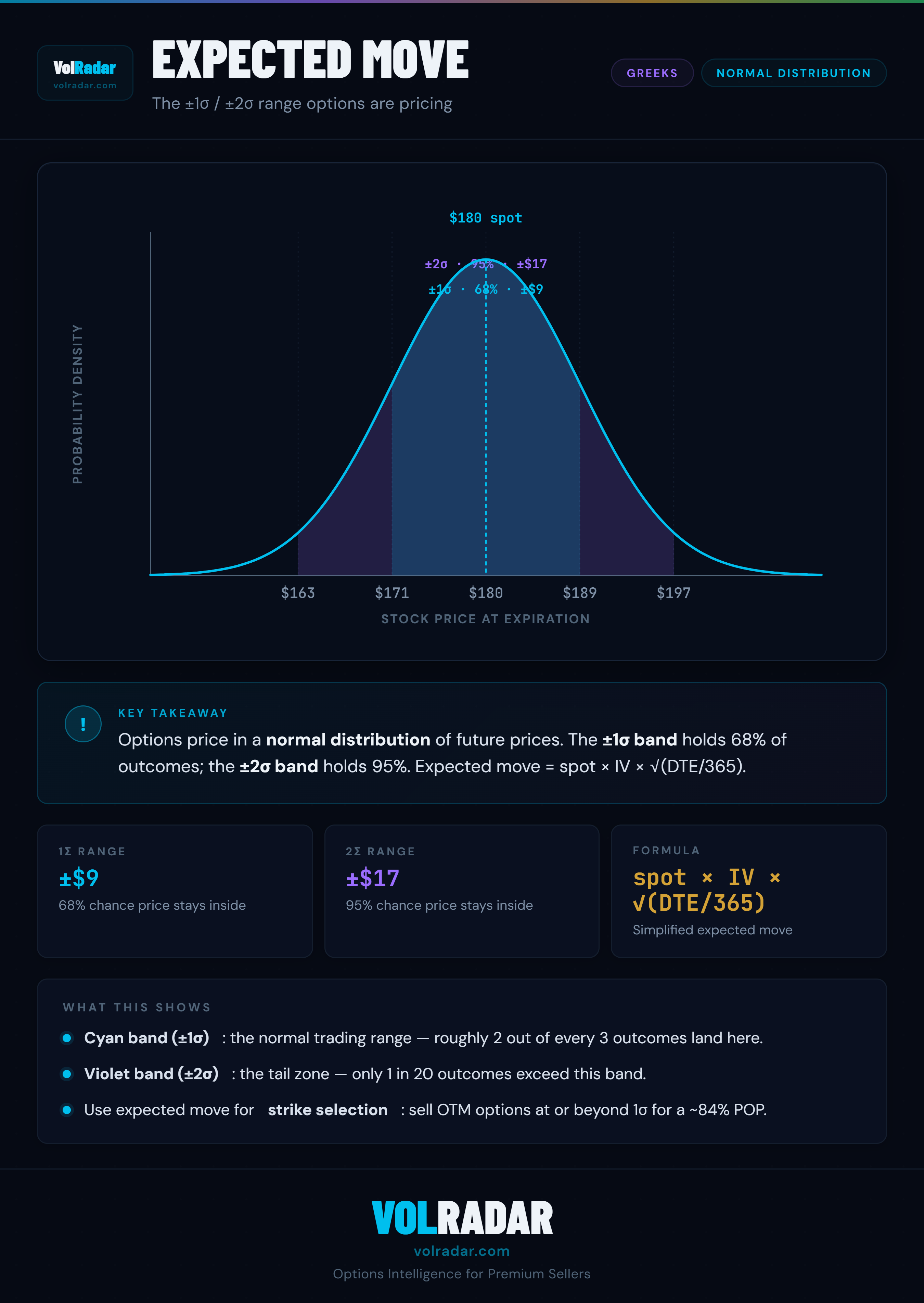
The information about In-the-Money (ITM) above is for educational purposes only and is not financial advice. Read our full investment disclaimer.
Understand options faster.
One term, one worked example, one real ticker. Every Sunday. No jargon.
One email per week, no drip campaigns · Unsubscribe anytime