Loading...
Mechanics
Out-of-the-Money (OTM) — Options Order Mechanics Explained
An out-of-the-money option has no intrinsic value: a call with a strike above the stock price, or a put with a strike below it.
By Aigars PilmanisLast updated
Educational content. Not financial, investment, tax, or legal advice. Options involve risk and are not suitable for all investors. How we write & review this glossary.
An out-of-the-money (OTM) option is an option that would have no intrinsic value if exercised now: a call is OTM when the underlying price is below the strike price, and a put is OTM when the underlying price is above the strike price. Its whole premium is time value, which goes to zero at expiration if the option is still out of the money.
VolRadar Lens
- Definition
- No intrinsic value
- Call OTM
- Stock below strike
- Put OTM
- Stock above strike
Moneyness is a snapshot: an option that is out of the money today moves in the money as soon as the stock crosses the strike, so whether it has any intrinsic value at expiration depends on where the stock ends relative to the strike, not where it started.
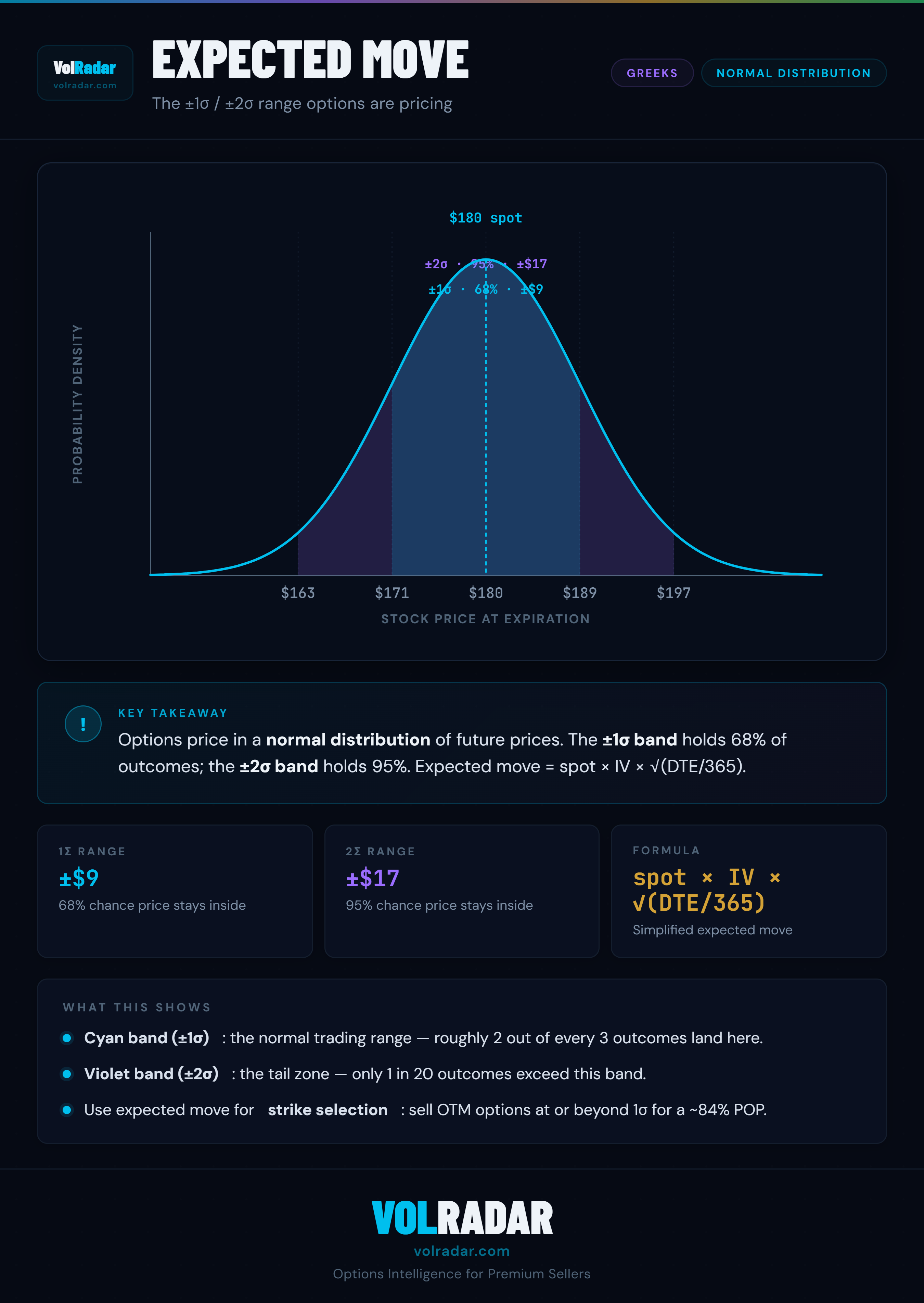
Visual ReferenceVisual reference for Out-of-the-Money (OTM)ShowHide
Why It Matters
Moneyness decides what an option's price is made of. On the same stock and expiration, an OTM option costs less than an at-the-money or in-the-money one, but everything it costs is time value, so it generally loses value if the stock does not move far enough, soon enough. For a buyer that means a smaller premium at risk and the need for a larger move. For a seller it means collecting only time value while carrying the risk that the stock moves through the strike. Many common positions use OTM strikes, including the long strangle, the short strangle, credit spreads and covered calls, and delta is often used as shorthand for how far out of the money a strike sits.
How It Works
Moneyness compares the strike price with the current underlying price. A call is in the money when the stock is above the strike and out of the money when it is below; a put is in the money when the stock is below the strike and out of the money when it is above. An option whose strike is about equal to the stock price is at the money. Only in-the-money options have intrinsic value, so the premium of an OTM option is entirely time value: what a buyer pays for the chance that the stock moves past the strike before expiration. Time value generally erodes as expiration approaches and rises with implied volatility, and it decreases as an option becomes more deeply out of the money. Delta follows the same pattern. At-the-money calls have a delta around 0.50 and at-the-money puts around -0.50; OTM options have deltas closer to zero, and the further out of the money the strike, the closer to zero the delta. As expiration nears, OTM deltas fall toward zero.
Example
Hypothetical, illustrative figures. A stock trades at $100. A $105 call and a $95 put are both $5 out of the money, so neither has intrinsic value. If the $105 call is quoted at $1.20, all $1.20 is time value, or $120 per contract of 100 shares. The buyer breaks even at expiration at $105 + $1.20 = $106.20. If the stock is below $105 at expiration, the call expires worthless and the buyer loses the $120. If the stock rises to $108 before expiration, the call is $108 - $105 = $3 in the money: its premium now includes $3 of intrinsic value and it is no longer out of the money.
Common Mistakes
Assuming out of the money means safe: moneyness is measured against today's price, and a sharp move can take an OTM option in the money before expiration. Reading a low delta as a precise probability: some traders treat delta as the chance of finishing in the money, but it is an approximation. Comparing a small credit with nothing else: on a credit spread with far OTM strikes, a small credit can sit against a much larger maximum loss, the spread width minus the credit. Forgetting that an OTM option has no intrinsic value to fall back on: if the stock stays on the wrong side of the strike, the whole premium goes to zero at expiration.
Frequently Asked Questions
What is the difference between in the money and out of the money?
An in-the-money option has intrinsic value: a call whose strike is below the stock price, or a put whose strike is above it. An out-of-the-money option has none: a call whose strike is above the stock price, or a put whose strike is below it. At the money means the strike is about equal to the stock price.
Do out-of-the-money options expire worthless?
At expiration, generally yes. An option that is still out of the money has no intrinsic value and is not exercised automatically, so unless its holder instructs otherwise it expires worthless and the buyer loses the premium paid. Before expiration it still has time value and can be sold.
Why are out-of-the-money options cheaper?
Their premium is only time value. The further the strike is from the stock price, the larger the move needed before the option would have intrinsic value, so buyers pay less for it. More time to expiration and higher implied volatility raise that time value.
What delta does an out-of-the-money option have?
A delta closer to zero than an at-the-money option, which is around 0.50 for a call and -0.50 for a put. The further out of the money the strike and the nearer the expiration, the closer the delta gets to zero.
General references
General references for this topic area, not citations for the specific figures above. VolRadar is not affiliated with these organizations.
The information about Out-of-the-Money (OTM) above is for educational purposes only and is not financial advice. Read our full investment disclaimer.
Understand options faster.
One term, one worked example, one real ticker. Every Sunday. No jargon.
One email per week, no drip campaigns · Unsubscribe anytime