Loading...
Mechanics
Roll (Rolling) — Options Order Mechanics Explained
Roll (Rolling): Rolling an option means closing an open option and opening a new one on the same underlying at a later expiration, a different strike, or both.
By Aigars PilmanisLast updated
Educational content. Not financial, investment, tax, or legal advice. Options involve risk and are not suitable for all investors. How we write & review this glossary.
Rolling an option means closing an open option and opening a new one on the same underlying at a later expiration, a different strike, or both, usually as a single order. Traders roll to keep a position on longer or to move a tested strike. A roll can pay a net credit or cost a net debit, and rolling to a later expiration keeps capital at risk for more time.
VolRadar Lens
- Definition
- Rolling an option means closing your current position and simultaneously opening a new one at a different strike, expiration, or both.
- Use
- A roll can be done for a net credit or a net debit.
A credit roll adds to the cash collected across the old and new positions and a debit roll takes from it; a roll to a later expiration also keeps the exposure open for longer.
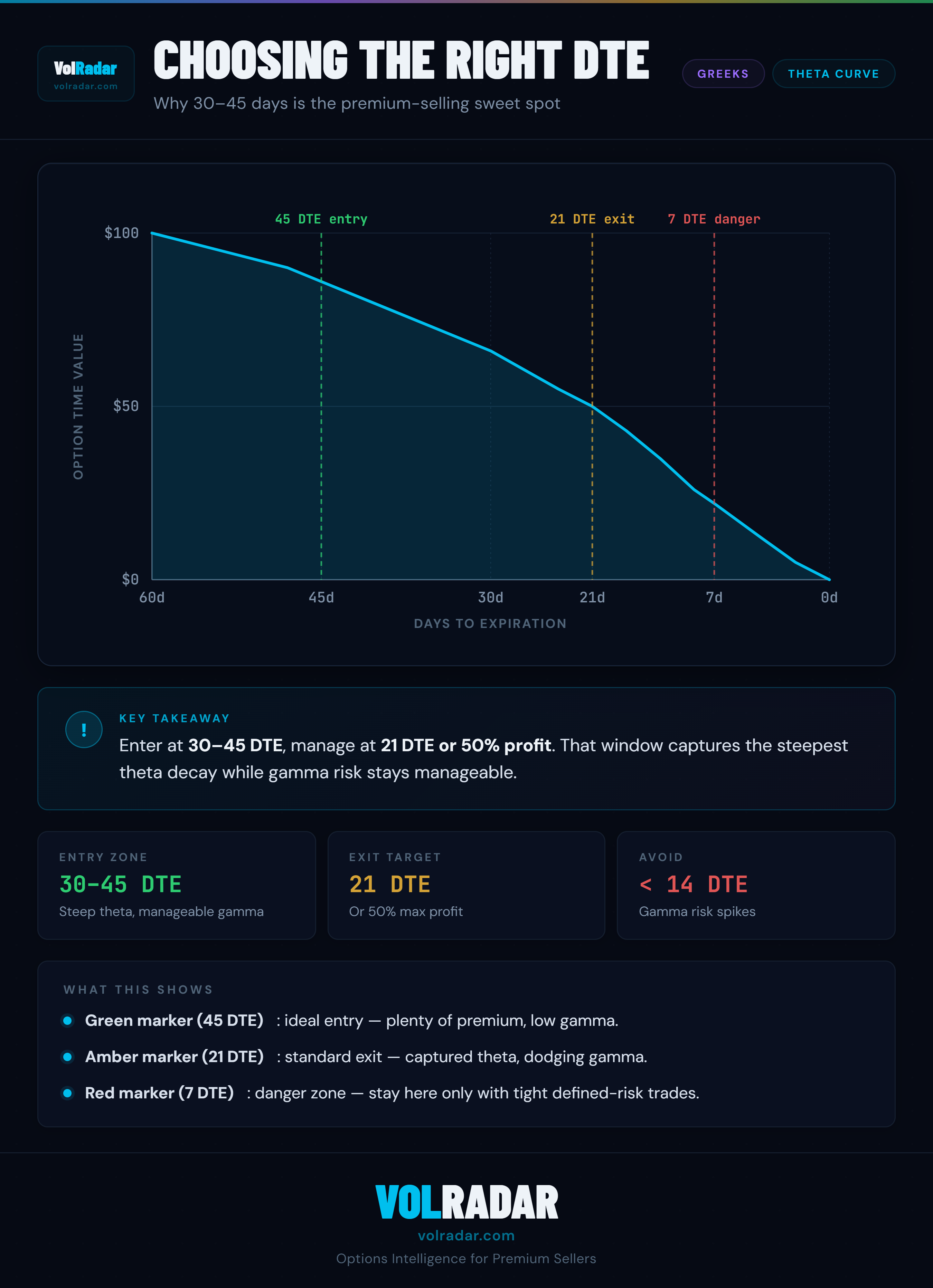
Visual ReferenceVisual reference for Roll (Rolling)ShowHide
Why It Matters
Rolling is one of the adjustments available for short-premium positions, alongside closing the trade, hedging it or accepting assignment: when a trade has not reached its target by the planned management date, or the stock tests the strike, a roll continues the position instead of closing it. A roll to a later expiration keeps the exposure open for longer, and any roll is a new decision about a new trade, not a way to erase a loss. VolRadar's DTE Optimizer compares expirations for premium selling, which covers one part of a roll out: choosing the new expiration. Closing the existing option, its realized profit or loss, execution costs and assignment risk are separate parts of the decision.
How It Works
A roll has two legs: buy to close the current option and sell to open the new one (for a short position), entered together as one order with a limit on the net credit or debit. Roll out: same strike, later expiration; for a short option this often collects a net credit, because the later option usually has more time value, though bid-ask costs, dividends or interest rates can turn it into a debit. Roll up or down: same expiration, higher or lower strike. Roll out and up or out and down: both change, a common adjustment when the stock has moved toward the strike. For a credit spread, both legs of the spread are rolled together. If the legs are entered as separate orders, one can fill without the other, leaving the position temporarily changed.
Example
Hypothetical short put rolled out at 21 days to expiration (DTE). You sold a 45-DTE $100 put for $1.20. At 21 DTE it trades at $0.40, and you buy it back: realized profit = $1.20 - $0.40 = $0.80 per share, or $80 per standard 100-share contract. In the same order you sell the next month's $100 put, about 49 DTE, for $1.80. Net roll credit = $1.80 - $0.40 = $1.40 per share, or $140 per standard 100-share contract. The strike risk is still $100, now for 28 more days (49 - 21). Breakeven on the new put = $100 - $1.80 = $98.20.
Common Mistakes
Rolling when the original reason for the trade no longer holds: a roll gives the trade more time, not a new thesis. Rolling for a debit without noticing that it reduces the net cash collected across the old and new positions. Rolling repeatedly by default; some sellers set a roll limit in advance so that rolling does not replace a decision to close. Legging a roll with separate orders in an illiquid option and getting only one leg filled. Using market orders on both legs, which pays the bid-ask spread twice.
Track positions approaching a management decision
The Scanner ranks today's premium-selling candidates and the conditions behind each one, recomputed daily from market close.
Frequently Asked Questions
What does it mean to roll an options position?
Rolling means closing an existing option and opening a new one on the same underlying with a different expiration, strike, or both. The two legs are typically entered as a single combined order with a limit on the net credit or debit.
How does rolling out differ from rolling up or down?
Rolling out moves to a later expiration at the same strike. Rolling up moves to a higher strike and rolling down to a lower one. Rolling out and up or out and down changes both the expiration and the strike in one order.
What is the difference between a credit roll and a debit roll?
A credit roll collects more for the new option than it costs to close the old one, which adds to the net cash collected across the old and new positions. A debit roll pays more to close the old option than the new one brings in, which reduces the net cash collected across the old and new positions. Either way, a roll to a later expiration keeps the position at risk for longer. The closed option's gain or loss is realized when it is bought back; a credit does not change it.
How does rolling relate to the 21-DTE guideline?
The 21-DTE guideline is an informal management convention, not an exchange or regulatory rule: close or roll short options when about 21 days remain. A roll out at that point moves the position to a later expiration; all else equal, an at-the-money option with more time to expiration has lower gamma than one closer to expiration.
What execution risks come with rolling options?
A roll has two legs, so bid-ask spreads apply twice, and wide or illiquid markets make that cost larger. A limit order near the mid price can avoid paying the full spread on both legs, but it may not fill. If the legs are sent as separate orders, one can fill without the other.
General references
General references for this topic area, not citations for the specific figures above. VolRadar is not affiliated with these organizations.
The information about Roll (Rolling) above is for educational purposes only and is not financial advice. Read our full investment disclaimer.
Understand options faster.
One term, one worked example, one real ticker. Every Sunday. No jargon.
One email per week, no drip campaigns · Unsubscribe anytime