Loading...
Strategies
Premium Selling — Options Strategy Explained
Premium selling is writing (selling) options to collect the premium up front, accepting the writer's obligations and risk.
By Aigars PilmanisLast updated
Educational content. Not financial, investment, tax, or legal advice. Options involve risk and are not suitable for all investors. How we write & review this glossary.
Premium selling is an options approach built on writing (selling) options to receive the premium up front, in exchange for taking on the option writer's obligation if assigned: to buy or sell the underlying for a physically settled option, or to pay the cash settlement amount for a cash-settled one such as a traditional index option. The seller's maximum gain is the premium received; the potential loss can be many times larger and, for an uncovered call, is unlimited.
VolRadar Lens
- Edge source
- Volatility risk premium (not assured)
- Exposure
- Often short vega and short gamma, depending on the structure.
- Typical DTE
- Varies by strategy, from days to months
Premium selling swaps a capped, known maximum gain for losses that can be much larger than the premium. Whether it pays over many trades depends on premiums received exceeding losses and costs; research on the volatility risk premium describes past averages, not future results.
Visual ReferencePayoff structure and strike placementShowHide
Why It Matters
The case for premium selling rests on the volatility risk premium: the tendency for option-implied volatility to exceed the volatility the underlying later realizes. In a study published in the Review of Financial Studies (2009), Carr and Wu, using option data from January 1996 to February 2003, found that the average variance risk premium was strongly negative, meaning buyers of variance paid more than it later delivered, for the S&P 500, S&P 100 and Dow Jones Industrial Average, and negative but smaller for the Nasdaq-100 and most of the individual stocks studied. A historical average over a sample does not say what any single trade or year will return, and the same exposure produces large losses when volatility jumps. VolRadar's volatility risk premium (VRP) reading compares a stock's implied volatility with its realized volatility, which is one input a premium seller can use to see whether options are currently priced above recent movement.
How It Works
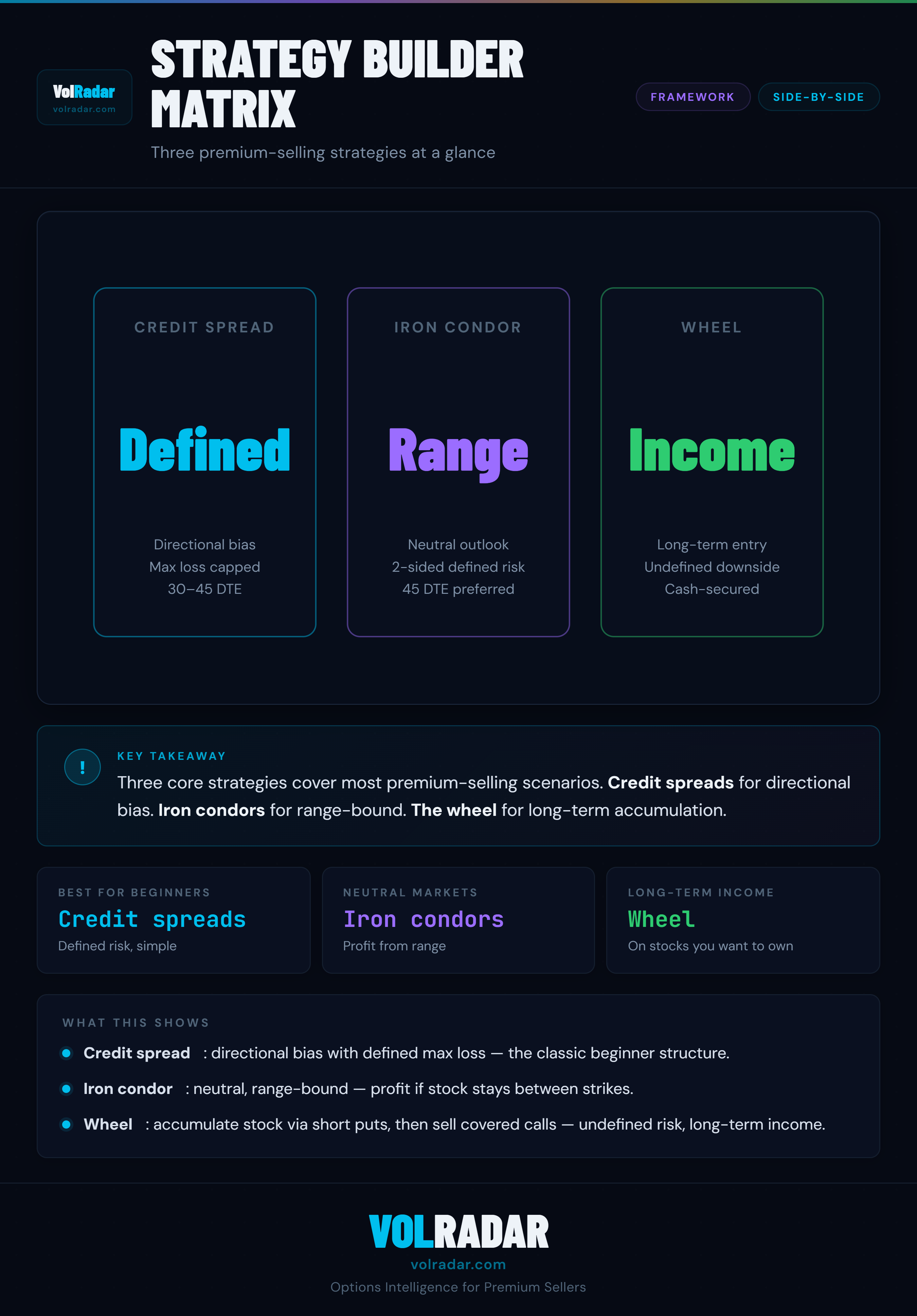
An option's premium has two parts, intrinsic value and time value, and only in-the-money options have intrinsic value. The seller receives the premium when the position opens. If the option later expires worthless or is bought back for less, the difference is the seller's profit; if it has to be bought back for more, the seller loses. If it is assigned, the result depends on how the option's intrinsic value at assignment compares with the premium received. Two forces usually work for a short option when other things are equal: time value erodes as expiration approaches, and a fall in implied volatility lowers the option's price. Two work against it: a move of the underlying in the direction that raises the option's value (up for a call, down for a put), and a rise in implied volatility. Common premium-selling structures differ mainly in how the risk is limited: a covered call is backed by shares, a cash-secured put by cash to buy the shares, a credit spread by a long option further out of the money that caps the loss, while a short strangle or short straddle leaves the call side uncovered.
Example
Hypothetical, at expiration, per share and for one 100-share contract: XYZ at $52. You sell a $50 put for $1.20 and receive $120. If XYZ ends at or above $50, the put expires worthless and the $120 is kept. Breakeven is 50 − 1.20 = $48.80. If XYZ ends at $45, the put is worth $5.00 and the loss is 5.00 − 1.20 = $3.80 per share ($380). If XYZ went to zero, the loss would be 50 − 1.20 = $48.80 per share ($4,880). Adding a long $45 put bought for $0.40 turns it into a credit spread: net credit 1.20 − 0.40 = $0.80 ($80), maximum loss (50 − 45) − 0.80 = $4.20 per share ($420). Commissions are ignored.
Common Mistakes
Equating a high share of winning trades with a positive result: one large loss can outweigh many small gains. Relying on the idea that most options expire worthless: that is not a sourced statistic, and an option expiring worthless says nothing about a seller's net result across many trades. Treating the premium as income before the position is closed. Selling uncovered calls without accounting for unlimited upside risk, or short puts without the capital to take the shares. Ignoring that a rise in implied volatility can lift the option's price even if the stock has not moved. Overlooking assignment: a short physically settled option can be assigned, leaving the seller with a stock position; a cash-settled option is settled in cash instead.
Is the market paying premium sellers today?
The SPY Premium Window study tracks when systematic option selling has historically been compensated — recomputed daily from market close. Free to read, no account needed.
Frequently Asked Questions
What is premium selling in options?
Writing (selling) options to receive the premium up front. The seller takes on the obligation to buy or sell the underlying if assigned (or, for a cash-settled option, to pay the cash settlement amount) and keeps at most the premium received.
What are common premium-selling strategies?
Covered calls, cash-secured puts, credit spreads, iron condors, and short strangles or straddles. They differ in how the risk is limited, from capped (spreads) to unlimited on the upside (uncovered calls).
What is the maximum loss when selling options?
For an uncovered call it is unlimited. For a short put it is the strike minus the premium received, reached if the stock goes to zero. For a credit spread it is the distance between the strikes minus the net credit.
How does time decay help an option seller?
Time value usually erodes as expiration approaches, so, other things being equal, a short option typically loses value over time, which benefits the seller. Price moves and changes in implied volatility can outweigh that effect.
What does the volatility risk premium have to do with premium selling?
It is the tendency for option-implied volatility, more precisely implied variance, to exceed what is later realized. Carr and Wu (2009), measuring variance risk premia with synthetic variance-swap rates against realized variance, found them negative on average for major U.S. stock indexes from 1996 to 2003, meaning variance buyers paid more than was delivered. It is a historical average, not a promise for any trade.
General references
General references for this topic area, not citations for the specific figures above. VolRadar is not affiliated with these organizations.
The information about Premium Selling above is for educational purposes only and is not financial advice. Read our full investment disclaimer.
Understand options faster.
One term, one worked example, one real ticker. Every Sunday. No jargon.
One email per week, no drip campaigns · Unsubscribe anytime