Loading...
Strategies
Bear Call Spread — Options Strategy Explained
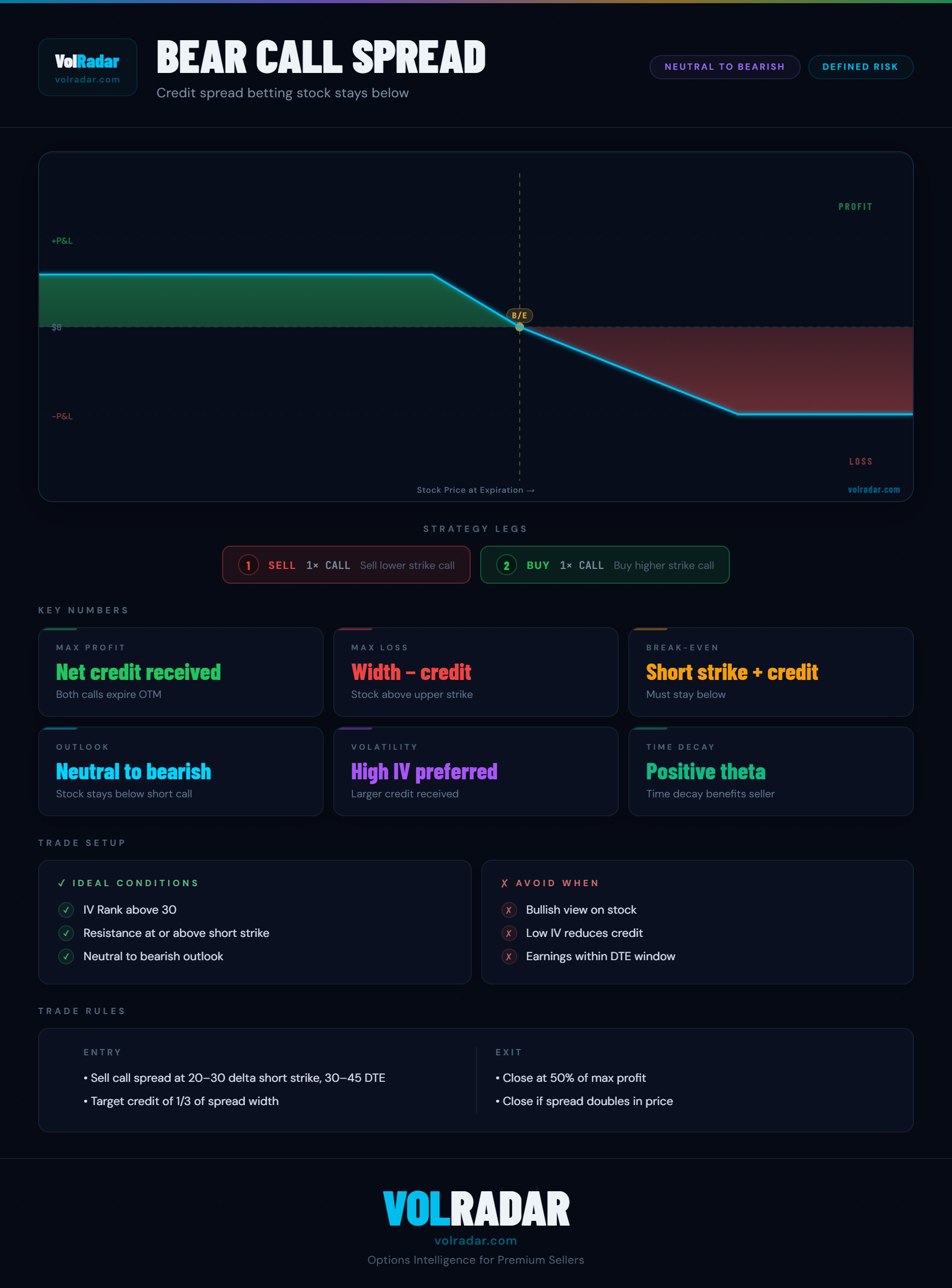
A bear call spread sells a lower-strike call and buys a higher-strike call with the same expiration for a net credit, capping both gain and loss.
By Aigars PilmanisLast updated
Educational content. Not financial, investment, tax, or legal advice. Options involve risk and are not suitable for all investors. How we write & review this glossary.
Read the full guide
Bear Call Spread — Collect Premium with a Bearish Bias
A bear call spread sells a call and buys a higher-strike call — defined-risk credit trade for a bearish view. Setup, breakevens, and how IV Rank shifts the trade economics.
Read the guide→A bear call spread, also called a credit call spread, is a two-leg options strategy that sells a call at a lower strike and buys a call at a higher strike with the same expiration, for a net credit. It profits if the stock stays below the short strike, and both its maximum gain (the credit) and its maximum loss (the strike width minus the credit) are fixed when the trade is opened.
The position
Direction
Bearish
- Max profit
- Net credit
- Max loss
- Spread width minus credit
- Risk type
- Defined (net credit)
VolRadar Lens
- Same as
- Call Credit Spread
Because the long call offsets much of the short call's sensitivity, implied volatility has only a slight effect on the spread, so most of its result comes down to where the stock ends relative to the two strikes.
Visual ReferencePayoff structure and strike placementShowHide
Why It Matters
The bear call spread is a defined-risk way to express a neutral-to-bearish view: the credit arrives up front and the worst case is known before the trade is placed. Compared with selling a naked call, it collects less premium but replaces unlimited upside risk with a fixed maximum loss. It is also one half of an iron condor, which pairs a bear call spread above the stock price with a bull put spread below it. The same position is called a call credit spread when the focus is on the credit rather than on the directional view.
How It Works
Construction: sell one call at the lower strike and buy one call at a higher strike, on the same underlying and with the same expiration. The call sold is worth more than the call bought, so the position opens for a net credit. At expiration: maximum profit = net credit, earned if the stock is below the short strike. Maximum loss = (higher strike - lower strike) - net credit, reached if the stock is above the long strike. Break-even = short strike + net credit. The long call is what limits the loss: without it, the position would be a naked short call with theoretically unlimited risk if the stock rises. Because the two calls partly offset each other, a change in implied volatility has only a slight effect, and the passage of time helps the position, though not as much as it helps a plain short call.
Example
Hypothetical, illustrative figures. A stock trades at $140. A trader sells the $145 call for $2.10 and buys the $150 call for $0.70, both with 35 days to expiration. Net credit: $2.10 - $0.70 = $1.40 per share, or $140 per contract. Maximum profit is $140, kept if the stock is below $145 at expiration. Maximum loss is ($150 - $145 - $1.40) x 100 = $360, if the stock is above $150. Break-even is $145 + $1.40 = $146.40. If, a few weeks later, the spread can be bought back for $0.65, closing it locks in $1.40 - $0.65 = $0.75 per share, or $75 per contract, about 54% of the maximum profit ($0.75 / $1.40).
Common Mistakes
Treating the credit as the risk: the amount at stake is the spread width minus the credit, which is often larger than the credit itself ($360 against $140 in the example). Ignoring early assignment: with American-style options the short call can be assigned before expiration, which generally happens around an ex-dividend date, leaving a short stock position until it is closed or the long call is exercised. Letting the spread expire with the stock between the strikes: the short call is in the money and will generally be exercised while the long call expires worthless, which can leave an unintended short stock position. Adding a bear call spread on a stock you already own without checking the combined position: it changes the net exposure of the holding.
Is the market paying premium sellers today?
The SPY Premium Window study tracks when systematic option selling has historically been compensated — recomputed daily from market close. Free to read, no account needed.
Frequently Asked Questions
How do you calculate the max profit, max loss and break-even of a bear call spread?
Maximum profit is the net credit received. Maximum loss is the difference between the strikes minus the net credit. Break-even at expiration is the short call strike plus the net credit. For a $5-wide spread sold for $1.20, that is a $120 maximum profit and a $380 maximum loss per contract, with break-even $1.20 above the short strike.
Is a bear call spread the same as a call credit spread?
Yes. Both names describe selling a lower-strike call and buying a higher-strike call with the same expiration for a net credit. 'Bear' describes the view the position profits from; 'credit' describes the cash received when it is opened.
Bear call spread vs naked short call: what is the difference?
A naked short call collects more premium but has theoretically unlimited risk if the stock rises. The bear call spread gives up part of that premium to buy the higher-strike call, which caps the maximum loss at the strike width minus the credit.
Can a bear call spread be assigned early?
Yes, if the options are American-style: the short call can be assigned at any time, and early assignment generally occurs when the stock goes ex-dividend. After assignment the trader is short the shares, and the long call still limits the loss because it can be exercised to buy them at the higher strike.
General references
General references for this topic area, not citations for the specific figures above. VolRadar is not affiliated with these organizations.
The information about Bear Call Spread above is for educational purposes only and is not financial advice. Read our full investment disclaimer.
Understand options faster.
One term, one worked example, one real ticker. Every Sunday. No jargon.
One email per week, no drip campaigns · Unsubscribe anytime