Loading...
Strategies
Covered Call — Options Strategy Explained
A covered call is selling one standard call contract against 100 shares you own: you collect premium and agree to sell at the strike if assigned.
By Aigars PilmanisLast updated
Educational content. Not financial, investment, tax, or legal advice. Options involve risk and are not suitable for all investors. How we write & review this glossary.
Covered Call vs Cash-Secured Put vs Wheel Strategy
Covered Call sells upside on stock you already own. Cash-Secured Put sells downside protection on stock you would buy at the strike. Wheel Strategy alternates between the two, collecting premium through full cycles of put assignment, share ownership, and call assignment.
| Feature | Covered Call | Cash-Secured Put | Wheel Strategy |
|---|---|---|---|
| Market bias | Neutral to mildly bullish | Neutral to mildly bullish | Long-term bullish on the underlying |
| Capital needed | Full cost of 100 shares per contract | Cash equal to strike times 100 per contract | Full share or cash collateral at every stage |
| Premium source | Call premium; dividends stay with the shares | Put premium, with cash set aside as collateral | Put and call premium across the cycle |
| Risk profile | Loses on share downside below cost basis minus premium | Loses if assigned far below strike | Carries stock downside exposure in both phases: through the short put before assignment and through the shares after |
| Position management | Can be rolled up and out: buy back the call, sell a later, higher strike | Can be rolled down and out: buy back the put, sell a later, lower strike | Commonly described as a cycle between put, shares, and call; options may also expire or be closed |
| Used to express | A neutral-to-mildly-bullish view on shares already held | Willingness to buy the shares at the strike, with cash set aside | A repeating put-then-call cycle on one stock, assigned on both sides |
Key trade-off
A covered call is written against shares already held, so assignment delivers them at the strike. A cash-secured put is written against cash, so assignment buys the shares at the strike. The wheel runs both in sequence — put, assignment, call, assignment — and carries the full downside of owning the stock between the legs.
Covered call P&L formula
Max Profit = (Strike − Cost Basis) + Premium Received. Max Loss = Cost Basis − Premium Received (occurs if the stock goes to zero). Breakeven = Cost Basis − Premium Received.Variables
- Cost Basis
- — Price paid per share for the underlying stock
- Strike
- — Strike price of the short call
- Premium Received
- — Credit collected per share when selling the call
Example
Buy stock at $100, sell the $105 call for $2.00. Max Profit = (105 − 100) + 2 = $7 per share if assigned. Max Loss = 100 − 2 = $98 per share (stock to zero). Breakeven = 100 − 2 = $98.
Read the full guide
Covered Call Strategy — Generate Income on Stocks You Own
A covered call sells a call option against 100 shares you already own — premium income up front, capped upside above the strike. Setup, strike selection, and when to skip the trade.
Read the guide→A covered call is an options strategy in which you own 100 shares of a stock and sell one standard call contract (which covers 100 shares) against them. You receive the call premium, and in exchange you agree to sell the shares at the strike price if the option is exercised. The premium lowers your breakeven, but it also caps your upside at the strike.
The position
Direction
Neutral to mildly bullish
- Drives outcome
- Price finishing at or above the call strike, where profit is at its maximum, while the shares are held.
- Max profit
- Premium plus appreciation to strike
- Max loss
- Stock to zero minus premium
- Risk type
- Owned stock + short call
VolRadar Lens
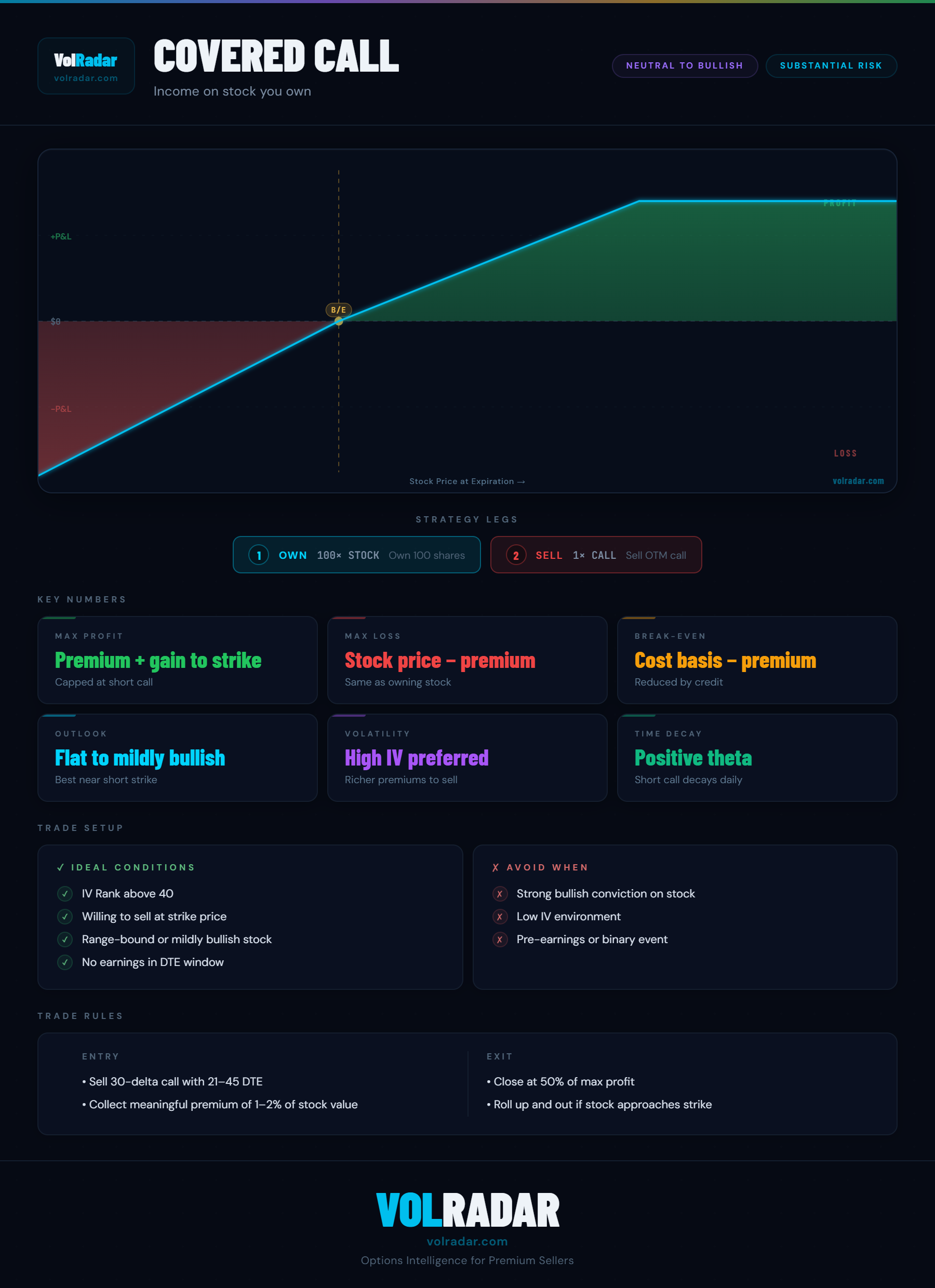
A covered call trades upside above the strike for premium now: if the call is assigned, the shares are sold at the strike, and a large drop in the shares is cushioned only by the premium received.
Visual ReferencePayoff structure and strike placementShowHide
Why It Matters
A covered call builds on shares an investor already holds and changes the payoff of stock ownership. At expiration it is better by the full premium when the price finishes at or below the strike, better by less between the strike and the strike plus the premium, and worse above that; before expiration, the short call's remaining value also counts against the position. How much premium it pays depends on implied volatility, strike distance and time to expiration, so the income is variable, not a fixed yield. The key trade-off is that you keep the downside of the shares, reduced only by the premium, while giving up the upside above the strike.
How It Works
Own 100 shares, or a multiple, and sell one standard call contract per 100 shares (an adjusted contract, for example after a stock split or merger, can cover a different deliverable), usually at a strike above the current price. The premium is credited when the trade opens. At expiration there are three broad outcomes. If the stock is below the strike, the call expires and you keep the shares and the premium. If it is above the strike, you can expect the shares to be called away at the strike, and you keep the premium. If the stock falls, you keep the premium but the shares lose value; the premium only offsets part of the loss. According to the Options Industry Council, the maximum profit is reached when the stock is at the strike at expiration, and the breakeven is the stock purchase price minus the premium received. Because US equity options are generally American-style, assignment can also happen before expiration, notably the day before an ex-dividend date.
Example
Hypothetical: you buy 100 shares at $50 and sell one $55 call with about 30 days to expiration for $1.20. Premium = $1.20 x 100 = $120. Breakeven = $50 - $1.20 = $48.80. If the stock closes at $53, the call expires and you keep the $120 plus the shares. If it closes at $60 and you are assigned, you sell at $55: gain = ($55 - $50 + $1.20) x 100 = $620, the maximum for this trade, while simply holding the stock would have gained $1,000. If it closes at $45, the shares are down $500 and the premium offsets $120, for a net loss of $380.
Common Mistakes
Treating assignment as a failure: it is a normal outcome of the strategy, and it sells the shares at the strike. Treating the premium as downside protection. It reduces the breakeven by the premium amount only; a sharp decline still produces a large loss. Choosing a strike below your cost basis without noticing that assignment would lock in a loss on the shares. Ignoring dividends. An in-the-money call is more likely to be exercised early before an ex-dividend date, and if that happens you do not receive the dividend. Selling through an earnings announcement without accounting for it: the premium for an expiration that includes the report reflects the market's estimate of the event move, and the actual gap can be larger than the premium received.
Comparison
Covered call versus cash-secured put: at the same strike and expiration, the two have similar payoff shapes (a relationship known as put-call parity), but the covered call starts from owning shares and the cash-secured put starts from cash. Covered call versus poor man's covered call: the poor man's version replaces the shares with a long-dated in-the-money call, which needs less capital but adds the long call's own time decay and volatility exposure.
Is the market paying premium sellers today?
The SPY Premium Window study tracks when systematic option selling has historically been compensated — recomputed daily from market close. Free to read, no account needed.
Frequently Asked Questions
What is a covered call strategy?
You own 100 shares and sell one standard call contract, which covers 100 shares, against them. You collect the premium and agree to sell the shares at the strike if the call is exercised.
What happens if my covered call is assigned?
Your 100 shares are sold at the strike price and you keep the premium. Your total result is the strike minus your purchase price plus the premium, per share.
What is the breakeven on a covered call?
Your stock purchase price minus the premium received. Buying at $50 and selling a call for $1.20 gives a breakeven of $48.80.
Is a covered call lower risk than owning the stock?
Partly. At expiration the premium offsets a decline in the shares only by the amount of the premium, so the shares can still fall far below the breakeven. In exchange, the upside above the strike is given up. How much the risk changes depends on the premium, and therefore on the strike and time to expiration.
Can a covered call be assigned early?
Yes. US equity options are generally American-style and can be exercised before expiration. Early exercise is most likely when the call is in the money, particularly just before an ex-dividend date.
General references
General references for this topic area, not citations for the specific figures above. VolRadar is not affiliated with these organizations.
The information about Covered Call above is for educational purposes only and is not financial advice. Read our full investment disclaimer.
Understand options faster.
One term, one worked example, one real ticker. Every Sunday. No jargon.
One email per week, no drip campaigns · Unsubscribe anytime