Loading...
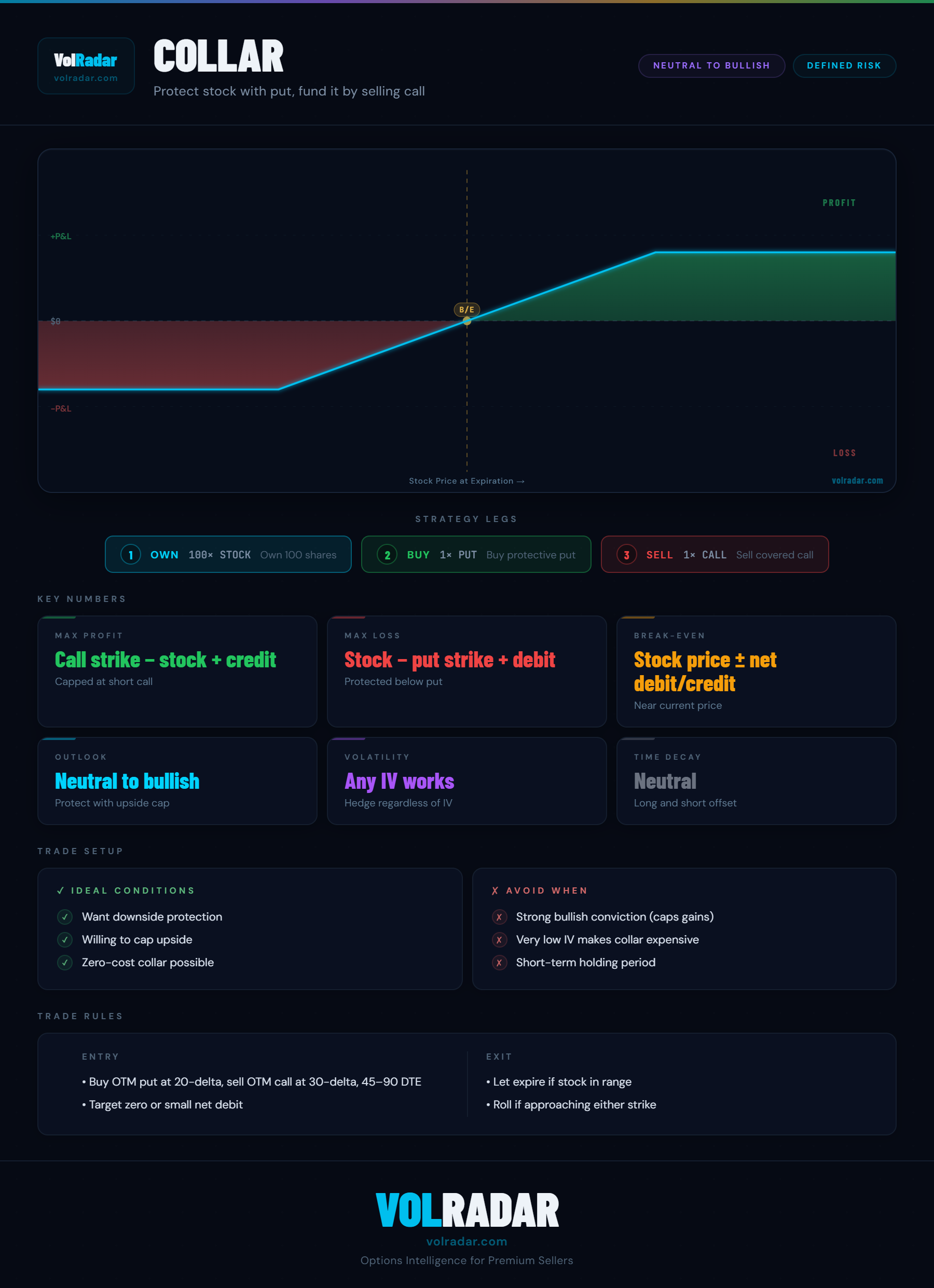
Combining a protective put with a covered call on the same shares. The call premium partially or fully offsets the put cost, creating a defined range of outcomes between the two strikes.
⚡
Key takeawayA zero-cost collar (call premium = put premium) locks in a range with no cash outlay. Popular for hedging concentrated stock positions.
💡 Why It Matters
The collar hedges a stock position with defined cost. You buy a protective put and sell a covered call — the call premium offsets (partially or fully) the put cost. Popular for concentrated stock holdings where you need downside protection without selling shares.
⚙ How It Works
Own 100 shares. Buy an OTM put (floor). Sell an OTM call (ceiling). The call credit reduces or eliminates the put cost. Your outcome is bounded: you can't lose below the put strike or gain above the call strike. A zero-cost collar means call credit = put cost exactly.
📋 Example
Own AAPL at $200. Buy $190 put for $3.50, sell $210 call for $3.50. Zero cost. Your range: $190-$210. Below $190 the put protects you; above $210 shares are called away. You've locked in a $20 range for free, giving up unlimited upside for defined downside protection.
⚠ Common Mistakes
Setting the call strike too close to current price for a zero-cost collar. A $200 stock with a $195 call/$180 put collar caps upside at $195 — only $5 of room. Widen the call to accept some net cost if needed. Also: forgetting the collar resets at expiration — you need to re-establish it.
❓ FAQ
What is Collar?
Combining a protective put with a covered call on the same shares. The call premium partially or fully offsets the put cost, creating a defined range of outcomes between the two strikes.
Why does Collar matter for premium sellers?
A zero-cost collar (call premium = put premium) locks in a range with no cash outlay. Popular for hedging concentrated stock positions.
How does Collar work?
Own 100 shares. Buy an OTM put (floor). Sell an OTM call (ceiling). The call credit reduces or eliminates the put cost. Your outcome is bounded: you can't lose below the put strike or gain above the call strike. A zero-cost collar means call credit = put cost exactly.
What are common mistakes with Collar?
Setting the call strike too close to current price for a zero-cost collar. A $200 stock with a $195 call/$180 put collar caps upside at $195 — only $5 of room. Widen the call to accept some net cost if needed. Also: forgetting the collar resets at expiration — you need to re-establish it.
Related Terms
Albatross Spread
A very wide iron condor where the short strikes are far OTM and the wings are far apart.
Bear Call Ladder
Sell one lower-strike call, buy one middle-strike call, buy one higher-strike call.
Bear Call Spread
A bearish credit spread that sells a lower call and buys a higher call, collecting premium if the stock stays below the short strike.
Bear Put Ladder
Sell one higher-strike put, buy one middle-strike put, buy one lower-strike put.
This is not financial advice. Read our full investment disclaimer.