Loading...
Strategies
Bear Put Ladder — Options Strategy Explained
Bear Put Ladder: A bear put spread with an extra short put added at a lower strike: it gains in a middle range and gives the gain back on a large fall.
By Aigars PilmanisLast updated
Educational content. Not financial, investment, tax, or legal advice. Options involve risk and are not suitable for all investors. How we write & review this glossary.
Read the full guide
Bear Put Ladder — Ratio Put Strategy for Moderate Bearish Views
A bear put ladder buys a higher-strike put and sells two lower-strike puts — credit or near-zero debit on a moderate bearish view. The hidden risk if the stock crashes through both short strikes.
Read the guide→A bear put ladder is a three-leg put position that buys one put at a higher strike and sells two puts at lower strikes, one at a middle strike and one at a lower strike, all with the same expiration. It is a bear put spread with an extra short put added below it. The extra short put makes the position cheaper than the bear put spread and sometimes allows a net credit, but below the lowest strike the position starts giving its gain back.
The position
Direction
Volatility play
- Drives outcome
- The put-side mirror of a call ladder; the payoff changes slope at each strike.
- Risk type
- See structure
VolRadar Lens
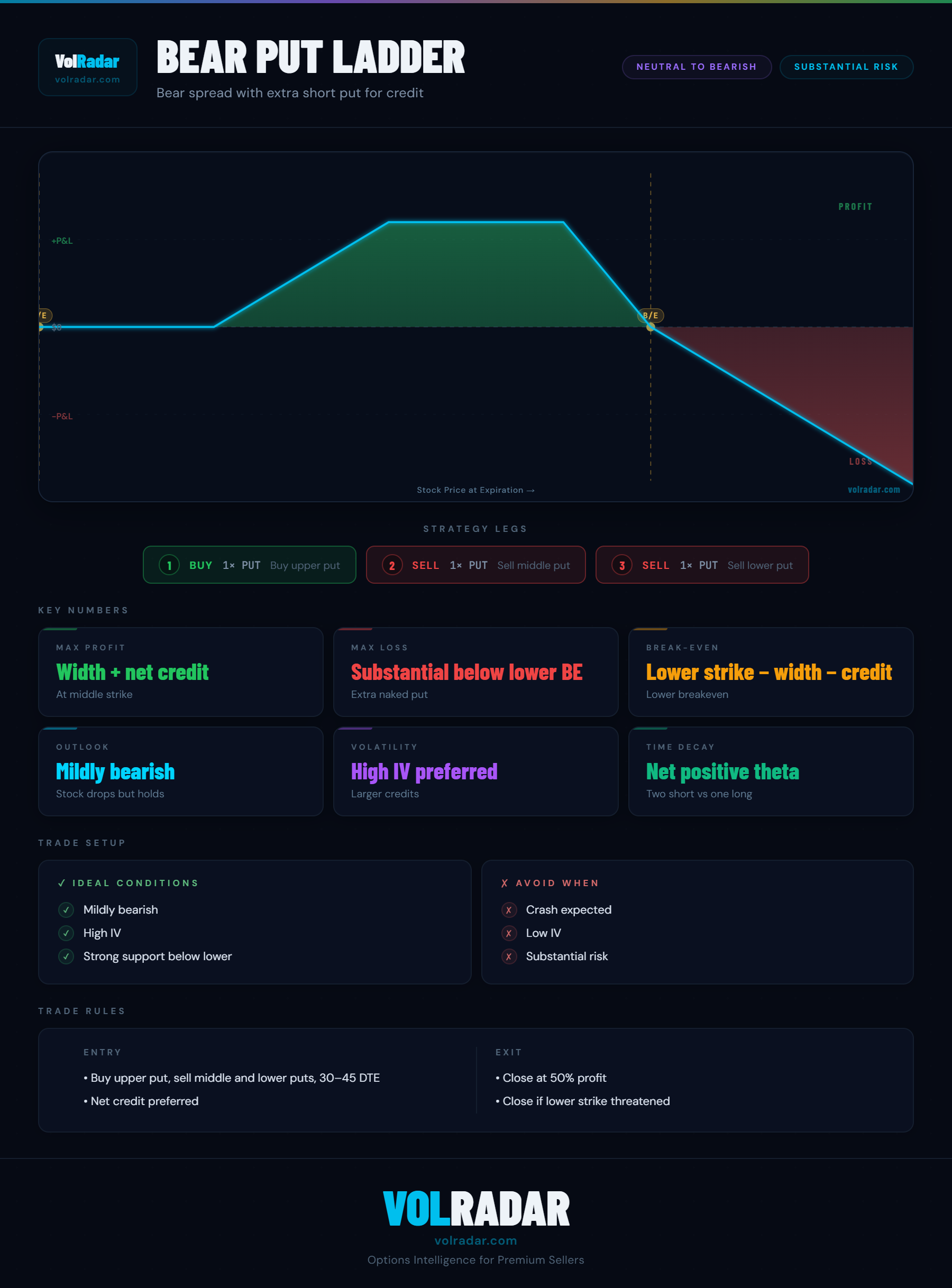
The extra short put reshapes the bear put spread: the maximum gain sits between the two lower strikes, and below the lowest strike the position gives that gain back as the stock keeps falling.
Visual ReferencePayoff structure and strike placementShowHide
Why It Matters
A bear put ladder is a bearish position with a specific target zone rather than an open-ended one. Compared with a plain bear put spread, the second short put lowers the cost or turns it into a credit, and the price of that is that the gain is capped in the middle zone and shrinks again below the lowest strike. A trader choosing this shape is therefore expressing a view that the stock will fall to the area between the two lower strikes and not far past it.
How It Works
Call the strikes K1 < K2 < K3. The ladder is long the K3 put, short the K2 put and short the K1 put, same expiration. Per share, before the net premium, the value at expiration is zero at or above K3; K3 minus the stock price between K2 and K3; the constant K3 - K2 between K1 and K2; and below K1 it shrinks by one for every one the stock falls, because the second short put adds a loss of K1 minus the stock price. If the position is opened for a net debit, maximum gain is (K3 - K2) minus the debit, available between K1 and K2; the loss above K3 equals the debit; the upper breakeven is K3 minus the debit and the lower breakeven is K1 - (K3 - K2) + the debit. Between the two breakevens the position is profitable. Below the lower breakeven, when that breakeven is above zero, it loses, and the loss is bounded because a stock price cannot fall below zero: at a price of zero the position is worth K3 - K2 - K1 per share. If the position is opened for a net credit, there is no upper breakeven, because above K3 the result is the credit itself; the maximum gain and lower breakeven formulas hold with the debit entered as a negative number, and if the lower breakeven is at or below zero the position has no loss region. The two short puts are American-style options for standard equity options and can be assigned before expiration; the Options Industry Council says early assignment of a put generally occurs when it is deep in the money. Ladder names are not standardized: some sources and platforms use the same name for a different arrangement of the legs, so confirm the actual legs rather than relying on the name. The mirror-image position, with every leg reversed, is the bull put ladder.
Example
Hypothetical, per share, with standard 100-share contracts and the stock near 100: buy the 100 put at 4.80, sell the 95 put at 2.70 and sell the 90 put at 1.40, same expiration. Net debit = 4.80 - 2.70 - 1.40 = 0.70 ($70 per ladder). At expiration: at or above 100 the loss is the 0.70 debit ($70). At 92 the value is (100 - 92) - (95 - 92) = 5.00, so the gain is 5.00 - 0.70 = 4.30 ($430), and 4.30 is also the maximum gain anywhere from 90 to 95. The upper breakeven is 100 - 0.70 = 99.30 and the lower breakeven is 90 - 5 + 0.70 = 85.70. At 80 the value is 20 - 15 - 10 = -5.00, so the result is -5.00 - 0.70 = -5.70 (-$570). At a stock price of zero the result would be -85.70 (-$8,570), the bound on the loss. Commissions on three legs are not included.
Common Mistakes
Treating the ladder as keeping the bear put spread's maximum gain on a big fall: below the lowest strike the second short put gives the gain back, and the result can turn into a loss, bounded only by the stock price reaching zero. Reading the name as a guide to the legs: other sources arrange the legs differently, so list the long and short strikes before comparing numbers. Forgetting the loss above the highest strike: if the stock does not fall, the loss is the net debit. Mixing per-share and per-contract figures: dollar results are per-share figures times the contract multiplier (100 for standard US equity options). Ignoring early assignment of the short puts, which can occur before expiration.
Is the market paying premium sellers today?
The SPY Premium Window study tracks when systematic option selling has historically been compensated — recomputed daily from market close. Free to read, no account needed.
Frequently Asked Questions
How does a bear put ladder differ from a bear put spread?
A bear put spread buys a higher-strike put and sells a lower-strike put, so its loss on a large fall is limited to the debit and its gain stays at the maximum below the lower strike. A bear put ladder adds a second short put at an even lower strike, which lowers the net cost but makes the position give its gain back below that strike.
Where are the breakevens of a bear put ladder?
For a net debit, the upper breakeven is the highest strike minus the debit and the lower breakeven is the lowest strike minus the difference between the two upper strikes, plus the debit. In the example these are 99.30 and 85.70.
Is the loss on a bear put ladder unlimited?
No. Below the lowest strike the result worsens as the stock falls and can become a loss, but a stock price cannot go below zero, so the loss is bounded. In the example the bound is 85.70 per share at a price of zero.
How is a bear put ladder different from a bull put ladder?
With the names used here, a bull put ladder is the exact opposite position: every leg is reversed, so its gains and losses have the opposite sign at every stock price. Because ladder names vary between sources, check the legs of any position that uses these names.
Can the short puts of a bear put ladder be assigned early?
Yes, American-style short puts can be assigned before expiration. The Options Industry Council says early assignment of a put generally occurs when it is deep in the money. A long put at a higher strike can be used to cover an assignment, which may require financing a long stock position for a business day.
General references
General references for this topic area, not citations for the specific figures above. VolRadar is not affiliated with these organizations.
The information about Bear Put Ladder above is for educational purposes only and is not financial advice. Read our full investment disclaimer.
Understand options faster.
One term, one worked example, one real ticker. Every Sunday. No jargon.
One email per week, no drip campaigns · Unsubscribe anytime