Loading...
Strategies
Bear Put Spread — Options Strategy Explained
A bear put spread buys a higher-strike put and sells a lower-strike put at the same expiration for a net debit.
By Aigars PilmanisLast updated
Educational content. Not financial, investment, tax, or legal advice. Options involve risk and are not suitable for all investors. How we write & review this glossary.
Read the full guide
Bear Put Spread — Defined-Risk Bearish Options Trade
A bear put spread buys a put and sells a lower-strike put — bearish bias at lower cost than a long put. Strike selection, breakeven math, and when defined-risk debit beats outright shorts.
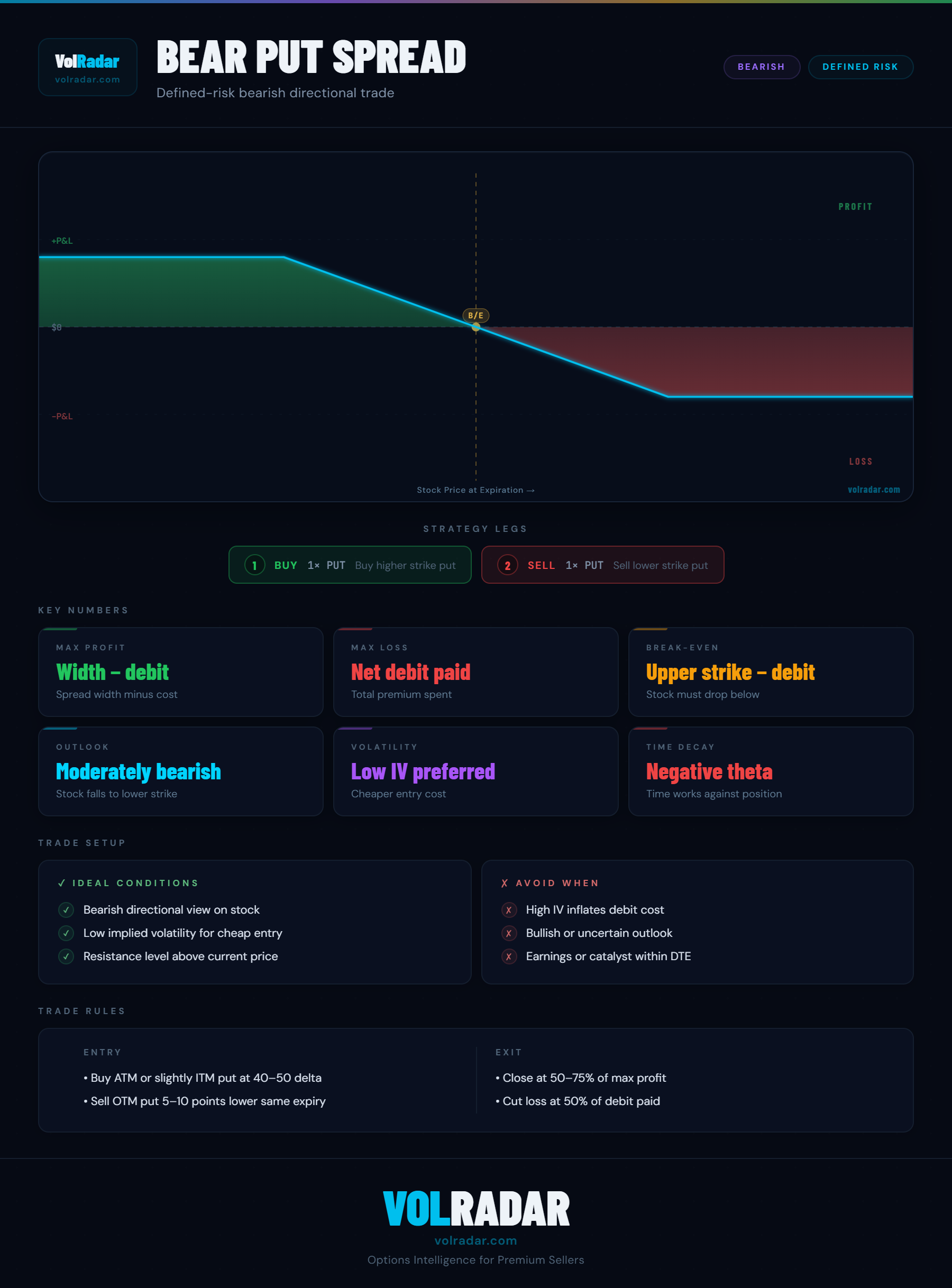
Read the guide→A bear put spread buys a higher-strike put and sells a lower-strike put at the same expiration for a net debit. It is a defined-risk bearish strategy: the most it can lose is the debit paid, the most it can gain is the strike width minus the debit, and at expiration it makes money when the underlying is below the long strike minus the debit.
The position
Direction
Bearish
- Drives outcome
- A moderate decline toward the short put strike.
- Max profit
- Spread width minus debit
- Max loss
- Debit paid
- Risk type
- Defined (net debit)
VolRadar Lens
A defined-risk bearish trade: cheaper than buying the higher-strike put outright and with a higher breakeven than that put, but with profit capped at the spread width minus the debit.
Visual ReferencePayoff structure and strike placementShowHide
Why It Matters
Premium sellers typically collect credit, but the bear put spread serves a specific role: a defined-risk hedge or directional position when a pullback is expected. Buying a put outright can be expensive, especially when implied volatility is high. The bear put spread offsets part of that cost by selling a lower-strike put against it, reducing the net debit and the position's sensitivity to volatility. This matters for a trader holding bullish premium-selling positions who wants a portfolio hedge without paying the full price of a long put, accepting that the protection stops below the short strike. The capped loss also limits the damage if the bearish view is wrong.
How It Works
Buy a put at strike A, sell a put at lower strike B, same expiration. You pay a net debit at entry. Max profit equals the strike width minus the debit paid, realized when the underlying closes at or below strike B. Max loss is the debit paid, which occurs if the underlying stays at or above strike A. Breakeven: strike A minus the debit. The position gains as the underlying falls; the effect of time passing depends on where the underlying sits relative to the strikes, tending to hurt near the higher strike and to help below the lower strike, and changes in implied volatility have only a slight effect because the two puts partly offset each other.
Example
Hypothetical figures. With an ETF at $510, a trader buys the 30-day $510 put for $9.00 and sells the 30-day $500 put for $5.50, paying a net debit of $3.50 ($350 per contract). Maximum loss is the $350 debit; maximum profit is the $10 strike width minus the debit, $6.50 per share, or $650. Breakeven is 510 - 3.50 = $506.50. If the ETF closes at $498 at expiration, the spread is worth its full $10 width and the profit is $650, about 186% of the debit (650 / 350). If it closes at or above $510, both puts expire worthless and the $350 is lost.
Common Mistakes
Paying too much of the width: when the debit is a large share of the strike width, the remaining profit potential is small relative to the risk. Setting the long strike far out of the money, which requires a large move just to reach breakeven. Forgetting that time decay can work against the position while the underlying stays near or above the higher strike. Treating a bearish view as enough: the underlying has to be below the breakeven at expiration, not just stop rising. Ignoring early assignment on the short put if it goes deep in the money.
Is the market paying premium sellers today?
The SPY Premium Window study tracks when systematic option selling has historically been compensated — recomputed daily from market close. Free to read, no account needed.
Frequently Asked Questions
How does a bear put spread differ from buying a single long put?
A bear put spread buys a higher-strike put and sells a lower-strike put against it, reducing the net debit paid. A single long put costs more, and its profit keeps growing as the underlying falls, up to the strike minus the premium if the underlying went to zero. The spread caps the maximum profit at the strike difference minus the debit; in exchange it costs less, has a higher breakeven than the long put alone, and its exposure to time decay depends on where the underlying sits relative to the strikes. Traders typically use the spread when they expect a moderate decline rather than a crash.
What strikes are commonly used for a bear put spread?
The long put is often at or near the money and the short put at a lower strike. Hypothetical: with an ETF at $580, a spread might buy the $580 put and sell the $570 put. Maximum loss is the net debit and maximum profit is the strike width minus the debit, so the width sets their sum rather than either one alone. With the same long strike, a wider spread generally costs more but offers larger profit potential, while a narrower one costs less but caps the gain sooner.
When does a bear put spread reach maximum profit?
Maximum profit is reached when the underlying closes at or below the short put strike at expiration. Both puts then expire in the money, the spread is worth its full width, and the profit is the width minus the initial debit. For a $10-wide spread bought for $4.00, max profit is $6.00 per share or $600 per contract.
What is the breakeven price for a bear put spread at expiration?
Breakeven equals the long put strike minus the net debit paid. If the spread buys a $100 put and sells a $90 put for $3.00 net debit, breakeven is $97. Below $97 at expiration the spread is profitable; above it, it loses money. The underlying has to finish below the breakeven, not merely below the long strike, for the spread to make money.
How does a bear put spread compare with a bear call spread?
With the same two strikes, both have the same shape of profit and loss at expiration: gains capped below the lower strike, losses capped above the higher one. The bear put spread is paid for up front and makes money if the underlying falls below its breakeven; the bear call spread collects a credit and keeps it if the underlying stays below the short call. Which one fits depends on the prices available and whether the trader prefers to pay a debit or collect a credit.
General references
General references for this topic area, not citations for the specific figures above. VolRadar is not affiliated with these organizations.
The information about Bear Put Spread above is for educational purposes only and is not financial advice. Read our full investment disclaimer.
Understand options faster.
One term, one worked example, one real ticker. Every Sunday. No jargon.
One email per week, no drip campaigns · Unsubscribe anytime