Loading...
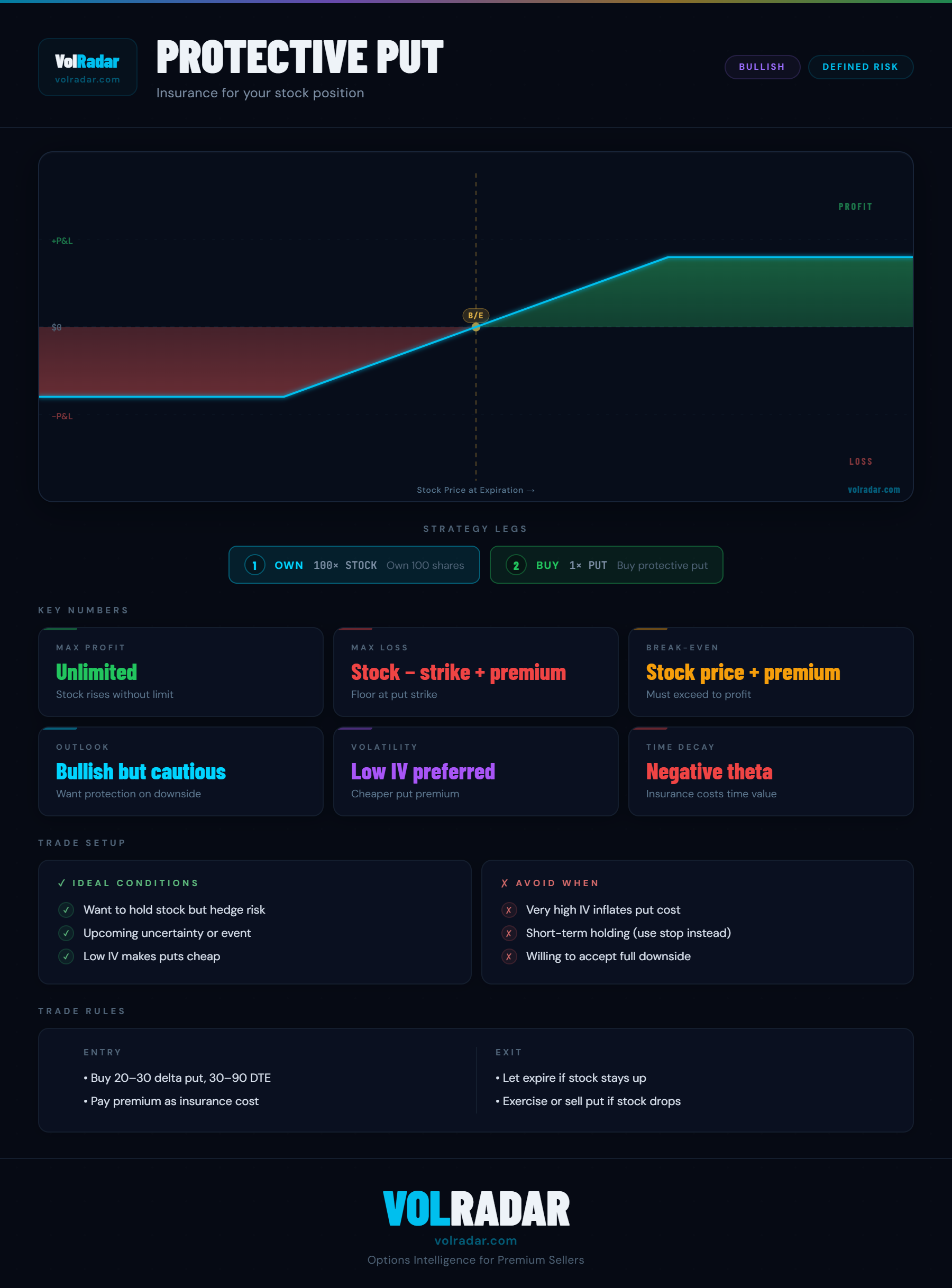
Buying a put option on shares you already own to limit downside risk. Acts as portfolio insurance — the put gains value if the stock drops, offsetting share losses below the strike.
⚡
Key takeawayInsurance costs money. Protective puts cap your downside but reduce net returns by the premium paid. Use selectively around events, not as a permanent hedge.
💡 Why It Matters
The protective put is portfolio insurance — buy a put on shares you own to cap your downside. It's the simplest hedging strategy: if the stock crashes below the strike, the put gains value dollar-for-dollar, offsetting your share losses.
⚙ How It Works
Own shares, buy an OTM put. If the stock drops below the put strike, the put gains intrinsic value that offsets your share losses. Your maximum loss = current price minus put strike + premium paid. If the stock rises, the put expires worthless and the premium is your insurance cost.
📋 Example
You own 100 AAPL at $200. Buy the $190 put for $3.50 (90 DTE). If AAPL drops to $170: shares lose $30, put gains $20 (intrinsic $190-$170). Net loss: $13.50/share (capped). Without the put: $30 loss. The $3.50 insurance premium saved you $16.50.
⚠ Common Mistakes
Using protective puts as a permanent hedge. The premium cost compounds — $3.50 per quarter = $14/year on a $200 stock (7% drag). Use protective puts tactically around events or periods of elevated risk, not as a standing position.
❓ FAQ
What is Protective Put?
Buying a put option on shares you already own to limit downside risk. Acts as portfolio insurance — the put gains value if the stock drops, offsetting share losses below the strike.
Why does Protective Put matter for premium sellers?
Insurance costs money. Protective puts cap your downside but reduce net returns by the premium paid. Use selectively around events, not as a permanent hedge.
How does Protective Put work?
Own shares, buy an OTM put. If the stock drops below the put strike, the put gains intrinsic value that offsets your share losses. Your maximum loss = current price minus put strike + premium paid. If the stock rises, the put expires worthless and the premium is your insurance cost.
What are common mistakes with Protective Put?
Using protective puts as a permanent hedge. The premium cost compounds — $3.50 per quarter = $14/year on a $200 stock (7% drag). Use protective puts tactically around events or periods of elevated risk, not as a standing position.
Related Terms
Albatross Spread
A very wide iron condor where the short strikes are far OTM and the wings are far apart.
Bear Call Ladder
Sell one lower-strike call, buy one middle-strike call, buy one higher-strike call.
Bear Call Spread
A bearish credit spread that sells a lower call and buys a higher call, collecting premium if the stock stays below the short strike.
Bear Put Ladder
Sell one higher-strike put, buy one middle-strike put, buy one lower-strike put.
This is not financial advice. Read our full investment disclaimer.