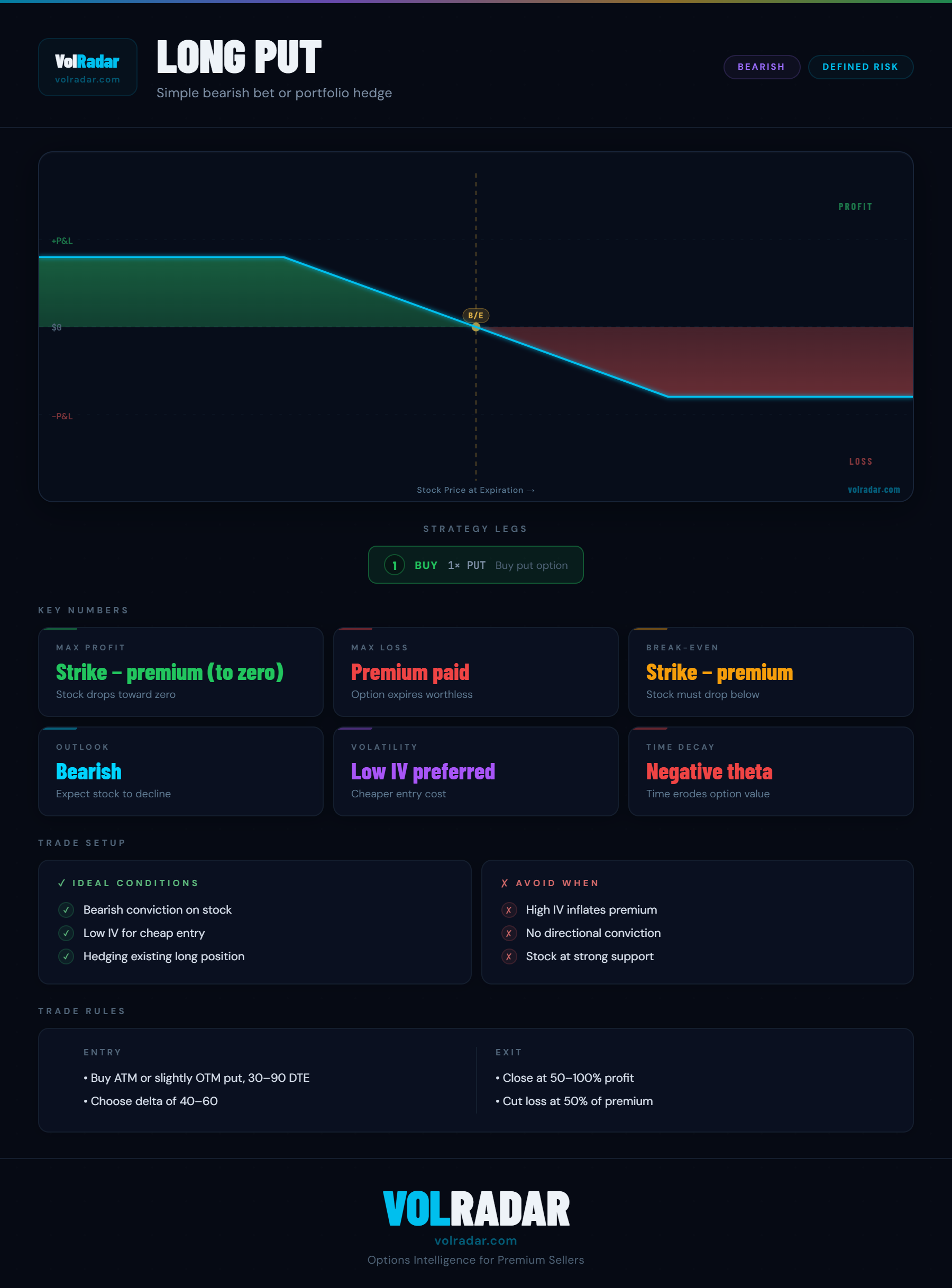
A contract giving the holder the right to sell 100 shares of the underlying at the strike price before expiration. Put buyers profit from downward moves; put sellers collect premium betting the stock stays above the strike.
⚡ KEY TAKEAWAY: Selling OTM puts is the bread-and-butter premium selling trade. You collect premium and only get assigned if the stock drops below your strike.
Why It Matters
The put option is the foundation of premium selling. Selling OTM puts is the most common income strategy in options — the CSP and wheel strategy are built entirely on short puts. Understanding puts is prerequisite to every bearish strategy and every spread.
How It Works
The put buyer pays a premium for the right to sell 100 shares at the strike price before expiration. The put seller collects that premium and is obligated to buy shares at the strike if assigned. Put value increases when the stock falls (negative delta), decreases with time (negative theta for longs), and increases with IV.
Example
SPY at $580. Sell the $565 put for $3.00. If SPY stays above $565: put expires worthless, keep $300 per contract. If SPY drops to $555: assigned at $565, effective cost = $562 (strike minus premium), holding 100 shares of SPY at a 3.1% discount to the $580 entry price.
Common Mistakes
Selling puts on stocks you don't want to own. If SPY drops to $540, you own 100 shares at $565. Are you comfortable holding through a further decline? If not, you should be trading spreads (defined risk) instead of naked puts. Also: not having enough cash for assignment.
A contract giving the holder the right to sell 100 shares of the underlying at the strike price before expiration. Put buyers profit from downward moves; put sellers collect premium betting the stock stays above the strike.
Why does Put Option matter for premium sellers?
Selling OTM puts is the bread-and-butter premium selling trade. You collect premium and only get assigned if the stock drops below your strike.
How does Put Option work?
The put buyer pays a premium for the right to sell 100 shares at the strike price before expiration. The put seller collects that premium and is obligated to buy shares at the strike if assigned. Put value increases when the stock falls (negative delta), decreases with time (negative theta for longs), and increases with IV.
What are common mistakes with Put Option?
Selling puts on stocks you don't want to own. If SPY drops to $540, you own 100 shares at $565. Are you comfortable holding through a further decline? If not, you should be trading spreads (defined risk) instead of naked puts. Also: not having enough cash for assignment.