Loading...
Strategies
Naked Put — Options Strategy Explained
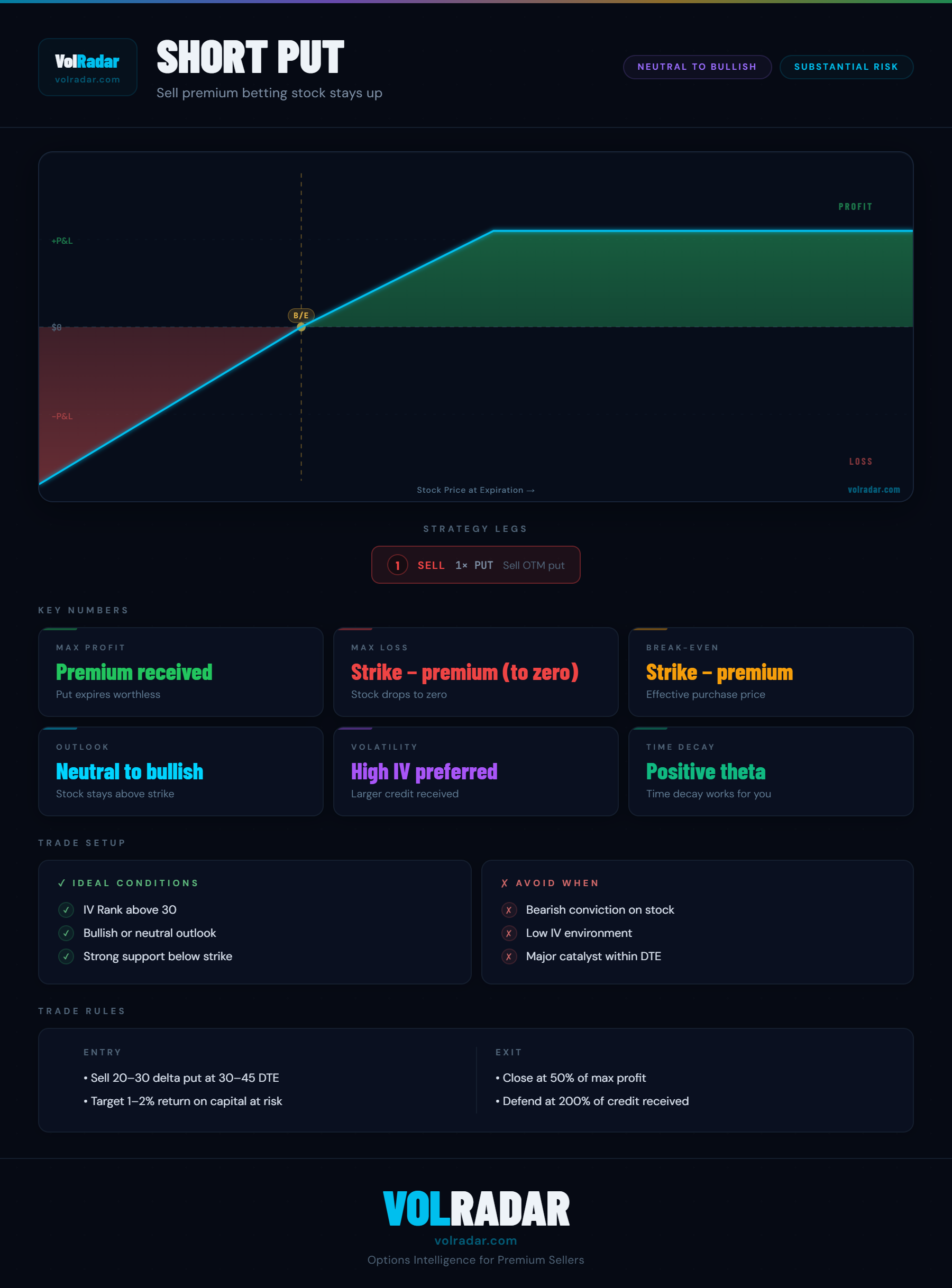
A naked put is a short put carried on margin rather than fully backed by cash, with a maximum loss of (strike - premium) x 100.
By Aigars PilmanisLast updated
Educational content. Not financial, investment, tax, or legal advice. Options involve risk and are not suitable for all investors. How we write & review this glossary.
Naked Put vs Cash-Secured Put vs Put Credit Spread
Naked Put sells a put with margin backing only. Cash-Secured Put posts full cash equal to the strike. Put Credit Spread adds a long protective put to define the maximum loss. All three express a neutral-to-bullish view, but with very different capital and risk profiles.
| Feature | Naked Put | Cash-Secured Put | Put Credit Spread |
|---|---|---|---|
| Capital efficiency | Often higher than a cash-secured put because only margin is reserved; varies with broker margin rules | Lowest because full strike is held in cash | Varies with spread width and broker margin rules |
| Max loss | (Strike minus premium per share) times 100, not capped by a long leg | (Strike minus premium per share) times 100, fully cash-backed | Width minus credit, capped and known at entry |
| Approval needed | A higher approval tier on a margin account; levels vary by broker | An approval level that varies by broker | A spread approval level that varies by broker |
| Assignment outcome | Shares delivered, may require margin call coverage | Shares delivered against posted cash | Long put limits liability at assignment |
| Reward profile | Full premium received with margin set aside rather than full cash | Full premium received with full collateral | Net credit after paying for the long put leg |
| Used to express | Short-put exposure on margin in an account approved for naked options | Short-put exposure with full cash collateral | Short-put exposure with the loss capped by a long put |
Key trade-off
All three carry a short put. A naked put reserves margin and leaves the downside open to zero; a cash-secured put holds the full strike value in cash; a put credit spread caps the loss at the width minus the credit. Approval levels and account type decide which of them an account can hold.
A naked put is a short put sold without enough cash set aside to buy the shares at the strike, so it is carried on margin. The seller keeps the premium, but if assigned has to buy the shares at the strike, 100 per contract for a standard, unadjusted equity option. The risk is substantial: the maximum loss is (strike - premium) x 100, reached if the stock falls to zero.
The position
Direction
Bullish to neutral
- Max profit
- Premium received
- Risk type
- Large; maximum loss is strike minus premium per share
VolRadar Lens
- Margin
- Reg-T or Portfolio Margin required
A naked put has the same payoff as a cash-secured put; only the collateral differs. The margin requirement is usually smaller than what an assignment costs, which is the full strike x 100 per contract.
Visual ReferencePayoff structure and strike placementShowHide
Why It Matters
Naked and cash-secured puts have the same payoff; the difference is leverage. Because the margin is usually a fraction of the assignment cost, the same account can sell more contracts naked than it could cash-secured, and every additional contract adds another (strike - premium) x 100 of downside. Margin requirements are also recalculated as the stock moves: if the price falls, the requirement rises, and a broker can issue a margin call or close positions. Knowing the full assignment cost, not only the margin, is what separates the two.
How It Works
You sell a put and receive the premium. If the stock stays above the strike through expiration, the put expires worthless and you keep the premium. If the stock is below the strike, you can be assigned and have to buy the shares at the strike (100 per contract for a standard, unadjusted equity option; contracts adjusted for corporate actions can have a different deliverable); your effective cost is strike minus premium. Standard US equity options are American-style, so assignment can also come before expiration (equity FLEX options can instead be European-style). Instead of holding strike x 100 in cash, a margin account posts only a margin requirement. FINRA Rule 4210 sets the minimum for a short equity put: the option's market value plus 20% of the underlying value, reduced by any out-of-the-money amount, but not less than the option's value plus 10% of the strike value. Brokers can require more, and many do, so the actual figure is broker-specific.
Example
Hypothetical: a stock trades at $52. You sell one $50 put with 30 days to expiration for $1.50, collecting $150. Breakeven = $50 - $1.50 = $48.50. Maximum loss = ($50 - $1.50) x 100 = $4,850, if the stock goes to zero. FINRA 4210 minimum margin: 20% x $5,200 = $1,040, minus the $200 out-of-the-money amount = $840, plus the $150 option value = $990. The floor is 10% x $5,000 + $150 = $650, so the minimum is $990 (your broker may ask more). A cash-secured version of the same put would hold $5,000. If the stock closes at $44 and you are assigned, you pay $5,000 for shares worth $4,400; net of the premium the loss is ($48.50 - $44) x 100 = $450.
Common Mistakes
Reading the margin requirement as the capital at stake: a $990 margin requirement can turn into a $5,000 share purchase on assignment. Overlooking correlation: short puts on stocks that tend to fall together can all move into the money in the same market drop. Forgetting that the margin requirement grows as the stock falls, which can force a close at the worst moment. Treating assignment as a surprise rather than a normal outcome of a short put that finishes in the money.
Is the market paying premium sellers today?
The SPY Premium Window study tracks when systematic option selling has historically been compensated — recomputed daily from market close. Free to read, no account needed.
Frequently Asked Questions
What is the difference between a naked put and a cash-secured put?
The payoff is identical. A cash-secured put holds strike x 100 in cash for each contract; a naked put is carried on margin, which usually requires only part of that amount. The naked version uses less capital per contract, which makes it easier to take on more exposure than the account could absorb if assigned.
What is the maximum loss on a naked put?
(Strike - premium) x 100 per contract, reached if the stock goes to zero. For a $50 put sold for $1.50, that is $4,850. The loss is capped because a stock cannot fall below zero, but it is many times the premium collected.
How much margin does a naked put require?
FINRA Rule 4210 sets the minimum for a short equity put: option value plus 20% of the underlying value, minus any out-of-the-money amount, with a floor of option value plus 10% of the strike value. Brokers may set higher house requirements, so check your broker's figure.
Can a naked put be assigned early?
Yes, for standard US equity options, which are American-style: the put holder can exercise on any trading day before expiration (European-style contracts, such as some equity FLEX options, cannot be exercised early). If that happens, you buy the shares at the strike, 100 per standard contract, and need the cash or margin to carry them.
General references
General references for this topic area, not citations for the specific figures above. VolRadar is not affiliated with these organizations.
The information about Naked Put above is for educational purposes only and is not financial advice. Read our full investment disclaimer.
Understand options faster.
One term, one worked example, one real ticker. Every Sunday. No jargon.
One email per week, no drip campaigns · Unsubscribe anytime