Loading...
Strategies
Wheel Strategy — Options Strategy Explained
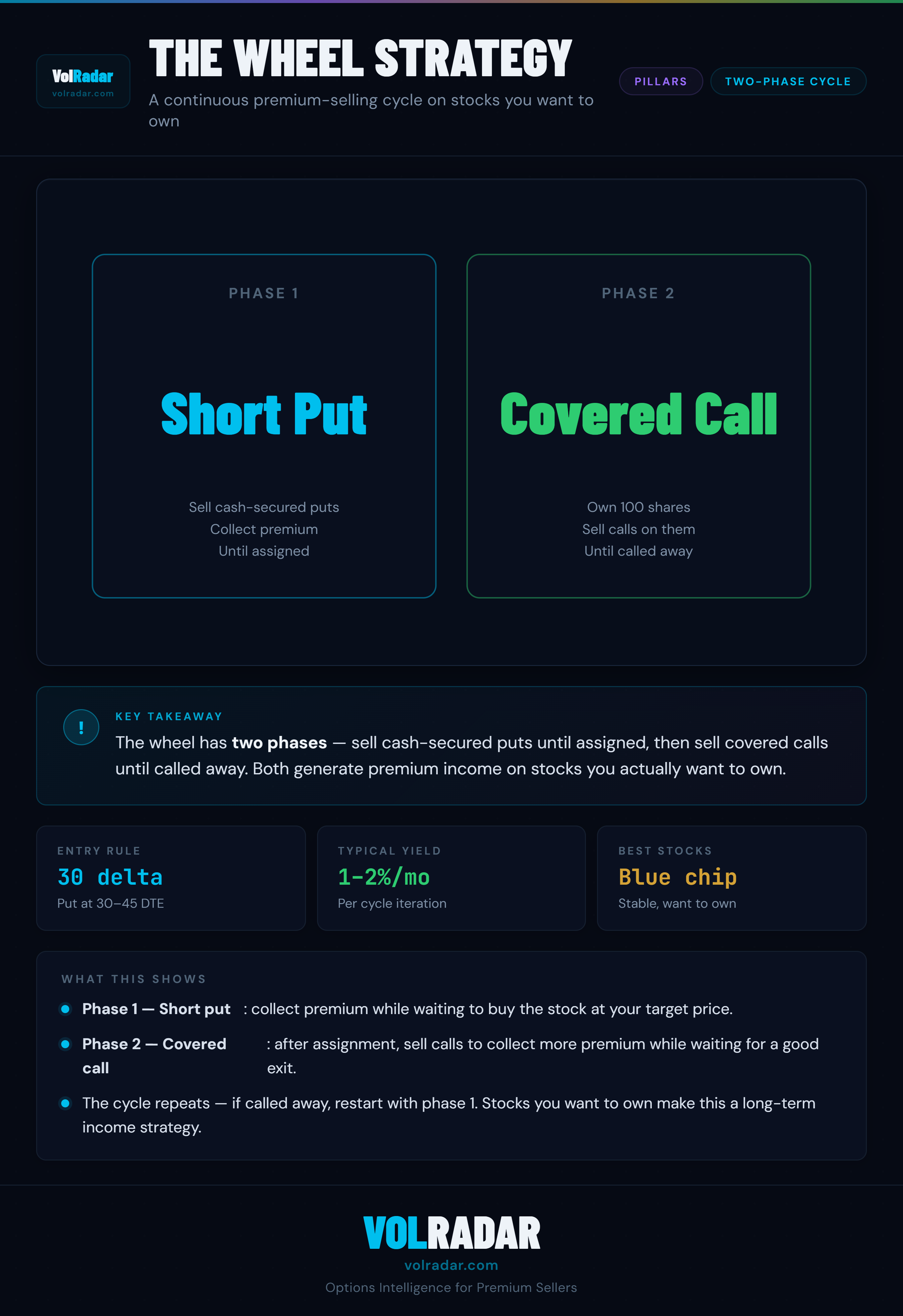
The wheel strategy cycles between selling cash-secured puts and covered calls on the same stock.
By Aigars PilmanisLast updated
Educational content. Not financial, investment, tax, or legal advice. Options involve risk and are not suitable for all investors. How we write & review this glossary.
Wheel Strategy vs Covered Call vs Cash-Secured Put
Wheel Strategy is a repeating cycle that can combine Cash-Secured Puts and Covered Calls on the same underlying. Cash-Secured Put runs only the pre-assignment leg. Covered Call runs only the post-assignment leg. The Wheel chains both for as long as the cycle is repeated.
| Feature | Wheel Strategy | Covered Call | Cash-Secured Put |
|---|---|---|---|
| Position lifecycle | Repeating loop across put, shares, and call legs while the cycle continues | One option leg sold against owned shares | One option leg sold against cash |
| Capital commitment | Full collateral at every phase of the cycle | Cost basis of 100 shares per contract | Cash equal to strike times 100 |
| Market bias | Long-term bullish on the underlying | Neutral to mildly bullish | Neutral to mildly bullish |
| Premium source | Premium from both put and call sales over time | Premium from short calls | Premium from short puts |
| Trigger to switch legs | Assignment on a leg moves the strategy to the next leg | Stays a call seller until shares called away | Stays a put seller until shares assigned |
| Used to express | A repeating put-then-call cycle on one stock, if assigned on both sides | A short call against shares already held | Willingness to buy the shares at the strike |
Key trade-off
The wheel links the two legs: a cash-secured put until assignment, then covered calls on the shares until they are called away. A covered call is the call leg on its own, on shares already held. A cash-secured put is the put leg on its own, backed by cash.
The wheel strategy is an options cycle on one stock: sell cash-secured puts until you are assigned 100 shares per standard contract, then sell covered calls on those shares until they are called away, then start again with puts. Both phases collect premium. Unlike selling covered calls alone (or holding a covered-call ETF), the wheel starts from cash and only owns the shares after a put is assigned.
The position
Direction
Neutral to bullish, continuous
- Drives outcome
- The stock's path through both legs; the shares carry the full downside.
VolRadar Lens
- Components
- CSP, assignment, covered call, repeat
- Risk
- Bagholding through a deep drawdown
Whenever the put is assigned, the wheel moves into owning the stock, so its risk is the stock's downside from strike minus premium.
Visual ReferencePayoff structure and strike placementShowHide
Why It Matters
The wheel connects two strategies so that each outcome leads to the next step: assignment on the put starts the call phase, and being called away returns you to cash. The trade-off is asymmetric. Each phase earns a limited premium, while a sharp fall in the stock is held in full once you own the shares, and in a strong rally the calls cap the gain. Compared with a covered-call ETF, the wheel is run on a single stock you choose, with your own strikes and expirations, and spends part of the time in cash rather than always holding the shares. On VolRadar, the Wheel Calculator works through a put for one ticker, /best-wheel-stocks screens wheel candidates, and each ticker has a wheel-strategy page.
How It Works
Phase 1: sell a cash-secured put, keeping strike x 100 in cash per contract (a standard equity option usually delivers 100 shares; the figures here assume that). If the put expires out of the money, keep the premium and sell another. If it is assigned, you buy 100 shares at the strike; your effective cost is strike minus premium. Phase 2: sell a covered call on the 100 shares. If it expires, keep the premium and sell another. If the shares are called away at the strike, you are back in cash. Phase 3: when the shares are called away, the option-and-stock result of the cycle is all premiums collected plus (call strike - put strike) x 100, before dividends received, any closing or rolling debits and transaction costs. Then the cycle restarts with a new put. Selling calls below your effective cost raises the chance of being called away at a loss on the shares.
Example
Hypothetical: you sell one $50 put for $1.20 ($120), with $5,000 held as collateral. The stock falls to $49.50 and you are assigned 100 shares at $50; effective cost = $50 - $1.20 = $48.80. You then sell a $52 covered call for $0.95 ($95). If the stock is above $52 at expiration, assignment is normally expected, and if assigned, the shares are called away. Result, ignoring dividends and transaction costs: share gain ($52 - $50) x 100 = $200, plus premiums $120 + $95 = $215, total $415, or 8.3% on the $5,000 committed. The same figure from the effective cost: ($52 - $48.80) x 100 + $95 = $415.
Common Mistakes
Treating assignment as an unlikely outcome: once assigned on a fallen stock, calls struck at or above the effective cost can pay little, and the shares may stay below that cost for a long time. Selling calls below the effective cost to collect more premium, which can lock in a loss on the shares if they are called away. Selling through earnings without accounting for it: an expiration that includes the report prices the market's estimate of the event move. VolRadar's earnings gates hold back setups when an earnings date is close.
Comparison
Wheel vs covered call: a covered call starts from owning shares and only sells calls. The wheel starts from cash, sells puts first and only owns shares after assignment. Wheel vs covered-call ETF: the ETF holds a portfolio and writes calls under its own fund rules, which differ between funds in what the calls are written on, how much of the portfolio is covered and when calls are written; with the wheel you pick the stock, the strikes and the timing yourself and pay the commissions and bid-ask costs of each trade.
Is the market paying premium sellers today?
The SPY Premium Window study tracks when systematic option selling has historically been compensated — recomputed daily from market close. Free to read, no account needed.
Frequently Asked Questions
What is the difference between the wheel strategy and a covered call?
A covered call is one phase of the wheel. The wheel adds the cash-secured put phase before it: you get the shares by being assigned on a put, then sell calls until they are called away, then return to selling puts.
How is the wheel different from a covered-call ETF?
A covered-call ETF owns a portfolio and writes calls under its own fund rules, which differ between funds. The wheel is a single-stock cycle you run yourself, starting with puts from cash, and it is only in the stock after a put is assigned.
When does the wheel break down?
When the stock falls well below the put strike and stays there. You own the shares at a loss, and calls at or above your effective cost can pay little, so the choices include waiting, selling lower-strike calls and accepting the risk of being called away at a loss, selling the shares, or stopping the wheel.
How much capital does the wheel need?
Strike x 100 per standard equity-option contract for the put phase: a $50 put needs $5,000. After assignment the same capital is held as 100 shares.
What returns does the wheel make?
It depends on the stock, the strikes and the market; there is no standard figure. A cycle that ends with the shares called away results in the premiums plus the difference between the call strike and the put strike (x 100 per standard contract), before dividends received, any closing or rolling debits and transaction costs. The loss on the shares is limited only by the stock's floor of zero: the effective cost x 100 per contract, before later call premiums, dividends and costs.
General references
General references for this topic area, not citations for the specific figures above. VolRadar is not affiliated with these organizations.
The information about Wheel Strategy above is for educational purposes only and is not financial advice. Read our full investment disclaimer.
Understand options faster.
One term, one worked example, one real ticker. Every Sunday. No jargon.
One email per week, no drip campaigns · Unsubscribe anytime