Loading...
Strategies
Cash-Secured Put (CSP) — Options Strategy Explained
A cash-secured put is a short put backed by cash equal to the strike price x 100 per standard contract, so the seller can pay for the shares if assigned.
By Aigars PilmanisLast updated
Educational content. Not financial, investment, tax, or legal advice. Options involve risk and are not suitable for all investors. How we write & review this glossary.
Cash-Secured Put vs Naked Put vs Put Credit Spread
Cash-Secured Put posts full cash collateral to back potential assignment. Naked Put uses only margin. Put Credit Spread caps the downside by buying a lower-strike put against the short put, trading some premium for a defined maximum loss.
| Feature | Cash-Secured Put | Naked Put | Put Credit Spread |
|---|---|---|---|
| Capital needed | Full strike times 100 in cash per contract | Margin requirement set by the broker's formula | (Width between strikes minus credit per share) times 100, a common reference; actual requirement varies by broker |
| Max loss | Strike minus premium times 100 if stock goes to zero | Strike minus premium times 100 if stock goes to zero | Strike width minus credit, defined and capped |
| Margin treatment | Cash-secured, no margin used | Naked, eligible only on margin accounts with approval | Buying power reduction is commonly based on max loss; varies by broker and account type |
| Assignment outcome | Receive shares at the strike using posted cash | Receive shares at the strike, may trigger margin call | Long put offsets short put, limiting share liability |
| Premium collected | Full short put premium | Full short put premium | Net credit after paying for the long put leg |
| Used to express | A short put fully backed by cash, with assignment buying the shares | The same short-put exposure on margin, with the downside open to zero | A short-put view with the loss capped by a long put |
Key trade-off
A cash-secured put holds the strike value in cash, so assignment is fully funded. A naked put reserves only margin, so the same downside is carried on less collateral and the requirement can rise in a selloff. A put credit spread adds a long put that caps the loss at the width minus the credit.
Cash-secured put P&L formula
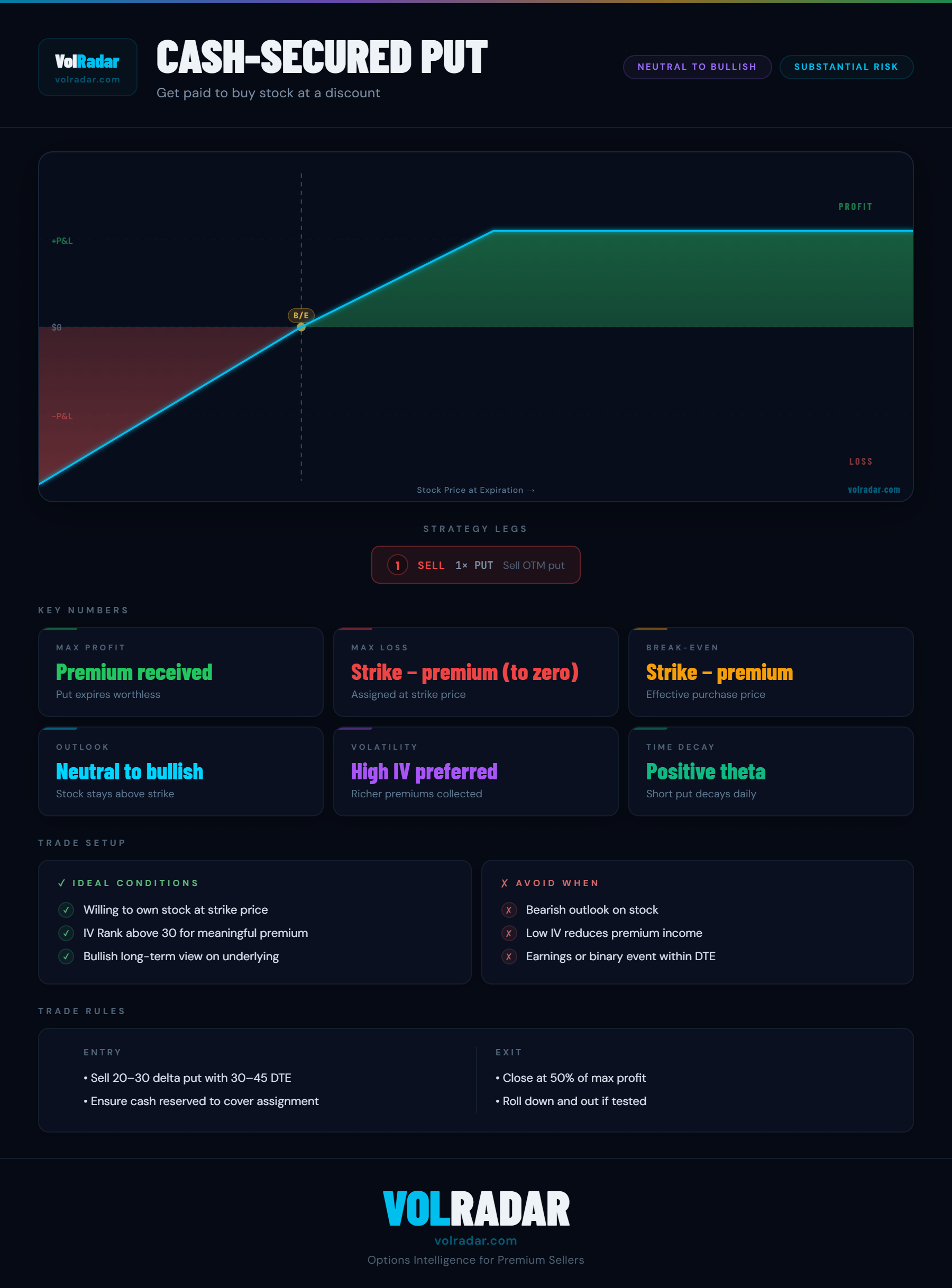
Max Profit = Premium Received (kept if the put expires worthless). Max Loss = Strike − Premium Received (occurs if the stock goes to zero and you take assignment). Breakeven = Strike − Premium Received.Variables
- Strike
- — Strike price of the short put — the price at which you would be obligated to buy
- Premium Received
- — Credit collected per share when selling the put
- Cash Secured
- — Strike × 100 set aside per contract to cover potential assignment
Example
Sell a $50 put for $1.50. Max Profit = $1.50 per share ($150 per contract). Max Loss = 50 − 1.50 = $48.50 per share if the stock goes to zero. Breakeven at expiration = $48.50.
A cash-secured put (CSP) is a short put backed by cash equal to the strike price x 100 per standard (100-share) contract, so the seller can pay for the shares if assigned: a $50 put needs $5,000. The seller keeps the premium either way. If the stock is below the strike at expiration, assignment is expected but not guaranteed; if it happens, the seller buys 100 shares at the strike, for an effective cost of strike minus premium.
The position
Direction
Neutral to bullish
- Drives outcome
- Price holding above the short put strike; assignment buys the shares at it.
- Max profit
- Premium received
- Max loss
- Strike minus premium (stock to zero)
- Risk type
- Cash-collateralized short put
VolRadar Lens
Assignment is a normal result of a cash-secured put, not a rare one; once assigned, the position carries the full downside of the shares, cushioned only by the premium.
Visual ReferencePayoff structure and strike placementShowHide
Why It Matters
A CSP turns a limit order into a paid obligation: you name the price at which you would buy and receive premium for committing to it. The trade-off is asymmetric. The most you can make is the premium, while the loss if the stock falls is the same as owning it from the breakeven down. Compared with buying the shares today, a CSP earns less when the stock rises strongly and loses less when it falls. At expiration, at any price below the strike its advantage is the premium plus the gap between today's price and the strike; above the strike that advantage shrinks until the shares pull ahead. In the hypothetical example on this page, 100 shares bought at $52 lose $700 at $45 while the CSP loses $350 (a $350 difference); at $51 the shares lose $100 while the CSP keeps $150 (a $250 difference); above $53.50 the shares do better. If assigned, the shares can become the starting point of a covered-call position.
How It Works
Each standard put contract obligates the seller to buy 100 shares at the strike if assigned, so a cash-secured put keeps strike x 100 in cash for each contract. The premium is credited when the trade opens. At expiration there are two outcomes. If the stock is above the strike, the put expires worthless and you keep the premium. If it is below the strike, assignment is expected but not guaranteed: the put holder decides whether to exercise. If you are assigned, you buy 100 shares at the strike; your effective cost is strike minus premium. American-style equity puts can also be assigned before expiration, most often when the put is deep in the money. After assignment, some traders sell covered calls on the shares, which is the second half of the wheel strategy.
Example
Hypothetical: a stock trades at $52. You sell one $50 put with 30 days to expiration for $1.50. Collateral = $50 x 100 = $5,000. Premium = $1.50 x 100 = $150. Breakeven = $50 - $1.50 = $48.50. If the stock closes at $55, the put expires and you keep $150. If it closes at $45 and the put is exercised (the expected but not guaranteed outcome), you are assigned 100 shares at $50; against the $48.50 effective cost, the position shows an unrealized loss of ($48.50 - $45) x 100 = $350.
Common Mistakes
Treating assignment as unlikely: it is a normal outcome, not a rare one, and it means owning the shares with their full downside below the breakeven; a rich premium usually reflects a real risk of a large move. Forgetting that the collateral stays committed until the put expires, is closed or is assigned. Selling through an earnings announcement without accounting for it: the premium for an expiration that includes the report reflects the market's estimate of the event move, and the stock can gap through the strike by more than the premium received. VolRadar's Wheel tools screen out stocks with an earnings date coming up.
Is the market paying premium sellers today?
The SPY Premium Window study tracks when systematic option selling has historically been compensated — recomputed daily from market close. Free to read, no account needed.
Frequently Asked Questions
How much collateral does a cash-secured put require?
Strike price x 100 per standard 100-share contract: a $50 put needs $5,000 in cash. Some brokers let the premium received count toward that amount, but the obligation is still to buy 100 shares at the strike.
What happens if my cash-secured put is assigned?
If the put holder exercises, the cash buys 100 shares per contract at the strike. You keep the premium, so your effective cost is strike minus premium. From there you can hold the shares, sell them, or sell covered calls against them.
Can a cash-secured put be assigned before expiration?
Yes. US equity options are generally American-style, so the buyer can exercise at any time before expiration. Early assignment is most likely when the put is deep in the money and has little time value left.
How does a cash-secured put compare to buying the stock?
With the stock at $52, as in the example, 100 shares bought now gain or lose dollar for dollar from $52. A $50 put sold for $1.50 caps the gain at $150 and starts losing below $48.50, so at expiration it does better than the shares whenever the price finishes below $53.50 (by $350 at any price below $50), and worse when it finishes above $53.50.
How does delta relate to a cash-secured put's strike?
A put's delta is negative, so strikes are compared by absolute delta. Among puts on the same stock and expiration, a lower absolute delta is further below the price, with a lower model-implied chance of finishing in the money and less premium. Delta is only an approximation of the chance of finishing in the money, not a forecast.
General references
General references for this topic area, not citations for the specific figures above. VolRadar is not affiliated with these organizations.
The information about Cash-Secured Put (CSP) above is for educational purposes only and is not financial advice. Read our full investment disclaimer.
Understand options faster.
One term, one worked example, one real ticker. Every Sunday. No jargon.
One email per week, no drip campaigns · Unsubscribe anytime