Loading...
Strategies
Short Strangle — Options Strategy Explained
A short strangle sells an out-of-the-money call and an out-of-the-money put with the same expiration, for a combined credit.
By Aigars PilmanisLast updated
Educational content. Not financial, investment, tax, or legal advice. Options involve risk and are not suitable for all investors. How we write & review this glossary.
Read the full guide
Short Strangle — Wide Profit Zone, Undefined Risk
A short strangle sells an OTM call and OTM put at different strikes — wide profit zone, undefined risk. How to size, when to roll, and why an iron condor is the defined-risk alternative.
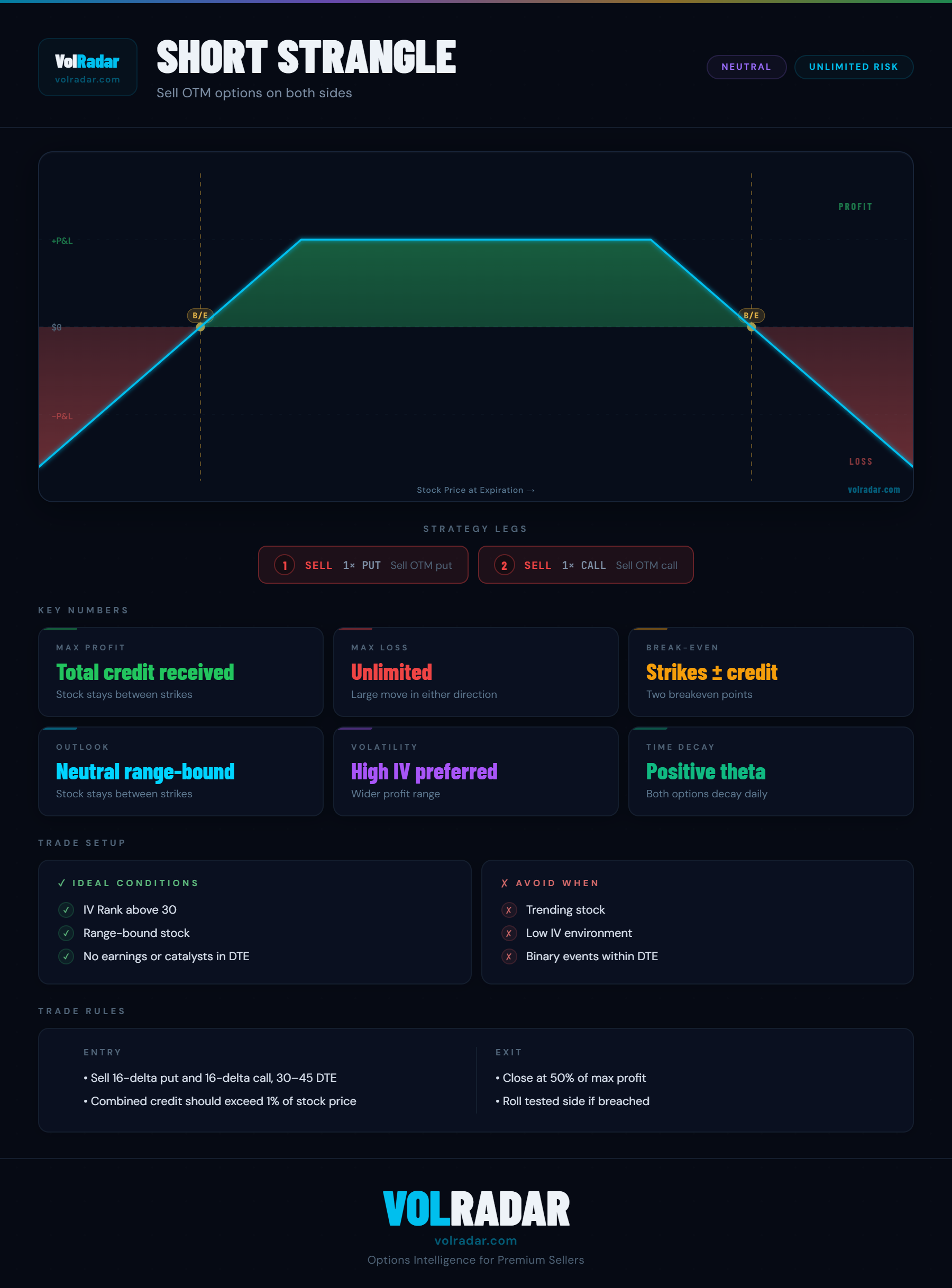
Read the guide→A short strangle is an options strategy, typically used with a neutral outlook, that sells an out-of-the-money call and an out-of-the-money put on the same underlying and expiration, with the call strike above the put strike. The maximum profit is the total premium received; losses begin beyond the breakevens (call strike plus, and put strike minus, the total premium): above the upper breakeven the loss has no upper limit, and below the lower breakeven it can be substantial.
The position
Direction
Neutral
- Max profit
- Total credit received
- Max loss
- Theoretically unlimited
- Risk type
- Undefined (naked)
VolRadar Lens
- Profit zone
- Between the two short strikes, widened by the credit
A short strangle keeps the full credit only if the stock ends between the two strikes. Loss is unlimited on the upside and large on the downside, and a rise in implied volatility hurts it.
Visual ReferencePayoff structure and strike placementShowHide
Why It Matters
The short strangle is the undefined-risk version of a range-bound premium sale. Held to expiration, it keeps the full credit if the stock finishes inside the strikes; before then, time decay and a fall in implied volatility help it while a rise in implied volatility can produce a loss even inside the strikes, and the credit is small compared with what a large move can cost. Knowing the two breakevens, and that the upside loss has no cap, is the starting point for comparing it with defined-risk alternatives such as the iron condor.
How It Works
Sell one call with a strike above the current price and one put with a strike below it, same expiration. You receive both premiums. At expiration: maximum profit = total premium, kept if the underlying finishes between the two strikes and both options expire worthless. Upper breakeven = call strike + total premium; lower breakeven = put strike - total premium. Above the upper breakeven the loss grows dollar for dollar with no upper limit; below the lower breakeven it grows until the stock reaches zero. Time decay helps the position, and a rise in implied volatility hurts it; the Options Industry Council describes the trade as a race between volatility and time decay. Both short legs are uncovered, so brokers require margin, and a rise in implied volatility can increase that requirement.
Example
Hypothetical: a stock trades at $100. Sell the $110 call for $1.60 and the $90 put for $1.90, a total credit of $3.50 per share, or $350 for one call and one put on standard 100-share contracts. Breakevens: $110 + $3.50 = $113.50 and $90 - $3.50 = $86.50. If the stock ends anywhere from $90 to $110, you keep $350. At $120, the call is worth $10 and the result is ($3.50 - $10) x 100 = -$650. At $80, the put is worth $10 and the result is also -$650. If the stock went to zero, the loss would be ($90 - $3.50) x 100 = $8,650.
Common Mistakes
Treating the credit as the risk; the credit is the most you can make, and the loss is set by how far the stock moves beyond a breakeven. Measuring the profit zone between the strikes instead of between the breakevens. Ignoring implied volatility; a volatility spike can produce a loss and a larger margin requirement before the stock reaches either strike. Holding through scheduled events without accounting for the gap risk on both sides.
Comparison
Short strangle vs short straddle: a straddle sells the call and the put at the same strike, usually at the money; a strangle sells them at two out-of-the-money strikes. With the same expiration, the straddle's options are closer to the money, so it collects more premium but has a narrower range between breakevens. Short strangle vs iron condor: an iron condor is a short strangle plus a long call above and a long put below; the extra options cost part of the credit but cap the loss at the width of the wider wing minus the net credit.
Is the market paying premium sellers today?
The SPY Premium Window study tracks when systematic option selling has historically been compensated — recomputed daily from market close. Free to read, no account needed.
Frequently Asked Questions
What is a short strangle?
Selling an out-of-the-money call and an out-of-the-money put with the same expiration, for a combined credit. Held to expiration, it keeps the full credit if the underlying finishes between the strikes; before then, time decay helps it, but a rise in implied volatility can show a loss even while the price is between the strikes.
What is the maximum profit and loss of a short strangle?
Maximum profit is the total premium received, kept if the stock finishes between the strikes. Losses begin beyond the breakevens: above the upper breakeven the loss has no upper limit, and below the lower breakeven it can be very large, reaching the put strike minus the total premium if the stock goes to zero.
How do you calculate short strangle breakevens?
Upper breakeven = call strike + total premium; lower breakeven = put strike - total premium. Selling a $110 call and a $90 put for $3.50 total gives $113.50 and $86.50.
How does implied volatility affect a short strangle?
A rise in implied volatility, all else equal, hurts the position and can increase the margin required. The passage of time, all else equal, helps it.
How is a short strangle different from an iron condor?
An iron condor adds a long call above the short call and a long put below the short put. That lowers the net credit but caps the maximum loss; a short strangle has no such cap.
General references
General references for this topic area, not citations for the specific figures above. VolRadar is not affiliated with these organizations.
The information about Short Strangle above is for educational purposes only and is not financial advice. Read our full investment disclaimer.
Understand options faster.
One term, one worked example, one real ticker. Every Sunday. No jargon.
One email per week, no drip campaigns · Unsubscribe anytime