Loading...
Strategies
Long Straddle — Options Strategy Explained
A long straddle buys a call and a put at the same strike and expiration, aiming to profit from a large move either way; the most it can lose is the premium paid.
By Aigars PilmanisLast updated
Educational content. Not financial, investment, tax, or legal advice. Options involve risk and are not suitable for all investors. How we write & review this glossary.
Read the full guide
Long Straddle — Profit from Big Moves in Either Direction
A long straddle buys both an ATM call and ATM put — premium up front, payoff on any large move either way. Breakevens, the time-decay catch, and when to trade them around catalysts.
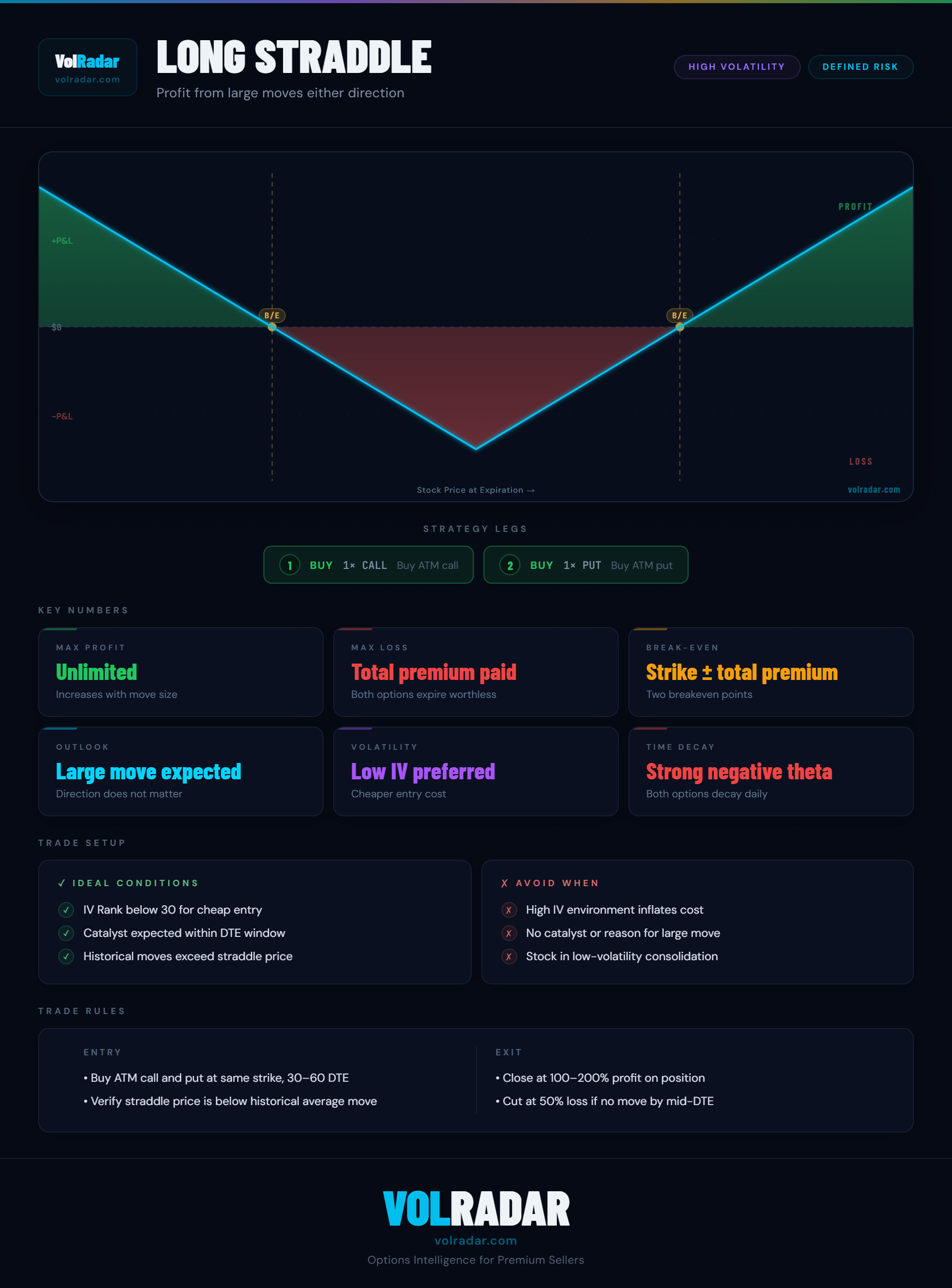
Read the guide→A long straddle buys a call and a put at the same strike price and expiration, creating a position that profits when the underlying makes a large move in either direction. Total cost is the combined premium of both legs, which is also the maximum loss if both options expire worthless. A rise in implied volatility can also lift the value of both legs before expiration.
The position
Direction
Volatility-long
- Drives outcome
- A move in either direction larger than the total premium.
- Max profit
- Unlimited on upside; downside limited as price cannot fall below zero.
- Risk type
- Defined (debit paid)
VolRadar Lens
- Breakeven
- Strike ± total debit
The two premiums set the hurdle: held to expiration, the underlying has to finish beyond the strike by more than their combined cost, so held to expiration it pays off only if the actual move is bigger than the price paid for the two options.
Visual ReferencePayoff structure and strike placementShowHide
Why It Matters
Premium sellers sit on the other side of long straddles. Understanding this structure shows what your short straddle counterparties are exposed to. Held to expiration, a straddle buyer needs the underlying to move more than the combined premium; a straddle seller profits when the move falls short of it. Knowing how long straddle buyers think helps you judge what a short premium position is being paid to absorb.
How It Works
Buy one at-the-money call and one at-the-money put with the same strike and expiration. Illustrative numbers: with the underlying at $530, you buy the $530 call for $7.50 and the $530 put for $7.00. Total cost: $14.50 per share ($1,450 for one straddle at the standard 100 multiplier). Break-evens at expiration: $544.50 upside, $515.50 downside, so the underlying must move more than $14.50, about 2.74% of $530, in either direction to break even. Time works against you: both legs lose time value as expiration approaches, and the decay tends to accelerate near the end. Gamma works for you: rapid underlying moves shift delta quickly toward the winning leg. A rise in implied volatility raises both legs; a fall lowers both, which is why a move after a scheduled event can still leave the position short of a profit.
Example
Hypothetical example. Stock XYZ trades at $86 ahead of an earnings report. You buy one $86 call at $4.30 and one $86 put at $4.10, a total debit of $8.40 per share, or $8.40 x 100 = $840 (contract multiplier 100 for standard US equity options). Break-evens at expiration: $86 + $8.40 = $94.40 and $86 - $8.40 = $77.60. XYZ reports and gaps to $97 the next session; assume the call is then quoted at $11.50 and the put at $0.30, total $11.80. Closing both legs gives ($11.80 - $8.40) x 100 = $340 before fees, about 40% of the $840 paid. Had XYZ instead finished at $88 at expiration, the call would be worth $2.00 and the put zero: ($2.00 - $8.40) x 100 = a $640 loss. The option prices after the move are assumed for illustration, not model output.
Common Mistakes
Overlooking that elevated implied volatility raises the cost of a straddle and widens the move needed to break even. If the stock's move after the event is too small to offset the fall in implied volatility, the straddle can end near break-even or at a loss. Holding too long is a second risk: time decay tends to accelerate in the final weeks, and every day without a move costs both legs. A third is overlooking that the combined premium already sets the size of move needed just to break even.
Is the market paying premium sellers today?
The SPY Premium Window study tracks when systematic option selling has historically been compensated — recomputed daily from market close. Free to read, no account needed.
Frequently Asked Questions
When does a long straddle structurally make sense?
A long straddle fits a view that the underlying will make a sharp move in either direction, or that implied volatility will rise, during the life of the options, for example ahead of a court ruling or another event whose outcome could be very good or very bad news for the stock. The position is long gamma and long vega but has negative theta, so time decay erodes it every day the stock does not move.
How much does the underlying need to move to break even?
At expiration the break-even points sit at strike + total premium (upside) and strike - total premium (downside). A long straddle bought for $8.40 with a $200 strike breaks even at $208.40 and $191.60 at expiration. Before expiration the position can show a profit on a smaller move, or even with no move, if implied volatility rises; it can also show a loss after a move if implied volatility falls.
Why is timing entry so important for long straddles?
Both legs are long options, so the position gains when implied volatility rises and loses when it falls, all else equal. Buying when implied volatility is already high raises the cost and the break-even distance, and a drop in implied volatility after the event can offset part or all of the gain from the move. Held to expiration, the actual move has to exceed the combined premium, which is the hurdle that option prices set.
What is the difference between a long straddle and a long strangle?
A long straddle uses the same strike for the call and the put, usually at the money. A long strangle buys a call with a higher strike and a put with a lower strike, both usually out of the money. Strangles generally cost less but need a larger move to reach break-even; straddles cost more but break even on a smaller move.
What happens to a long straddle at expiration?
At expiration the out-of-the-money leg expires worthless and the in-the-money leg may be exercised automatically if it is in the money by the minimum amount the exercise rules set, which would leave you with a long or short stock position. Many traders close or adjust a straddle before expiration to keep any remaining time value and avoid an unplanned stock position.
General references
General references for this topic area, not citations for the specific figures above. VolRadar is not affiliated with these organizations.
The information about Long Straddle above is for educational purposes only and is not financial advice. Read our full investment disclaimer.
Understand options faster.
One term, one worked example, one real ticker. Every Sunday. No jargon.
One email per week, no drip campaigns · Unsubscribe anytime