
What is a long straddle?
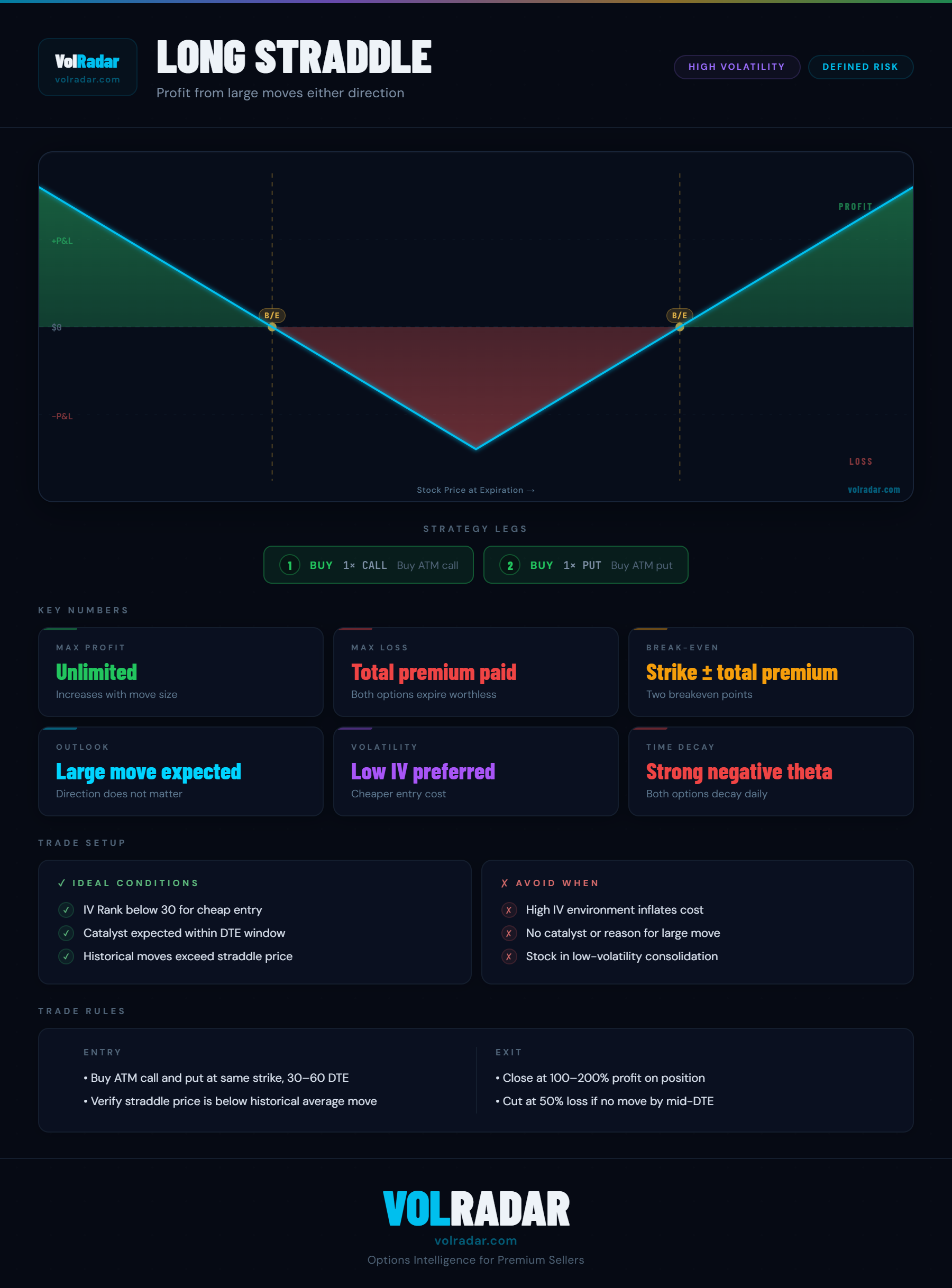
A long straddle buys 1 at-the-money call and 1 at-the-money put at the same strike and expiration. You pay a net debit equal to both premiums combined. If the stock makes a large move in either direction, one of the options gains value faster than the other loses. Breakeven is the strike plus total premium (upside) or strike minus total premium (downside). Max loss is the full premium paid if the stock stays flat.
When to buy a long straddle
Long straddles are most effective when IV is low (cheap options) and a catalyst is coming that could cause a large move — earnings, FDA decisions, FOMC meetings, or major product announcements. The straddle price directly represents the market's expected move for the stock: if the straddle is priced at $5 on a $100 stock, the market expects a ±5% move by expiration. If you expect a move larger than that, the straddle is cheap.
Straddle price as expected move indicator
The ATM straddle price is one of the most useful expected move proxies available. Before earnings, the straddle price represents the market's implied move for the event. If you believe the realized move will exceed the straddle price, you have a positive expected value trade. Use VolRadar's Expected Move Calculator to compare the options-implied expected move against the historical realized move distribution for the same stock.
Managing a long straddle
Time decay (theta) works against long straddles daily — the position loses value in stagnant markets. Close the profitable side when the stock moves significantly and the winning option has appreciated substantially. Many traders close the entire straddle at 100–200% profit on the position rather than waiting for more. Set a time-based stop: if the stock has not moved within the first 50% of the DTE, close the position to limit theta losses.