Loading...
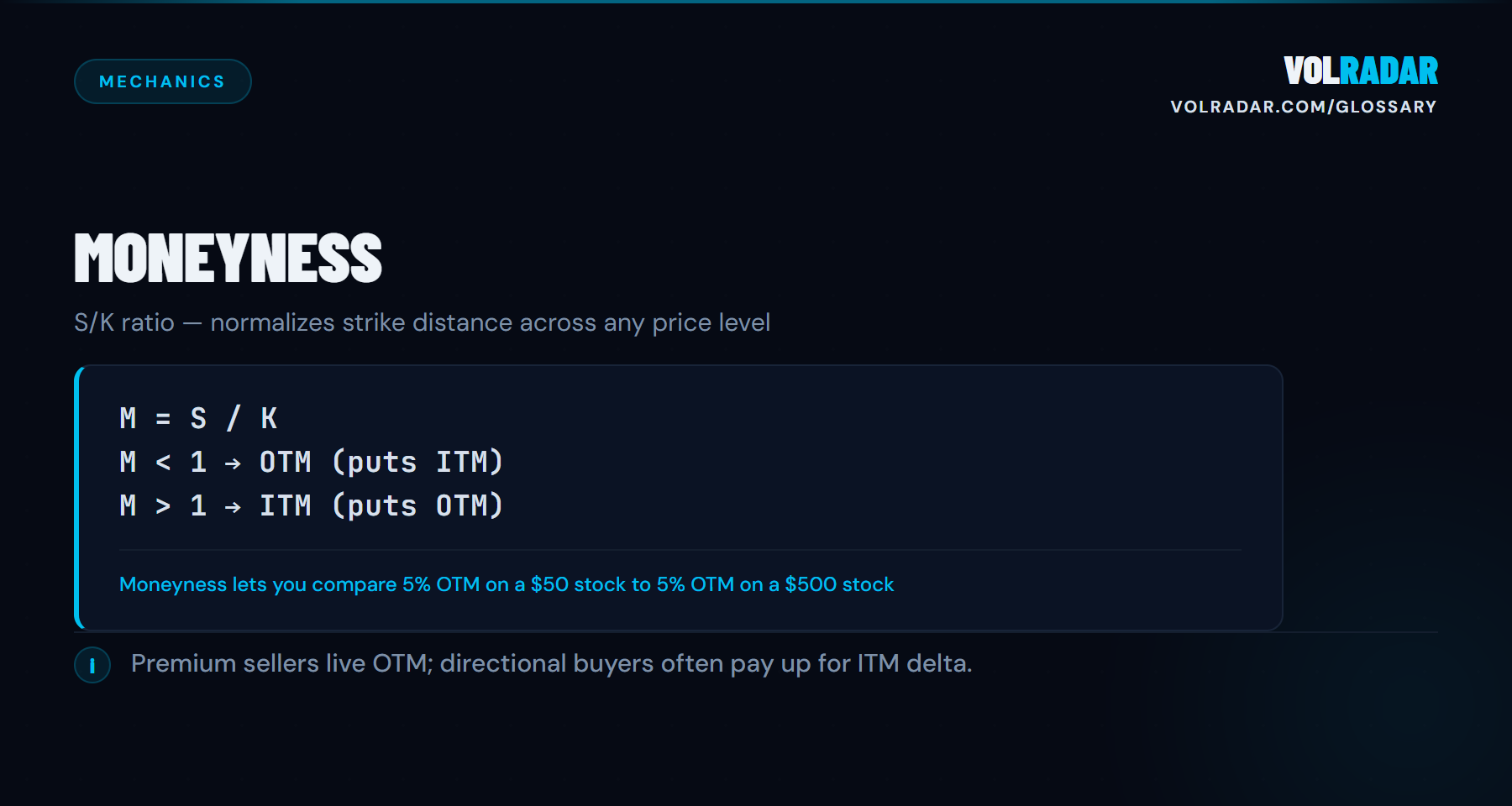
The ratio of spot price to strike price (S/K), normalizing how far a strike sits from the current price regardless of the stock's absolute level. Moneyness below 1.0 means a call is OTM; above 1.0 means ITM. Reversed for puts.
⚡
Key takeaway5% OTM on a $50 stock and 5% OTM on a $500 stock look identical through the moneyness lens. Use it to compare strikes across different underlyings.
💡 Why It Matters
Moneyness normalizes strike distance across any stock price. Comparing '5% OTM' is meaningful whether the stock is $50 or $500. Without moneyness, you can't compare option positions across different underlyings or evaluate your portfolio's overall strike positioning.
⚙ How It Works
Moneyness = S/K for calls (K/S for puts, in some conventions). Values below 1.0 are OTM (call) or ITM (put). Values above 1.0 are ITM (call) or OTM (put). A moneyness of 0.95 means the strike is 5% above the current price for a call — '5% OTM' regardless of the stock's absolute price.
📋 Example
You sell a 0.95 moneyness put on both AAPL ($200, strike $190) and MSFT ($400, strike $380). Both are 5% OTM, both have similar delta and probability profiles. Without moneyness, comparing '$10 OTM on AAPL' to '$20 OTM on MSFT' obscures the fact that the positions are equivalent.
⚠ Common Mistakes
Using dollar distance from ATM instead of percentage. '$10 OTM' means completely different things on a $50 stock (20% cushion) versus a $500 stock (2% cushion). Always think in moneyness or percentage terms.
❓ FAQ
What is Moneyness?
The ratio of spot price to strike price (S/K), normalizing how far a strike sits from the current price regardless of the stock's absolute level. Moneyness below 1.0 means a call is OTM; above 1.0 means ITM. Reversed for puts.
Why does Moneyness matter for premium sellers?
5% OTM on a $50 stock and 5% OTM on a $500 stock look identical through the moneyness lens. Use it to compare strikes across different underlyings.
How does Moneyness work?
Moneyness = S/K for calls (K/S for puts, in some conventions). Values below 1.0 are OTM (call) or ITM (put). Values above 1.0 are ITM (call) or OTM (put). A moneyness of 0.95 means the strike is 5% above the current price for a call — '5% OTM' regardless of the stock's absolute price.
What are common mistakes with Moneyness?
Using dollar distance from ATM instead of percentage. '$10 OTM' means completely different things on a $50 stock (20% cushion) versus a $500 stock (2% cushion). Always think in moneyness or percentage terms.
Related Terms
60/40 Tax Treatment
The favorable tax split for Section 1256 contracts: 60% of gains are taxed at the long-term capital gains rate and 40% at the short-term rate, regardless of ...
Adjusted Option
An option whose terms have been modified due to a corporate action — stock split, special dividend, merger, or spinoff.
All-or-None Order
An order that must fill completely or not at all, but unlike FOK, it can wait in the book for a complete fill rather than canceling immediately.
American-Style Option
An option that can be exercised by its holder at any time from listing until expiration.
This is not financial advice. Read our full investment disclaimer.