Loading...
Mechanics
American-Style Option — Options Order Mechanics Explained
An American-style option can be exercised by its holder on any business day up to expiration.
By Aigars PilmanisLast updated
Educational content. Not financial, investment, tax, or legal advice. Options involve risk and are not suitable for all investors. How we write & review this glossary.
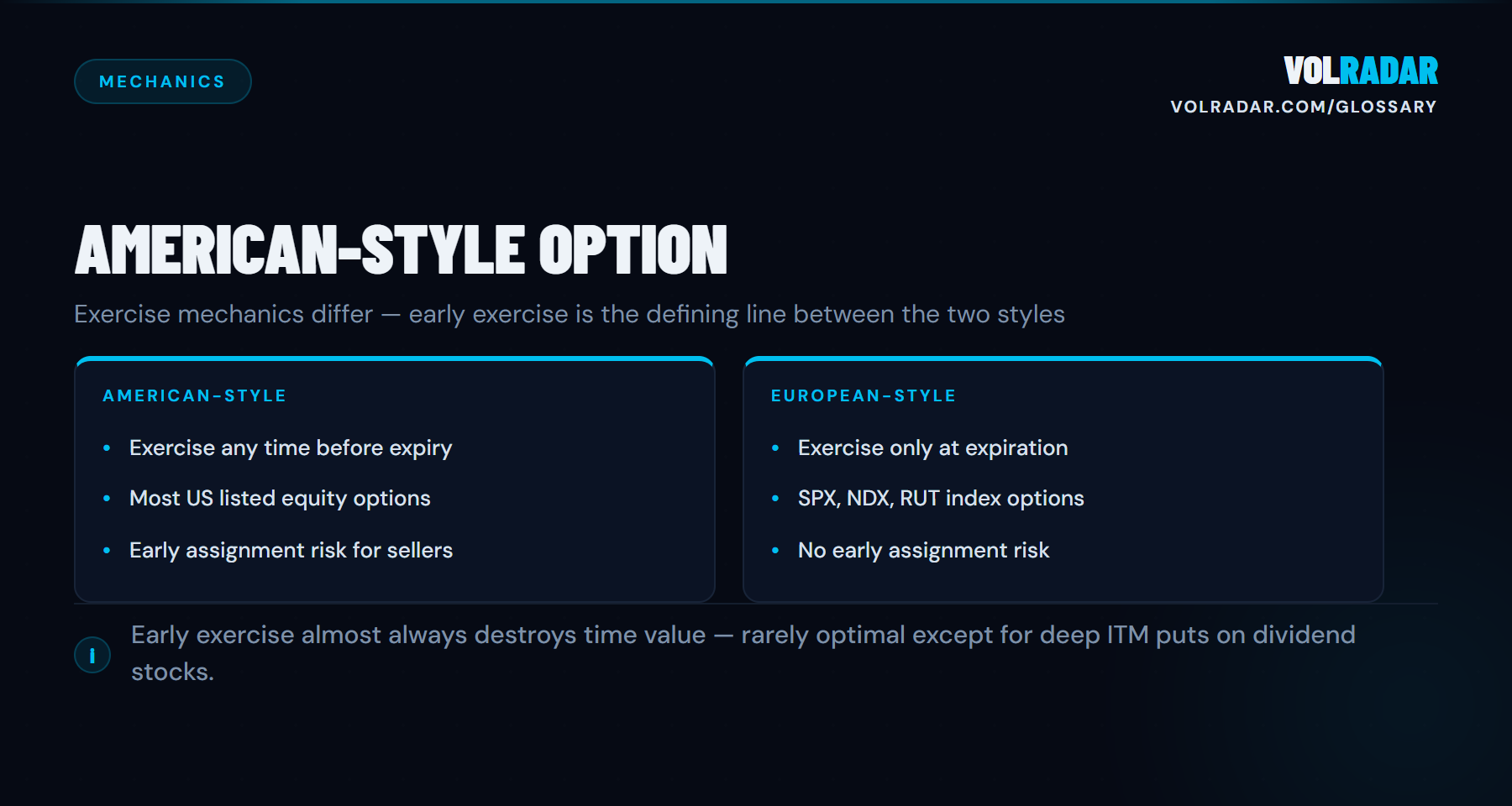
An American-style option is an option that the holder can exercise on any business day up to its expiration, not only at expiration. All standardized US equity options, including options on ETFs, use American-style exercise, so the writer of one of these options can be assigned before expiration.
Video explainer7:10
Watch: American-Style Option Explained
7:10 walkthrough — definition, mechanics, worked example, and common mistakes for American-Style Option.
What to remember from this video
American-style options can be exercised at any time, posing early assignment risk that can unexpectedly alter a trader's portfolio overnight.
Key Insights From The Video
- American-style options allow exercise any time before expiration, unlike European options.
- Early assignment risk can rise for in-the-money options with little extrinsic value, including short calls just before ex-dividend dates.
- Assignment settles T+1, impacting your portfolio the next business day.
- A dividend larger than a call's extrinsic value can make early exercise more likely.
- Most US equity and ETF options are American-style, carrying early assignment risk.
Read the complete video explanation~315 words · 2 min read
American-style options are contracts that can be exercised by the holder at any time from purchase through expiration. This feature creates a significant risk for sellers, known as early assignment risk. Sellers must manage this risk actively, as it can lead to unexpected changes in their portfolio positions overnight.
The risk of early assignment can be higher for deep in-the-money (ITM) options with little extrinsic value, and short calls can be exposed just before an ex-dividend date. For instance, if a call is in the money and the dividend exceeds its extrinsic value, the holder may have a financial incentive to exercise early to capture the dividend, though interest rates, taxes, and exercise costs also matter.
When an option is exercised early, the holder submits an exercise notice to their broker, which is then sent to the Options Clearing Corporation (OCC). The OCC assigns the exercise to a clearing member, which then allocates it to a customer with a short position, who must fulfill the obligation. This assignment settles on a T+1 basis, meaning the resulting stock position appears in the seller's account the next business day.
Understanding the difference between American and European-style options is crucial. While American options allow for early exercise, European options can only be exercised at expiration. This distinction affects risk assessments and strategy planning. For example, a short put on SPY (American-style) carries assignment risk, while the same strike on SPX (European-style) does not.
Traders must be vigilant about the exercise style of the options they trade, especially when dealing with US equity and ETF options, which are predominantly American-style. Monitoring ex-dividend dates and extrinsic values is essential to avoid surprise assignments.
In summary, early assignment poses a real risk that can lead to severe financial consequences if not properly managed. Traders should ensure they understand the mechanics and risks associated with American-style options to protect their portfolios effectively.
VolRadar Lens
- Definition
- An option contract that can be exercised by the holder at any time from purchase through expiration.
- Use
- All standard US equity and ETF options are American-style, so early assignment is a real consideration for anyone short premium.
The exercise decision belongs to the holder, so early assignment is something a writer can anticipate but not control; it becomes more likely when an option's remaining time value is small, especially just before an ex-dividend date.
Why It Matters
Every standardized equity option traded on US exchanges is American-style, so the possibility of early assignment is part of every short stock or ETF option position. It matters most for short calls ahead of ex-dividend dates and for deep in-the-money options with little time value left. Because the early-exercise right can only add value, an American-style option is worth at least as much as an otherwise identical European-style option. VolRadar's covered-call screener checks whether an estimated ex-dividend date falls before a candidate call's expiration.
How It Works
The holder tells the broker to exercise; the exercise notice goes to the Options Clearing Corporation (OCC), which randomly assigns it to a clearing member with a short position in that series, and the clearing member assigns one of its customers either randomly or first-in, first-out. A stock option assignment turns into a stock trade at the strike price that settles on the normal stock settlement cycle. Exercising early gives up the option's time value (the premium above its intrinsic value), which is why holders usually sell an option rather than exercise it. The main exception is a call just before an ex-dividend date: a call holder who exercises before the ex-date is entitled to the dividend, while a call that is kept loses value as the stock price drops by about the dividend, so exercising can be worth more than continuing to hold the call when the dividend is larger than the remaining time value. A call that can be sold for more than its intrinsic value is still worth more sold than exercised.
Example
Hypothetical: a stock trades at $52 and goes ex-dividend tomorrow with a $0.40 dividend. A $50 call trades at $2.15: intrinsic value $52 - $50 = $2.00, time value $0.15. Exercising today buys the stock at $50; on the ex-date the holder has shares worth about $51.60 plus the $0.40 dividend, $2.00 of value per share. Holding the call instead: if the stock opens about $0.40 lower at $51.60 and the call keeps $0.15 of time value, it is worth about $1.60 + $0.15 = $1.75. Exercise beats holding by about $2.00 - $1.75 = $0.25 per share, or $25 per contract, before financing and costs. Selling the call today at $2.15 would capture $0.15 more than exercising, because the $52 stock price already includes the dividend. So the exercise case is for a holder who wants to own the stock through the ex-date: for that holder, exercising beats holding the call, and any holder who exercises today leaves some writer of that call assigned. An assigned call writer has to deliver the shares and is responsible for the dividend.
Common Mistakes
Planning a short equity-option position as if it could only be assigned at expiration. Assuming a deep in-the-money call will not be exercised before a dividend because expiration is weeks away. Treating SPY and SPX as interchangeable: SPY options are American-style equity options settled in shares, while standard SPX options are European-style and cash-settled. Assuming assignment is spread evenly across writers: OCC assigns randomly to clearing members, and each broker uses its own random or first-in, first-out method.
Frequently Asked Questions
What is an American-style option in simple terms?
It is an option the holder may exercise on any business day up to expiration. A European-style option can be exercised only at expiration. All standardized US equity options are American-style; most, but not all, index options are European-style.
Why do American options carry early assignment risk?
Because the holder can exercise at any time, the writer can be assigned before expiration without advance notice. A call holder becomes entitled to the dividend by exercising before the ex-dividend date, so the chance of early assignment on in-the-money calls rises as the ex-date approaches.
Are American options worth more than European options?
They are worth at least as much, because the right to exercise early can only add value. The difference is often small, since exercising early usually means giving up time value; it matters most for in-the-money calls before dividends and deep in-the-money puts.
When is early exercise worth it for the holder?
Exercising forfeits the option's time value, so when an option can be sold for more than its intrinsic value, selling usually captures more. For a call, exercising just before an ex-dividend date can be worth more than continuing to hold it when the dividend is larger than the remaining time value, before financing and transaction costs.
Which contracts trade American versus European style?
Standardized US equity options, including ETF options such as SPY, QQQ and IWM, are American-style and settle in shares. Most index options, such as standard SPX options, are European-style and cash-settled, but some index options are American-style, so the contract specifications decide.
General references
General references for this topic area, not citations for the specific figures above. VolRadar is not affiliated with these organizations.
Visual ReferenceVisual reference for American-Style OptionShowHide
The information about American-Style Option above is for educational purposes only and is not financial advice. Read our full investment disclaimer.
Understand options faster.
One term, one worked example, one real ticker. Every Sunday. No jargon.
One email per week, no drip campaigns · Unsubscribe anytime