Loading...
Strategies
Diagonal Spread — Options Strategy Explained
A diagonal spread buys and sells two options of the same type on the same underlying with different strike prices and different expiration dates.
By Aigars PilmanisLast updated
Educational content. Not financial, investment, tax, or legal advice. Options involve risk and are not suitable for all investors. How we write & review this glossary.
Read the full guide
Diagonal Spread — Time Decay Plus Directional Flexibility
A diagonal spread sells a short-term option and buys a longer-term option at a different strike — pulling features from both calendar and vertical spreads. When to use it, and the poor-man's covered call variant.
Read the guide→A diagonal spread is an options position that buys one option and sells another of the same type (both calls or both puts) on the same underlying, with different strike prices and different expiration dates. It combines the strike difference of a vertical spread with the expiration difference of a calendar spread. In the common long form, the longer-dated option is bought and the shorter-dated option is sold, for a net debit.
The position
Structure
Different strikes + different expirations
- Direction
- Directional with theta tilt
VolRadar Lens
- Use
- Fine-tune delta and decay
Because the two options expire on different dates, a diagonal has no fixed payoff at expiration: once the short option is gone, what is left is a long option whose value still moves with the stock and with implied volatility.
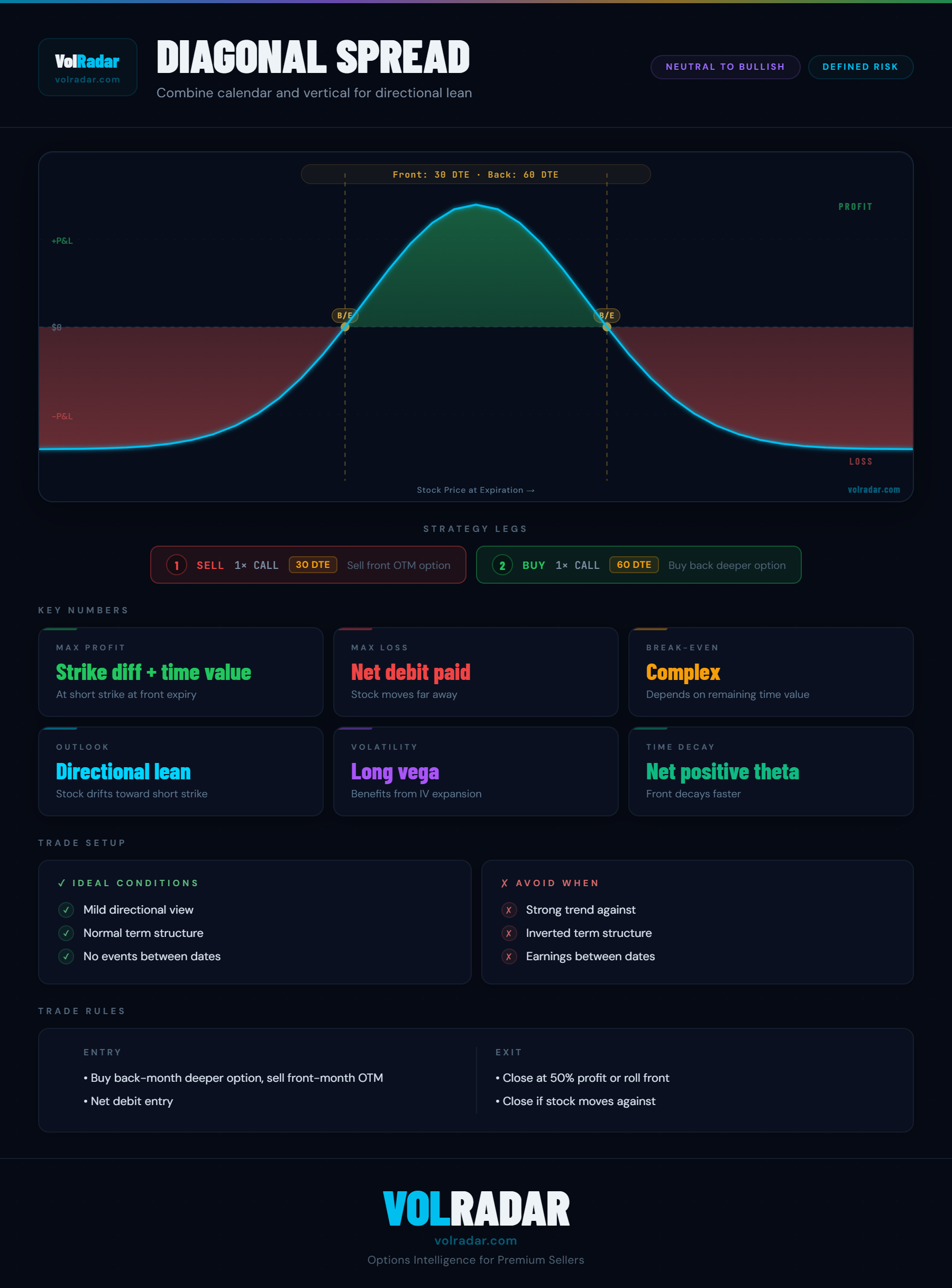
Visual ReferencePayoff structure and strike placementShowHide
Why It Matters
A diagonal sits between two simpler spreads. A vertical spread puts both options on one expiration, so its payoff at expiration is known; a calendar spread uses one strike and is mainly a position on time decay and implied volatility. A diagonal adds a directional tilt through the strike difference while still relying on the short-dated option losing value faster than the long one. A long call diagonal that buys a deep in-the-money, long-dated call and sells shorter-dated out-of-the-money calls against it is often called a poor man's covered call or fig leaf, because the long call stands in for the shares of a covered call.
How It Works
In a long call diagonal, a trader buys a call with a later expiration and sells a call with an earlier expiration, often at a higher strike; a long put diagonal does the same with puts, often selling the lower strike. The short option generally loses time value faster than the long one, especially when its strike is near the stock price, and when it expires or is closed another short-dated option can be sold against the same long option. At the short option's expiration, the best outcome is generally a stock price at the short strike: the short option expires worthless while the long option keeps as much value as possible. Because the long option still has time left at that point, profit and breakeven depend on its remaining value, and so on implied volatility, and are estimated with a pricing model rather than a fixed formula. When the long call's strike is at or below the short call's strike, the most the position can lose is the net debit, because at the short expiration the long call is worth at least the short call's intrinsic value; with the strikes reversed, the loss can exceed the debit. Dollar figures are per-share amounts times the contract multiplier (100 for standard US equity options).
Example
Hypothetical: a stock trades at $100. A trader buys a six-month $95 call for $10.00 and sells a one-month $105 call for $1.50, for a net debit of $10.00 - $1.50 = $8.50 per share, or $850 per contract with a 100 multiplier; because the long strike is below the short strike, $850 is the most the position can lose. If the stock is at $104 when the short call expires, the short call expires worthless and the long call is worth at least its $9.00 intrinsic value plus its remaining time value, against the $8.50 paid. If the stock is at $110, the short call costs $5.00 to settle but the long call is worth at least $15.00, leaving at least $10.00 against the $8.50 paid. If the stock falls to $90, the short call expires worthless, but the long call is out of the money and worth only its remaining time value; if the stock is still at or below $95 when the long call expires, the whole $850 is lost.
Common Mistakes
Treating the maximum loss as always equal to the debit: that holds for a long call diagonal only when the long strike is at or below the short strike (for a put diagonal, at or above). Assuming rising implied volatility always helps: the longer-dated option generally has more vega, so a long diagonal tends to gain when implied volatility rises, but a deep in-the-money long option carries little vega, so against a near-the-money short option the position can even lose when implied volatility rises; the near-term and far-term options can also trade at, and move by, different implied volatilities. Setting the two expirations too close together, which leaves little difference in time decay between the options. Forgetting assignment: an in-the-money short option can be assigned before expiration, and exercising the long option to deliver shares gives up its remaining time value. Planning only the short leg: the long option also expires, and the strategy has to be closed or rolled before then.
Is the market paying premium sellers today?
The SPY Premium Window study tracks when systematic option selling has historically been compensated — recomputed daily from market close. Free to read, no account needed.
Frequently Asked Questions
What is a diagonal spread in options trading?
A diagonal spread combines two options of the same type, both calls or both puts, at different strikes and different expirations. A long call diagonal typically buys a longer-dated lower-strike call and sells a shorter-dated higher-strike call. The structure blends a calendar spread's difference in time decay with a vertical spread's directional bias, and the short leg can be sold again after each expiration while the long leg remains.
How does a diagonal differ from a calendar spread?
A calendar spread uses the same strike for both legs across different expirations. A diagonal uses different strikes and different expirations, which adds directional exposure to the calendar's sensitivity to time decay and implied volatility. In a long call diagonal the short strike acts as a ceiling on gains until the short option expires, while the long leg keeps exposure beyond that date.
What is a poor man's covered call diagonal structure?
A poor man's covered call, also called a fig leaf or leveraged covered call, is a long call diagonal that mimics a covered call without owning 100 shares. The trader buys a deep in-the-money, longer-dated call (often a LEAPS call) as a stand-in for the stock and sells a shorter-dated out-of-the-money call against it. It needs less capital than buying the shares, but the long call can expire worthless and does not receive dividends.
When does a diagonal spread reach maximum profit?
Maximum profit on a long diagonal cannot be fixed in advance, because the long leg keeps value after the short option expires. At the short expiration the best case is generally the stock closing at the short strike: the short option expires worthless while the long option keeps the most value. After that the position is a long option, which can be held, sold, or used to sell another short-dated option.
What IV environment favors a long diagonal spread?
A long diagonal generally gains when implied volatility rises across both expirations after entry, because the longer-dated option usually has more vega than the short one. Selling the near-term option when its implied volatility is high relative to the longer-dated option also helps, since the short leg brings in more premium. The effect can shrink or even reverse when the long option is deep in the money, because such an option carries little vega while a near-the-money short option can carry more.
General references
General references for this topic area, not citations for the specific figures above. VolRadar is not affiliated with these organizations.
The information about Diagonal Spread above is for educational purposes only and is not financial advice. Read our full investment disclaimer.
Understand options faster.
One term, one worked example, one real ticker. Every Sunday. No jargon.
One email per week, no drip campaigns · Unsubscribe anytime