Loading...
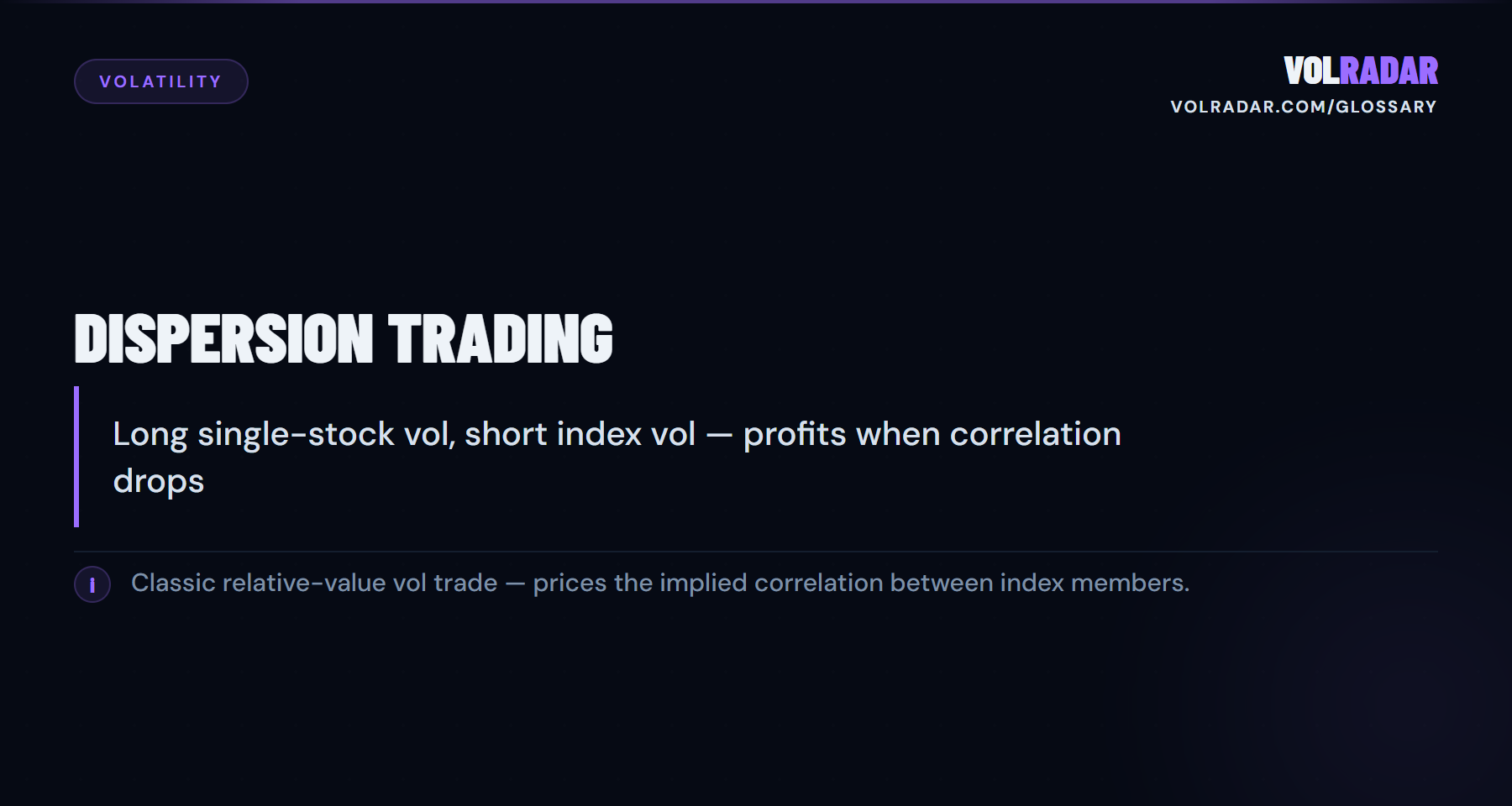
Dispersion trading exploits the persistent premium of index implied volatility over the weighted average of its component implied volatilities. The classic trade sells index straddles and buys component straddles, profiting from the correlation risk premium.
⚡
Key takeawayIndex IV typically trades 3-5 vol points above realized component-weighted IV. Premium sellers can capture this edge by selling SPX strangles rather than individual stock strangles, benefiting from the diversification discount embedded in index options.
💡 Why It Matters
Dispersion trading reveals a structural edge available to premium sellers: index options are persistently overpriced relative to component options because the index embeds a correlation risk premium. Selling index premium captures this edge without single-stock concentration risk.
⚙ How It Works
Index variance equals the weighted sum of component variances plus all pairwise covariance terms. The market prices in higher correlation than typically realized, making index IV higher than the weighted average of component IVs. Dispersion traders sell index vol and buy component vol to capture this spread.
📋 Example
SPX 30-day IV is 18%. The cap-weighted average of S&P 500 component IVs is 25%. Implied correlation is 0.52 versus realized correlation of 0.38. The dispersion trader sells $100K vega of SPX straddles and buys $100K vega across 50 liquid components. The correlation compression from 0.52 to 0.38 realized produces a profit.
⚠ Common Mistakes
Traders attempt dispersion with too few components, concentrating risk in specific names. A proper dispersion trade requires 30-50 components to approximate the index. Using only 5-10 stocks creates single-stock event risk that can overwhelm the correlation premium.
❓ FAQ
What is Dispersion Trading?
Dispersion trading exploits the persistent premium of index implied volatility over the weighted average of its component implied volatilities. The classic trade sells index straddles and buys component straddles, profiting from the correlation risk premium.
Why does Dispersion Trading matter for premium sellers?
Index IV typically trades 3-5 vol points above realized component-weighted IV. Premium sellers can capture this edge by selling SPX strangles rather than individual stock strangles, benefiting from the diversification discount embedded in index options.
How does Dispersion Trading work?
Index variance equals the weighted sum of component variances plus all pairwise covariance terms. The market prices in higher correlation than typically realized, making index IV higher than the weighted average of component IVs. Dispersion traders sell index vol and buy component vol to capture this spread.
What are common mistakes with Dispersion Trading?
Traders attempt dispersion with too few components, concentrating risk in specific names. A proper dispersion trade requires 30-50 components to approximate the index. Using only 5-10 stocks creates single-stock event risk that can overwhelm the correlation premium.
Related Terms
Close-to-Close Volatility
A basic volatility estimator using only daily closing prices.
Corridor Variance Swap
A corridor variance swap pays realized variance only when the underlying trades within a specified price range (corridor).
CPI Print
The CPI print is the monthly Consumer Price Index release by the Bureau of Labor Statistics, typically at 8:30 AM ET.
Earnings Calendar
An earnings calendar lists the scheduled dates and times (before open or after close) when public companies report quarterly financial results.
This is not financial advice. Read our full investment disclaimer.