Loading...
Mechanics
Early Assignment Risk — Options Order Mechanics Explained
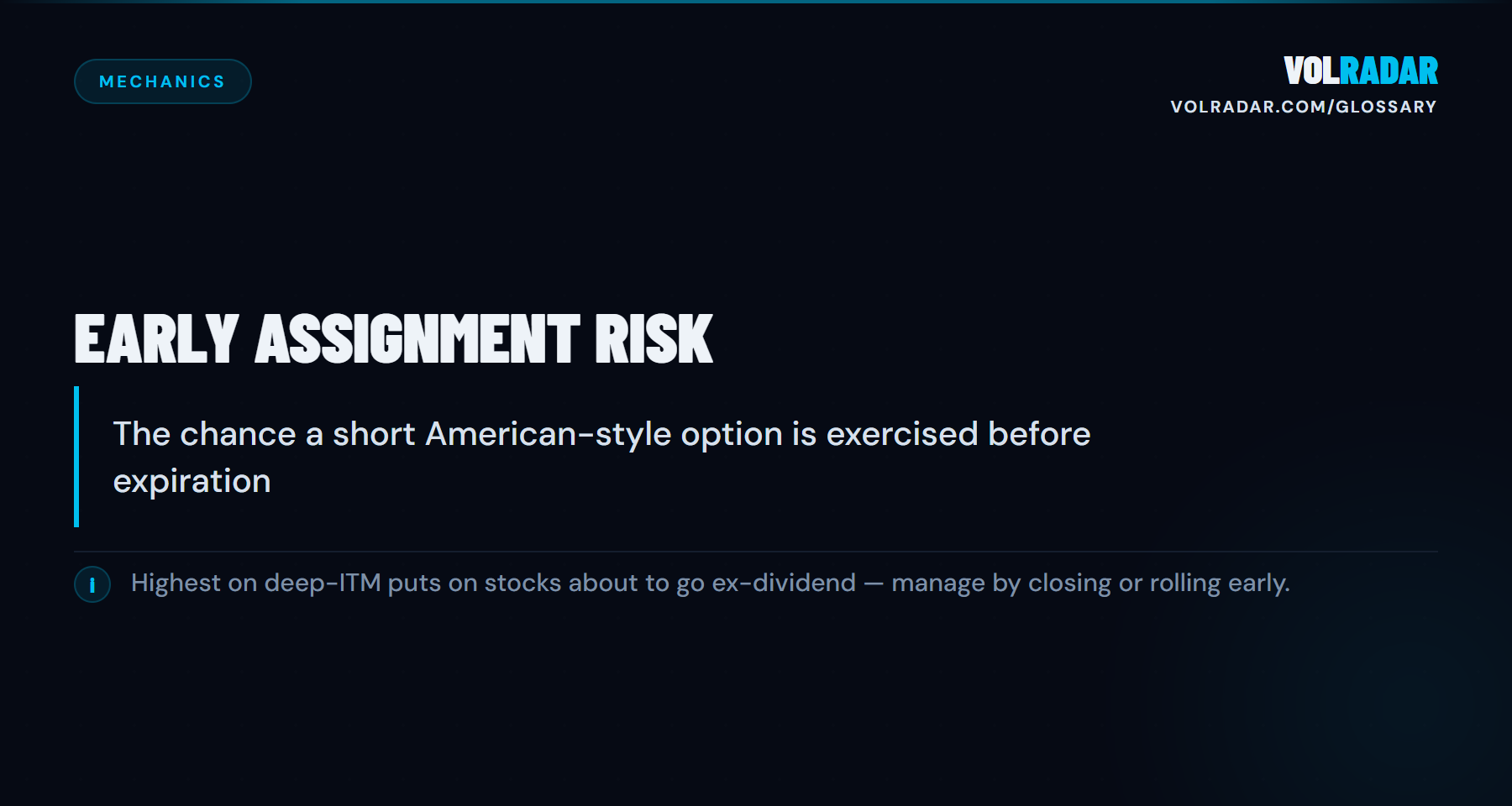
Early assignment risk is the chance that a short American-style option is assigned before its expiration date.
By Aigars PilmanisLast updated
Educational content. Not financial, investment, tax, or legal advice. Options involve risk and are not suitable for all investors. How we write & review this glossary.
Early assignment risk is the possibility that the writer of an American-style option is assigned an exercise notice before the option's expiration date, because a holder of that series chooses to exercise early. Standardized equity options are American-style, so their writers can be assigned on any business day. European-style options, which most (but not all) index options use, can be exercised only at expiration, so they carry no early assignment risk. Early exercise is most often seen on calls well in the money shortly before an ex-dividend date and on deep in-the-money puts.
Video explainer7:12
Watch: Early Assignment Risk Explained
7:12 walkthrough — definition, mechanics, worked example, and common mistakes for Early Assignment Risk.
What to remember from this video
Early assignment risk is like waking up to a surprise stock position due to short options being exercised before expiration, often triggered by dividends or deep ITM status.
Key Insights From The Video
- Early assignment transforms options into stock positions without warning.
- American-style options can be exercised anytime before expiration.
- Assignment becomes more likely as extrinsic value approaches zero, especially around dividends.
- Ex-dividend dates often trigger early assignment for short calls.
- The OCC allocates assignments to clearing members using its assignment procedures (typically with a random starting point, though some classes use pro-rata), and your broker then allocates by its own approved method.
Read the complete video explanation~370 words · 2 min read
Early assignment risk occurs when a short option position is exercised before its expiration date, transforming your options position into a stock position unexpectedly. This is most common with deep in-the-money (ITM) short calls near ex-dividend dates and deep ITM short puts near expiration. The surprise of seeing negative shares and a large margin requirement can be unsettling; the consequences depend on the account and the rest of the position.
American-style options can be exercised at any time before expiration, unlike European-style options, which can only be exercised at expiration. Early exercise becomes rational when the option's remaining time value, or extrinsic value, is less than the benefit of exercising, such as capturing a dividend or interest on cash proceeds.
Consider a hypothetical example where you're short a deep in-the-money call with a $180 strike, with the stock trading at $210 and a $0.95 dividend imminent. If the extrinsic value of your short call is only $0.40, the call holder might exercise early to capture the dividend, leaving you short 100 shares at $180. If this was part of a spread, your long call still exists alongside the unexpected stock position.
The Options Clearing Corporation allocates assignments among clearing members using its assignment procedures (typically with a random starting point, though some classes use pro-rata), and the broker then allocates to customer short positions using an approved method. Settlement occurs at the strike price, not the current market price, but early assignment can still bring dividend obligations, borrow costs, margin use, tax effects and overnight market exposure. Your gain or loss depends on your original cost basis and the structure of your position.
Common mistakes include ignoring ex-dividend dates when holding short calls and panicking when assigned. After early assignment on a spread, the position consists of the assigned stock plus any remaining long option, and the assignment can still carry margin, borrow, dividend and liquidation consequences depending on the account. Additionally, assuming European-style options carry this risk is incorrect.
As extrinsic value approaches zero, assignment becomes more likely. Closing or rolling short options before ex-dividend dates when extrinsic value is less than the dividend is a commonly cited approach; it is a convention, not a rule with proven results.
VolRadar Lens
- Definition
- The possibility that a short option position gets exercised by the holder before expiration day rather than at expiration.
- Use
- Short calls approaching ex-dividend and deep ITM short puts near expiration are where early assignment concentrates.
Dividends move the risk in opposite directions for calls and puts: OIC notes that assignment risk rises just before the ex-dividend date for short calls and just after it for short puts.
Why It Matters
Early assignment turns an option position into a stock position without notice. A short call can become short stock, with a margin requirement and dividend obligations; a short put can become long stock that has to be paid for. In a spread, assignment on the short leg leaves the long option in place, so the position is temporarily lopsided until the trader exercises or sells the long option or closes the stock. Knowing when early exercise is economically sensible for the holder makes it easier to anticipate.
How It Works
An option holder who exercises early gives up the option's remaining time value, so early exercise mostly happens when little time value is left. For calls, the usual reason is a dividend: a call holder who exercises before the ex-dividend date is entitled to the dividend, and an assigned call writer must deliver the stock plus the dividend. For puts, holders of deep in-the-money puts often exercise early to receive cash for the shares sooner. Assignment then follows two steps: OCC randomly assigns the exercise notice to a clearing member with a short position in that series, and the firm allocates it to one of its customers who is short that series, using a random, first-in-first-out or other fair method. Assignments are based on net positions after the close, so a short option bought back during the day cannot be assigned that night.
Example
Hypothetical: a trader is short one XYZ 90 call while XYZ trades at $100. The call trades at $10.05, so its time value is $10.05 - $10.00 = $0.05. XYZ goes ex-dividend tomorrow with a $0.50 dividend. A holder who exercises today gives up $0.05 x 100 = $5 of time value and becomes entitled to the $0.50 x 100 = $50 dividend, so early exercise is plausible. If the trader is assigned, they must sell 100 shares at $90 and receive $9,000. Without shares in the account, the result is a short position of 100 shares, $1,000 below the $100 market price ((100 - 90) x 100, before the premium originally received), and the obligation to pay the $50 dividend.
Common Mistakes
Ignoring ex-dividend dates on short calls that are in the money. Assuming only the original counterparty can exercise against you: any holder of the same series can, and OCC and the firm allocate the notice. Assuming European-style options can be assigned before expiration: they cannot. Assuming a price level exists that rules assignment in or out: OIC notes that holders may exercise slightly out-of-the-money options or decline to exercise in-the-money ones.
Frequently Asked Questions
Which options carry early assignment risk?
Short American-style options, which include standardized equity and ETF options. Writers of European-style options, the style most (but not all) index options use, can be assigned only at expiration.
Why do dividends raise early assignment risk on short calls?
A call holder who exercises before the ex-dividend date is entitled to the dividend, while the assigned writer must deliver the stock plus the dividend. When the dividend is worth more than the call's remaining time value, exercising before the ex-date can be worth more to the holder than selling the call.
Can I be assigned on a short option I closed today?
No. OIC explains that assignments are determined from net positions after the close and that OCC processes closing purchases before exercises, so a short position bought back during the day's trading hours cannot be assigned that night.
How is the assigned writer chosen?
OCC randomly assigns each exercise notice to a clearing member with a short position in that series. The firm then allocates it to a customer short that series using an exchange-approved method, usually random or first-in-first-out. Brokers can say which method they use.
General references
General references for this topic area, not citations for the specific figures above. VolRadar is not affiliated with these organizations.
Visual ReferenceVisual reference for Early Assignment RiskShowHide
The information about Early Assignment Risk above is for educational purposes only and is not financial advice. Read our full investment disclaimer.
Understand options faster.
One term, one worked example, one real ticker. Every Sunday. No jargon.
One email per week, no drip campaigns · Unsubscribe anytime