Loading...
The statistical property where extreme price moves occur more frequently than a normal distribution predicts. Markets price this through OTM put skew.
⚡
Key takeawayFat tails are why premium sellers occasionally get crushed. Size for survival, not just probability.
💡 Why It Matters
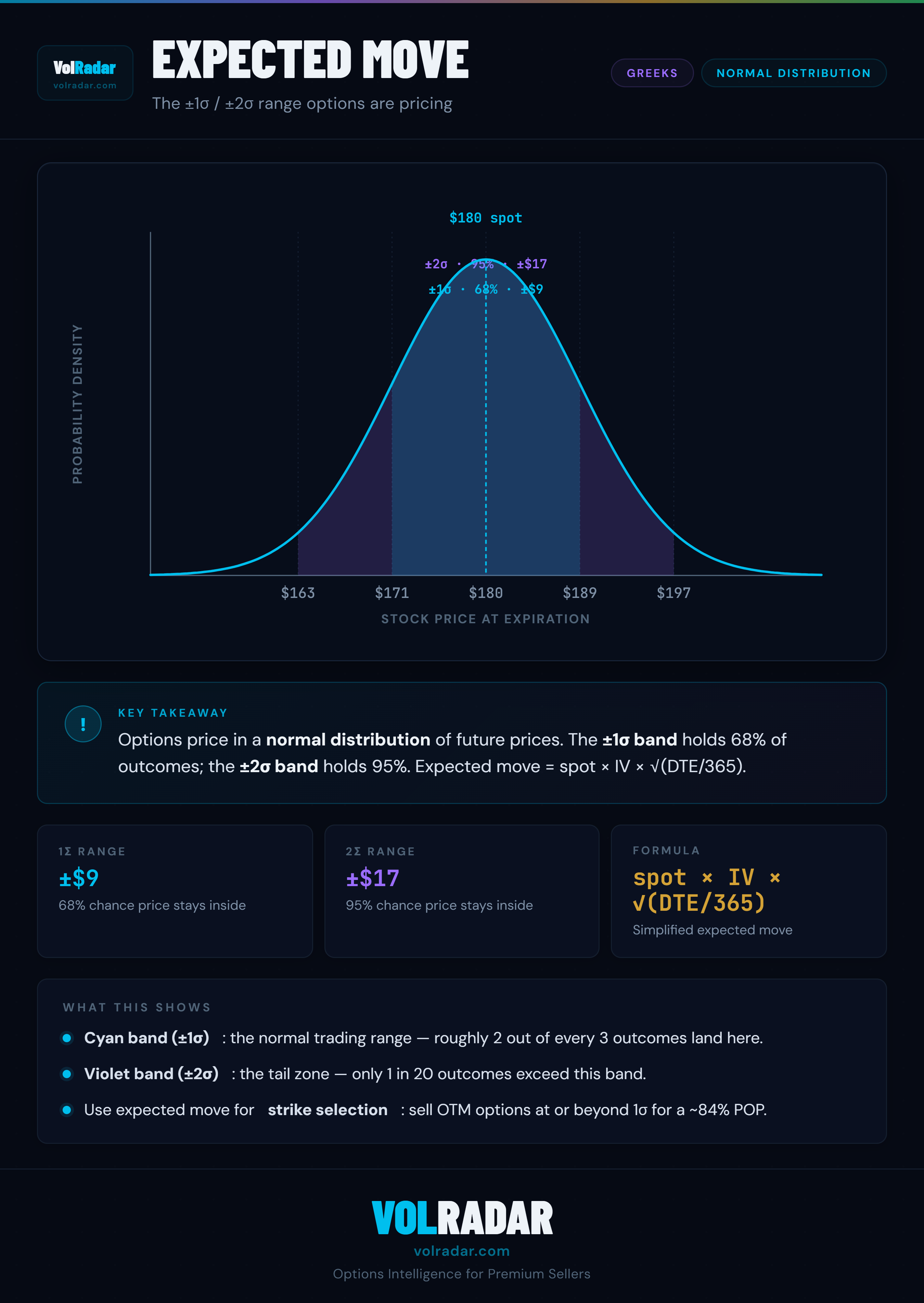
Fat tails mean extreme moves happen more often than normal distributions predict. The practical impact for premium sellers: your short options will occasionally face moves of 3-5+ standard deviations that a normal distribution says should happen once in 50 years but actually occur every 2-3 years.
⚙ How It Works
Real market returns have excess kurtosis — the distribution has heavier tails than a Gaussian bell curve. Events like Flash Crashes, COVID, and earnings blowups produce moves that are 4-10σ under normal assumptions. Options markets price this through elevated OTM put skew and higher-than-Black-Scholes premiums.
📋 Example
Under a normal distribution, a 4σ daily move on SPY (~6.3%) has a 0.003% probability — once every 130 years. In reality, 4σ+ daily moves happen roughly every 3-5 years. Your short put portfolio that looks safe under normal assumptions faces these events more frequently than the math suggests.
⚠ Common Mistakes
Sizing positions based on normal distribution probabilities. A 0.05 delta put has ~95% POP under log-normal assumptions. Under fat-tailed distributions, the actual POP is closer to 90-92%. That 3-5% difference compounds over hundreds of trades and years.
❓ FAQ
What is Fat Tails?
The statistical property where extreme price moves occur more frequently than a normal distribution predicts. Markets price this through OTM put skew.
Why does Fat Tails matter for premium sellers?
Fat tails are why premium sellers occasionally get crushed. Size for survival, not just probability.
How does Fat Tails work?
Real market returns have excess kurtosis — the distribution has heavier tails than a Gaussian bell curve. Events like Flash Crashes, COVID, and earnings blowups produce moves that are 4-10σ under normal assumptions. Options markets price this through elevated OTM put skew and higher-than-Black-Scholes premiums.
What are common mistakes with Fat Tails?
Sizing positions based on normal distribution probabilities. A 0.05 delta put has ~95% POP under log-normal assumptions. Under fat-tailed distributions, the actual POP is closer to 90-92%. That 3-5% difference compounds over hundreds of trades and years.
Related Terms
Close-to-Close Volatility
A basic volatility estimator using only daily closing prices.
Corridor Variance Swap
A corridor variance swap pays realized variance only when the underlying trades within a specified price range (corridor).
CPI Print
The CPI print is the monthly Consumer Price Index release by the Bureau of Labor Statistics, typically at 8:30 AM ET.
Dispersion Trading
Dispersion trading exploits the persistent premium of index implied volatility over the weighted average of its component implied volatilities.
This is not financial advice. Read our full investment disclaimer.