Loading...
Market Structure
Pin Risk — Options Market Structure Explained
Pin risk is the uncertainty over whether a short option will be assigned when the underlying closes at or near its strike on expiration day.
By Aigars PilmanisLast updated
Educational content. Not financial, investment, tax, or legal advice. Options involve risk and are not suitable for all investors. How we write & review this glossary.
Pin risk is the uncertainty a short option writer faces when the underlying closes at or very near the option's strike on expiration day: because the holder can still decide whether to exercise after the close, the writer may not know until the next business day whether the option will be assigned. It concerns options that can be exercised after the close, such as American-style equity options; cash-settled index options settle on a published exercise settlement value instead.
VolRadar Lens
- Definition
- Pin risk is the uncertainty about assignment, and the resulting exposure, when the underlying finishes near a short strike at expiration.
- Why it matters
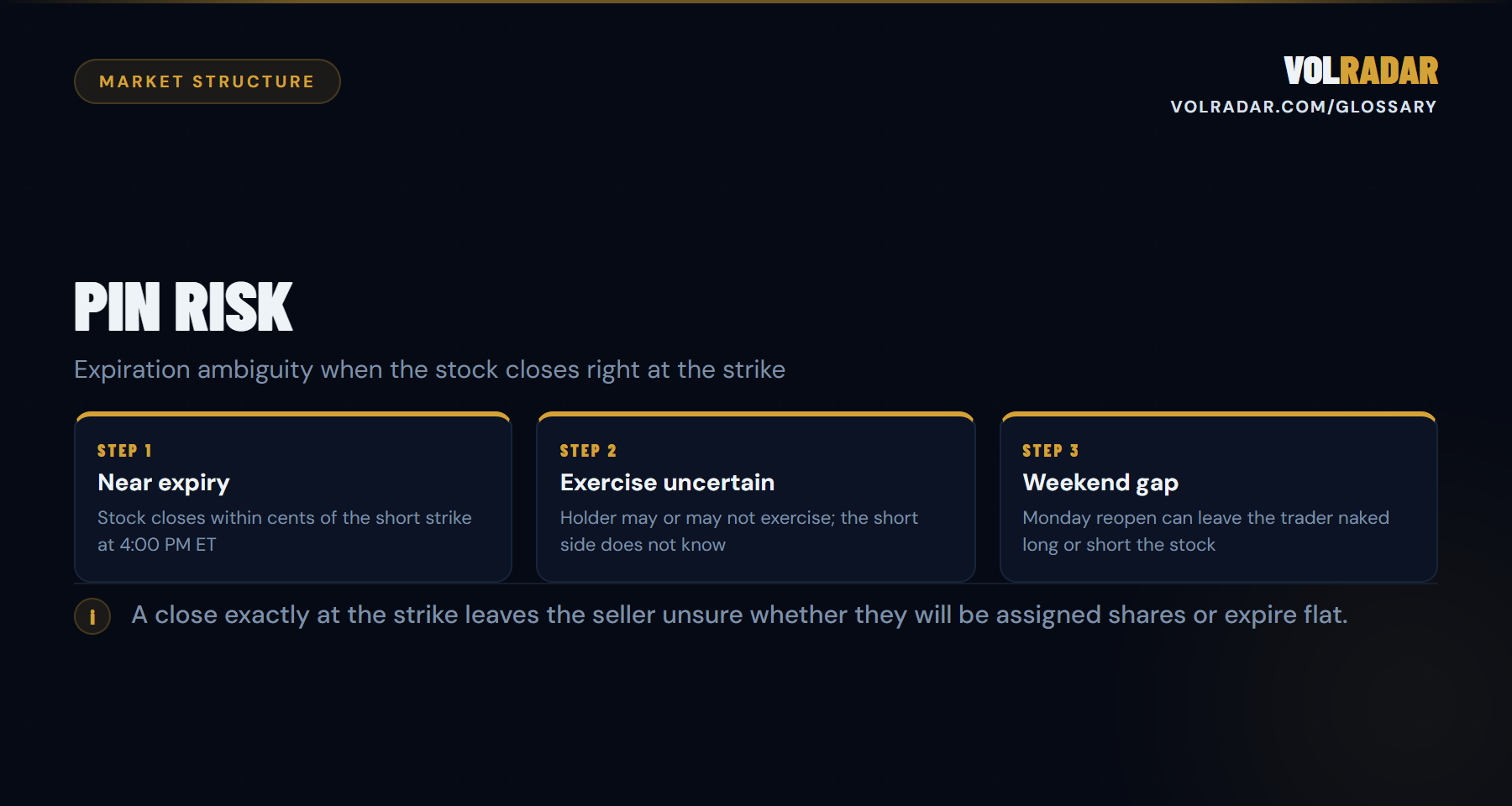
- A short strike sitting right at the closing price leaves assignment uncertain — the contract may or may not be exercised after the bell.
Pin risk is an information gap, not a price forecast: when the close sits at the strike, the short side cannot know the exercise outcome until the holder's decision has been processed after the close.
Visual ReferenceVisual reference for Pin RiskShowHide
Why It Matters
Pin risk is the point where the exercise decision, not the closing price alone, determines the outcome of a short option. A short writer may hold or lack the shares needed for the outcome that actually occurs, and the Options Industry Council notes the position may only become clear on the following Monday. The mirror-image applies to a long holder: OCC's default exercises an equity option that closes in the money by $0.01 or more unless the holder gives contrary instructions, and a firm's own threshold may differ.
How It Works
At expiration OCC exercises equity options that are in the money by $0.01 or more, measured against the underlying's closing price, unless the clearing member gives other instructions; a holder can also choose to exercise a slightly out-of-the-money option or to leave an in-the-money one unexercised (Options Industry Council). Exercise notices can still be sent after the close, up to the exchange cut-off of 4:30 p.m. CT and earlier broker cut-offs. When the close is far from the strike the outcome is clear. When it is at or within a cent or so of the strike, the holder's choice, which can use information that arrives after the close, decides it, and OCC then assigns notices randomly to clearing members with short positions. The Options Industry Council notes that a writer cannot know for sure until the Monday after expiration whether assignment will occur, and that the problem is most acute if the stock trades just below, at or just above the short strike. An assignment on a short put leaves the writer buying 100 shares per contract at the strike; an assignment on a short call leaves the writer delivering 100 shares per contract at the strike. A short position that has been closed before the end of trading cannot be assigned, because OCC processes closing transactions before exercises (Options Industry Council).
Example
Hypothetical example, one standard equity option (100 shares): a writer has sold one $50 call for $0.80 received, and the stock closes at exactly $50.00, so the call is not in the money and would not be exercised by exception. Case A: the holder does not exercise, the call expires, and the writer keeps the $80. Case B: news after the close moves the stock to $51.00, the holder exercises before the cut-off, the writer is assigned and must deliver 100 shares at $50.00; if the writer is not holding the shares and buys them at $51.00 on Monday, the loss on the shares is $1.00 x 100 = $100, and with the $80 received the net result is -$20. The writer could not tell which case applied when trading ended. Commissions are ignored.
Common Mistakes
Confusing pin risk with pinning: pin risk is the assignment uncertainty at the strike, while pinning (see pinned to a strike) is the tendency of prices to cluster at strikes. Assuming a close just out of the money rules out assignment: the holder may still exercise before the cut-off. Assuming a close just in the money means assignment will occur: exercise is the holder's choice, and OCC assigns notices randomly among short positions. Assuming the same uncertainty applies to cash-settled index options, which settle on an exercise settlement value rather than through a post-close exercise decision.
Frequently Asked Questions
What is pin risk?
Pin risk is the uncertainty over whether a short option will be assigned when the underlying closes at or very near its strike on expiration day. The Options Industry Council notes that a writer cannot know for sure until the Monday after expiration whether assignment will occur, and that the problem is most acute if the stock trades just below, at or just above the short strike.
Why can an option that closed out of the money still be exercised?
Exercise notices can be submitted after the close. Options exchanges have a 4:30 p.m. CT cut-off for receiving an exercise notice, and brokerage firms often set earlier cut-offs. A holder may choose to exercise a slightly out-of-the-money option, so the closing price alone does not settle the outcome (Options Industry Council).
What is the difference between pin risk and pinning?
Pin risk is the assignment uncertainty when an option finishes at or near its strike. Pinning is the reported tendency of stock prices to close near strikes on expiration dates. The two can occur together, but pin risk concerns exercise and assignment, while pinning concerns where the price closes.
Does pin risk affect long options as well as short options?
Yes, in a different form. OCC's default exercises an equity option that closes in the money by $0.01 or more unless the holder gives contrary instructions, and a holder may exercise or decline to exercise against that default. A firm may use its own threshold and cut-off (Options Industry Council).
Does pin risk apply to cash-settled index options?
The post-close exercise uncertainty described here concerns options that can be exercised after the close, such as American-style equity options. Cash-settled index options settle on an exercise settlement value, calculated from closing values for PM-settled options and opening prices for AM-settled options, and many are European-style (Options Industry Council).
General references
General references for this topic area, not citations for the specific figures above. VolRadar is not affiliated with these organizations.
The information about Pin Risk above is for educational purposes only and is not financial advice. Read our full investment disclaimer.
Understand options faster.
One term, one worked example, one real ticker. Every Sunday. No jargon.
One email per week, no drip campaigns · Unsubscribe anytime