Loading...
Strategies
Synthetic Positions — Options Strategy Explained
Synthetic Positions: A synthetic position combines two instruments, such as a call and a put, to replicate the payoff of a third, as put-call parity describes.
By Aigars PilmanisLast updated
Educational content. Not financial, investment, tax, or legal advice. Options involve risk and are not suitable for all investors. How we write & review this glossary.
A synthetic position is a combination of two instruments, such as stock and an option or a call and a put, whose profit and loss at expiration replicates a third position. Put-call parity links them: for example, a long call plus a short put at the same strike and expiration is a synthetic long stock, and long stock plus a short call (a covered call) is a synthetic short put.
Video explainer7:20
Watch: Synthetic Positions Explained
7:20 walkthrough — definition, mechanics, worked example, and common mistakes for Synthetic Positions.
What to remember from this video
Synthetic positions allow traders to replicate the payoff profile of stocks or options using combinations of other instruments, which can change the capital and margin profile.
Key Insights From The Video
- A covered call has an expiration payoff similar to a short put with the same strike and expiry, though dividends, financing, assignment and margin differ.
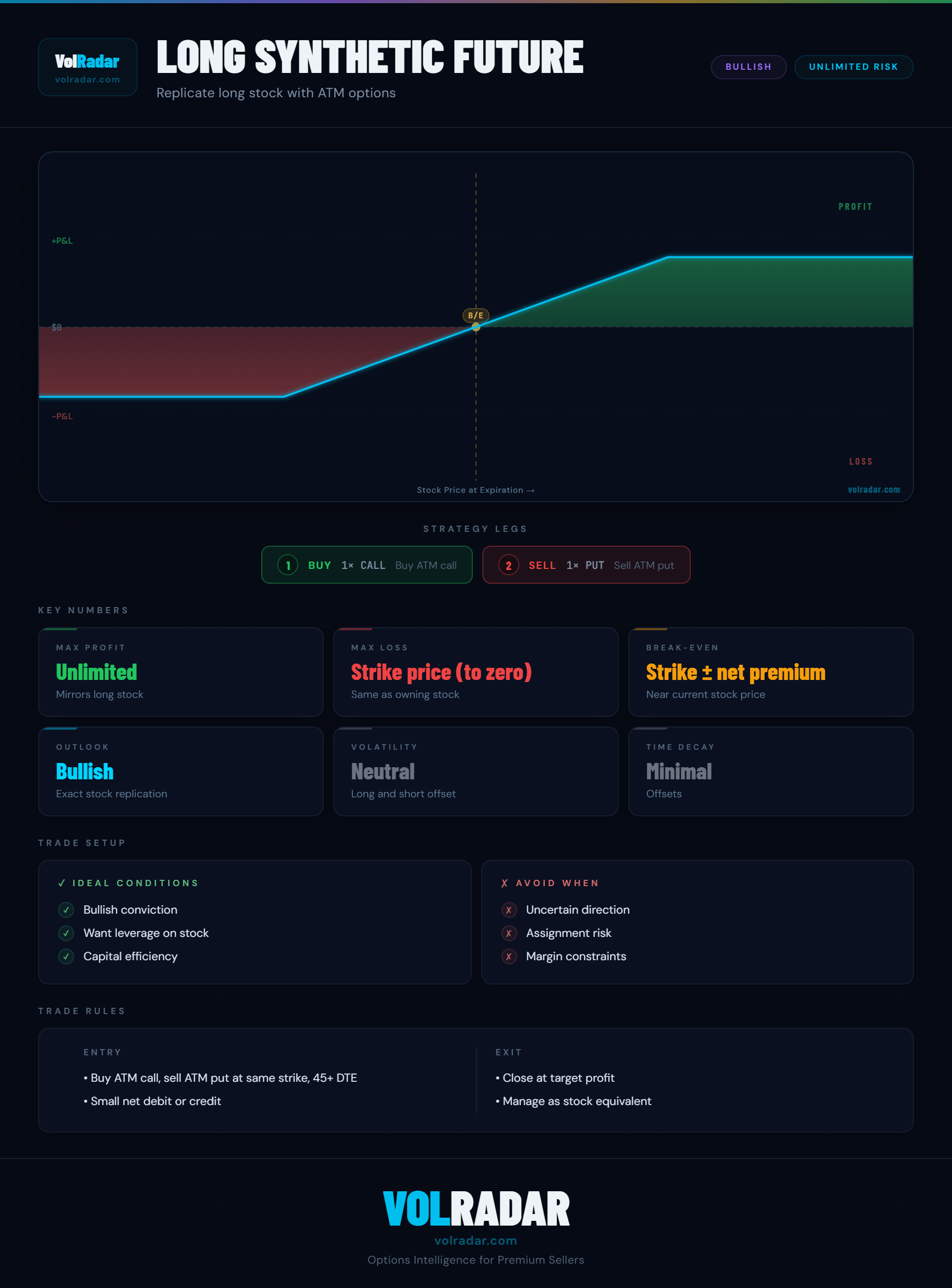
- Synthetic long stock: Buy call, sell put at the same strike and expiration.
- Synthetic short stock: Sell call, buy put at the same strike and expiration.
- Options-only synthetic stock positions do not collect dividends.
Read the complete video explanation~298 words · 1 min read
Synthetic positions enable traders to mimic the payoff profile of stocks or options by using specific combinations of financial instruments. This approach is rooted in put-call parity, which outlines the relationship between options and stocks. For example, a covered call strategy, often seen as conservative, has an expiration payoff similar to a short put with the same strike and expiry, though dividends, financing, assignment and margin treatment differ.
To create a synthetic long stock, you buy a call and sell a put with the same strike price and expiration date. This setup provides the same market exposure as owning the stock, with a different capital and margin profile. Conversely, a synthetic short stock involves selling a call and buying a put at the same strike and expiration.
Traders use synthetic positions for several reasons: capital efficiency, avoiding high borrow fees, and exploiting arbitrage opportunities. For instance, in a hypothetical case with a stock at $215, a trader could create a synthetic long stock by buying a $215 call for $8.50 and selling a $215 put for $8.20, resulting in a net debit of $0.30. This setup approximates owning 100 shares.
Synthetic positions are subject to certain risks, such as early assignment on the short leg, especially near ex-dividend dates. Additionally, options-only synthetic stock positions do not collect dividends, which can affect long-term returns. It's crucial to ensure that both legs of a synthetic position share the same strike and expiration to maintain the intended risk profile.
Understanding the nuances of synthetic positions allows traders to build tailored exposures that can have a different cost and margin profile than direct stock purchases. This flexibility is particularly beneficial when one leg of a trade is cheaper or more liquid than the equivalent direct position, which can matter when constructing positions.
The position
Structure
Synthetic positions replicate the payoff profile of stock or single-leg options using combinations of other instruments, built on put-call parity.
- Direction
- Depends on the position being replicated.
- Risk type
- See structure
VolRadar Lens
- Key feature
- Synthetics combine options, and sometimes stock, to reproduce another position's payoff; through put-call parity a synthetic has the same expiration payoff profile as the position it mirrors.
Synthetics match at expiration, not in every detail along the way: interest, dividends, early assignment of American-style options and margin can make a synthetic and its original behave differently before expiration.
Why It Matters
Synthetic relationships show when two positions that look different carry the same risk. A covered call and a short put at the same strike and expiration have nearly the same payoff, so the stock in a covered call does not protect against a fall any more than the short put's obligation does. Synthetics are also how traders build exposure when one instrument is unavailable or costly, for example a synthetic short stock when shares are hard to borrow, and how reversals and conversions keep option prices in line with the stock.
How It Works
With the same strike and expiration, OIC lists six relationships among stock, calls and puts (ignoring interest and dividends): long stock = long call + short put; short stock = short call + long put; long call = long stock + long put; short call = short stock + short put; long put = short stock + long call; short put = long stock + short call. Each follows from put-call parity, which for a non-dividend-paying stock and European-style options says call - put = stock - present value of the strike. Because of the present-value term, the net cost of a synthetic long stock (call - put) equals the stock price minus the present value of the strike: when the strike equals the stock price it is a small debit equal to the interest on the strike over the option's life, a lower strike gives a larger debit and a higher strike can give a credit, and dividends shift the relationship further. With American-style options, early assignment of the short leg can close or change the synthetic before expiration.
Example
Hypothetical (Black-Scholes prices, which assume European-style exercise; with American-style US equity options, early exercise can make call minus put differ slightly from parity; stock $100, 30 days, implied volatility 30%, interest 4%, no dividends, standard US equity options of 100 shares): buy the $100 call at about $3.59 and sell the $100 put at about $3.26, a net debit of $0.33 per share ($33). European parity check: $100 - $100 x e^(-0.04 x 30/365) = $0.33. At expiration, stock at $110: the synthetic gains $10 - $0.33 = $9.67 per share, against $10 for owning the shares; stock at $90: it loses $10 + $0.33 = $10.33, against $10. The $0.33 difference is the interest the share buyer would have given up by paying $100 up front.
Common Mistakes
Using different strikes or expirations and expecting an exact replica; the equivalences hold for the same strike and expiration. Forgetting that synthetic long stock receives no dividends and that synthetic short stock owes none, while the options' prices already reflect expected dividends. Ignoring early assignment on the short leg, especially a short call before an ex-dividend date. Assuming a synthetic needs less risk capital because it costs less up front: the loss if the stock falls to zero is about the same as for the shares.
Is the market paying premium sellers today?
The SPY Premium Window study tracks when systematic option selling has historically been compensated — recomputed daily from market close. Free to read, no account needed.
Frequently Asked Questions
What are the six synthetic positions in options?
With the same strike and expiration, and ignoring interest and dividends: long stock = long call + short put; short stock = short call + long put; long call = long stock + long put; short call = short stock + short put; long put = short stock + long call; short put = long stock + short call.
Is a covered call the same as a short put?
At the same strike and expiration their profit and loss at expiration is nearly the same: long stock plus a short call is a synthetic short put. Differences come from interest, dividends and the chance of early assignment.
General references
General references for this topic area, not citations for the specific figures above. VolRadar is not affiliated with these organizations.
Visual ReferencePayoff structure and strike placementShowHide
The information about Synthetic Positions above is for educational purposes only and is not financial advice. Read our full investment disclaimer.
Understand options faster.
One term, one worked example, one real ticker. Every Sunday. No jargon.
One email per week, no drip campaigns · Unsubscribe anytime