Loading...
Exotics
Asian Option — Options Trading Concept Explained
An Asian option pays off on the average price of the underlying over a set period, not only its price at expiration.
By Aigars PilmanisLast updated
Educational content. Not financial, investment, tax, or legal advice. Options involve risk and are not suitable for all investors. How we write & review this glossary.
An Asian option is an option whose payoff depends on the average of the underlying's price over a set averaging period, instead of only its price at expiration. In an average-price option, a call pays the amount by which that average exceeds the strike, or zero, and a put pays the amount by which the strike exceeds the average, or zero. Because one late price does not set the payoff, the result is less sensitive to the last print than a standard (vanilla) option.
Video explainer8:08
Watch: Asian Option Explained
8:08 walkthrough — definition, mechanics, worked example, and common mistakes for Asian Option.
What to remember from this video
Asian options use average pricing over time to mitigate the risk of unpredictable market spikes at expiration.
Key Insights From The Video
- Asian options settle based on average price, not final spot price.
- Averaging reduces effective volatility, lowering manipulation risk.
- Two types: average-price and average-strike options.
- Most common in OTC commodity and FX markets.
Read the complete video explanation~299 words · 1 min read
Asian options provide a solution to the stress of relying on a single spot price at expiration. Imagine an oil refiner needing to hedge the cost of crude oil bought daily over a month. Traditional options expose them to the risk of a volatile final price, but Asian options use the average price over the entire period, aligning financial hedges with real-world costs.
This averaging mechanism reduces the risk of market manipulation, as it would require consistent interference over the entire period, not just at expiration. This makes Asian options particularly attractive for hedgers in markets prone to volatility.
Asian options come in two main types: average-price options, which settle on the mean of all observations against a fixed strike, and average-strike options, which use the average as the strike price against the final spot.
Pricing these options involves complex calculations. Geometric averaging can have a closed-form solution under standard model assumptions, while arithmetic averaging is often priced with approximations or numerical methods such as Monte Carlo simulation. This complexity reflects the path-dependent nature of Asian options, where the payoff depends on the entire price journey, not just the endpoint.
As expiration approaches, Asian options can exhibit lower gamma and vega than vanilla options, as more of the payoff is already determined. This reduces the need for frantic delta hedging, providing a more stable position management.
Asian options are primarily traded over-the-counter in commodity and FX markets, where they serve the needs of corporate hedgers seeking to manage average costs rather than spot prices. Their use is expanding into listed markets, particularly in energy contracts.
Ultimately, a key feature of Asian options is that averaging reduces sensitivity to a single final price, which can suit businesses with continuous exposure to price fluctuations, though it does not eliminate tail risk.
VolRadar Lens
- Payoff
- An Asian option settles based on the average price of the underlying over a specified period rather than the final price at expiration.
- Lesson for sellers
- Averaging can reduce sensitivity to a single expiry print. Common in commodity and FX markets.
- Retail availability
- Typically OTC or structured products
The averaging window, the schedule of observations and whether the average is arithmetic or geometric are part of the contract: two Asian options on the same underlying with the same strike can have different values and different risks.
Why It Matters
Asian options match exposures that are themselves averages. A buyer who purchases a commodity steadily through a month is exposed to the month's average price, not to one day's price, and an average-price option pays on that average. For the same reason an Asian option is less sensitive to a single unusual price on the last day than a vanilla option. The trade-off is that Asian options are path-dependent: the payoff depends on the whole sequence of observations, so they cannot be priced or hedged as if only the final price mattered.
How It Works
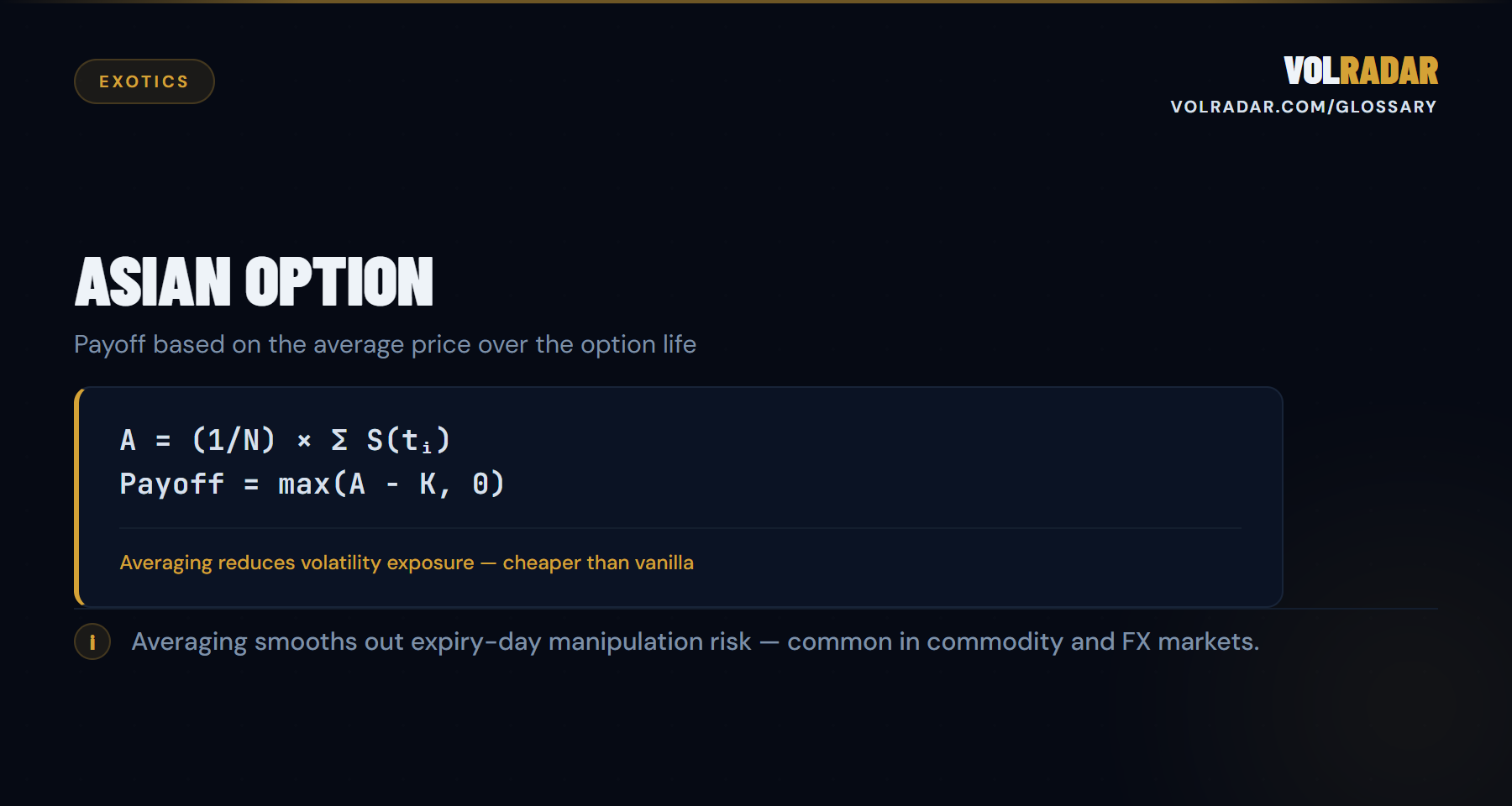
The contract names an averaging period and a set of observation dates, such as every business day in a month. The average of the observed prices is compared with the strike: a call pays max(average - strike, 0) and a put pays max(strike - average, 0) at expiration. A variant, the average-strike option, compares the final price with the average instead. An arithmetic average is the usual sum divided by the count. A geometric average multiplies the observations and takes the root. Pricing differs: a product of lognormal prices is lognormal, so the geometric version has a closed-form price under Black-Scholes assumptions, while the arithmetic average is not lognormal and is priced numerically (for example by Monte Carlo simulation) or by approximation. For continuous geometric averaging over the whole life with constant volatility, the variance of the log of the average is one third of the variance of the log of the final price (derivation in the claims file), which is one reason an Asian option is typically priced below a comparable vanilla option; the size of the difference depends on the averaging window and schedule. A listed example is the NYMEX WTI Average Price Option, a cash-settled, European-style option whose floating price is the arithmetic average of the first-nearby WTI futures settlement price for each business day of the contract month (CME Group rulebook, filed with the CFTC).
Example
Hypothetical, per-unit arithmetic only. An average-price call on a commodity with a strike of 80, averaged over five observations: 72, 77, 85, 88 and 82. The arithmetic average is (72 + 77 + 85 + 88 + 82) / 5 = 404 / 5 = 80.8, so the payoff is max(80.8 - 80, 0) = 0.80 per unit, or 0.80 x 1,000 units = $800 for 1,000 units, before the premium paid. A vanilla call on the same underlying with the same strike pays on the final price of 82: max(82 - 80, 0) = 2.00 per unit, or $2,000 for 1,000 units, before premium. The averaged price of 80.8 is closer to the strike than the final price of 82, which shows how the average dampens the effect of the last observation. The numbers are made up for the arithmetic.
Common Mistakes
Pricing an Asian option with the same volatility as a vanilla and assuming the same value: averaging lowers the effective variance of the averaged quantity. Treating an arithmetic Asian as if it had the geometric closed form: the geometric formula is exact only for geometric averaging. Ignoring the observation schedule: the number and timing of observations, and how many are already fixed, change the payoff distribution. Assuming Asian options are widely available through a retail broker: availability varies, and some are traded over the counter or on specific exchanges. Assuming the premium is always lower than a vanilla by a fixed percentage: the difference depends on the inputs and the averaging window.
Frequently Asked Questions
What is an Asian option?
An Asian option pays off on the average price of the underlying over an averaging period, not only on its price at expiration. A call pays the amount by which the average exceeds the strike, or zero.
How is an Asian option priced?
With geometric averaging and Black-Scholes assumptions there is a closed-form price. With the more common arithmetic averaging the average is not lognormal, so prices come from numerical methods such as Monte Carlo simulation or from approximations.
Are Asian options listed on exchanges?
Some are. For example, the NYMEX WTI Average Price Option is a cash-settled, European-style option on the monthly average of WTI futures settlement prices. Availability through retail brokers varies, and many Asian options are customized over the counter.
General references
General references for this topic area, not citations for the specific figures above. VolRadar is not affiliated with these organizations.
Visual ReferenceVisual reference for Asian OptionShowHide
The information about Asian Option above is for educational purposes only and is not financial advice. Read our full investment disclaimer.
Understand options faster.
One term, one worked example, one real ticker. Every Sunday. No jargon.
One email per week, no drip campaigns · Unsubscribe anytime