Loading...
Exotics
Binary Option — Options Trading Concept Explained
A binary option pays out only if a condition is true at expiration, such as closing above the strike, usually a fixed cash amount, and nothing otherwise.
By Aigars PilmanisLast updated
Educational content. Not financial, investment, tax, or legal advice. Options involve risk and are not suitable for all investors. How we write & review this glossary.
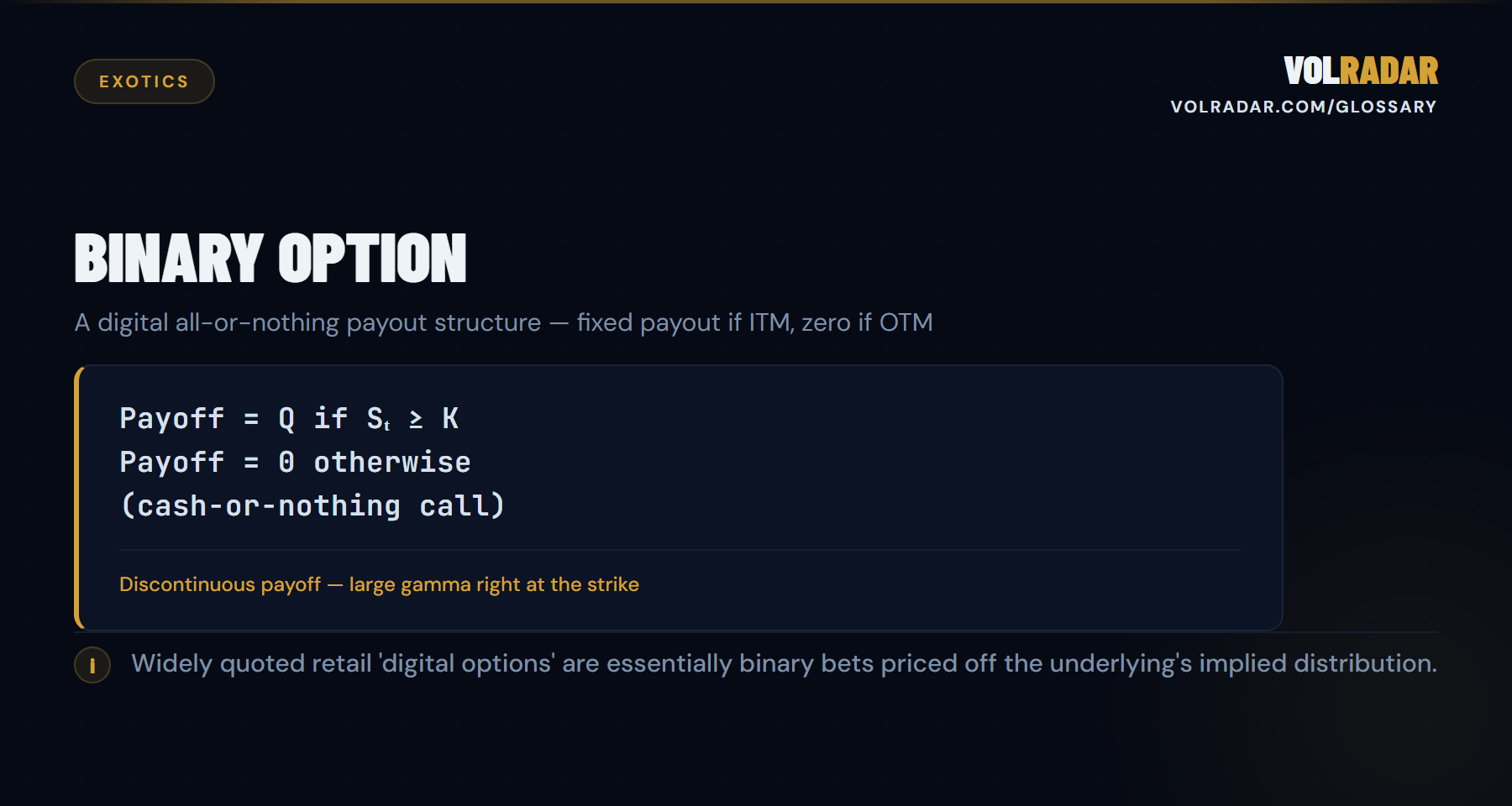
A binary option is an option that pays out only if a stated condition is true at expiration, such as the underlying closing above the strike, and pays nothing otherwise. Also called a digital option, it is an all-or-nothing contract. In the common cash-or-nothing form the payout is a fixed cash amount, so the payoff jumps from zero to the full amount at the strike instead of growing with the size of the move, as a vanilla option's payoff does; the asset-or-nothing form delivers one unit of the underlying instead.
Video explainer7:39
Watch: Binary Option Explained
7:39 walkthrough — definition, mechanics, worked example, and common mistakes for Binary Option.
What to remember from this video
Binary options are pure direction bets, offering predefined payouts with an all-or-nothing outcome, unlike the continuous payoff of standard options.
Key Insights From The Video
- Binary options pay a predefined payoff, either a fixed cash amount or one unit of the underlying asset, if the underlying finishes above or below the strike at expiration.
- A $1 cash-or-nothing call's price approximates the discounted risk-neutral probability of finishing above the strike; with little discounting, $0.35 would imply roughly 35%.
- Binary options have discontinuous payoffs, creating hedging challenges as delta and gamma spike near the strike.
- A binary option can be approximated with a tight vanilla call spread, scaled by the inverse of the strike width.
- Binary option prices are linked to the volatility skew, among other inputs.
Read the complete video explanation~320 words · 2 min read
Binary options strip trading down to a simple bet on direction: right or wrong. Unlike standard options, where profitability scales with market movement, binary options offer a predefined payout (a fixed cash amount or one unit of the asset) if the underlying finishes above or below the strike at expiration, otherwise paying zero. This creates an all-or-nothing outcome with no continuous payoff.
There are two main types of binary options: cash-or-nothing, which pays a fixed cash amount, and asset-or-nothing, which pays one unit of the underlying asset. Under Black-Scholes assumptions, European-style versions of both types have closed-form prices that rely on the standard normal cumulative distribution function.
The price of a binary option is related to the risk-neutral probability of finishing in the money. For instance, a $1 cash-or-nothing call priced at $0.35 indicates roughly a 35% risk-neutral probability (more precisely, a discounted one) of the underlying finishing above the strike price.
Binary options differ from vanilla options, which have a continuous payoff that smooths hedging near the strike. In contrast, binaries feature a cliff at the strike, making delta and gamma spike violently as expiration approaches, posing significant hedging challenges.
A binary option can be approximated with a tight vanilla call spread, scaled by the inverse of the strike width; listed strikes are typically much wider than that. This replication links digital option prices to the volatility skew, with the skew's slope at the strike being one input alongside spot, strike, maturity, discounting, and the volatility level.
Despite the hedging difficulties, binary options are crucial for structured products desks. They serve as fundamental building blocks, allowing traders to approximate continuous payoff structures by combining digital options at different strikes.
In the foreign exchange market, digital options are used for event trades around significant occurrences like central bank meetings or elections, providing a clean, defined risk bet on whether a currency will cross a certain threshold based on the news.
VolRadar Lens
- Payoff
- A cash-or-nothing binary option pays a fixed amount if the underlying finishes above (or below) the strike at expiration, and zero otherwise.
- Lesson for sellers
- Tight credit spreads approximate a binary payout profile. Understanding binaries helps explain why such spreads behave like a yes/no bet near expiry.
A cash-or-nothing binary option's price, as a share of its fixed payout, approximates the market-implied (risk-neutral) probability of paying out; it is not a forecast of the real-world chance, and the loss is the full price paid if the condition fails.
Why It Matters
A binary option isolates one question: will the condition be true at expiration or not. A $1 cash-or-nothing call priced at $0.35 implies a risk-neutral probability of finishing above the strike of 0.35 x e^(rT): about 35% when discounting is negligible, slightly more when interest rates are positive. That makes binaries a direct way to read market-implied probabilities. Structuring desks use digitals as building blocks, because a continuous payoff can be replicated as a strip of digitals. The same cliff makes binaries hard to hedge: close to expiration, delta and gamma spike when the price sits near the strike, because a small move can flip the payoff between zero and the full amount.
How It Works
There are two classic types. A cash-or-nothing binary pays a fixed cash amount; an asset-or-nothing binary pays one unit of the underlying. Both have closed-form Black-Scholes prices: a cash-or-nothing call that pays 1 is worth e^(-rT) x N(d2), where N(d2) is the model's risk-neutral probability of finishing above the strike. Because the payoff is a cliff at the strike, a cash-or-nothing binary's delta is shaped like a bell curve concentrated near the strike (its exact peak shifts with volatility, interest rates and time to expiration) rather than rising smoothly as a vanilla call's delta does; an asset-or-nothing call's delta can rise above one unit of the underlying near the strike and then settles back toward about one unit deep in the money. A binary can be approximated with a tight vanilla call spread: buy a call and sell a call at very close strikes, then scale the position so the spread's maximum payoff equals the binary's payout. That replication ties binary prices to the volatility skew: the slope of the skew around the strike moves the binary's price.
Example
Hypothetical: a binary pays $100 if an index closes above 5,800 on Friday and nothing otherwise, and it trades at $42. Buying 5 contracts costs 5 x $42 = $210. If the index closes above 5,800, the payout is 5 x $100 = $500, a profit of $500 - $210 = $290. If it closes at or below 5,800, the contracts settle at $0 and the loss is the full $210. The $42 price is 42% of the $100 payout, so the market-implied probability of paying out is roughly 42%, before fees and discounting; that is a risk-neutral figure, not a forecast.
Common Mistakes
Reading the price as a real-world forecast. A binary at $42 of a $100 payout reflects a risk-neutral probability and the market's pricing, not the actual chance of winning. Treating the loss as partial. If the condition fails, the whole premium is lost, however close the price finished to the strike. Ignoring the venue. US securities and commodities regulators have issued public investor alerts about binary options sold through internet platforms that are not registered, and advise checking that a venue is registered before trading. Assuming a narrow vertical spread is identical to a binary. It approximates the payoff, but between the two strikes the spread pays a partial amount.
Frequently Asked Questions
What is the payoff of a binary option?
A cash-or-nothing binary option, the common form, pays a fixed amount if its condition is true at expiration, for example the underlying closing above the strike, and nothing otherwise. The payoff does not grow with the size of the move, unlike a vanilla option, whose payoff increases the further the price moves past the strike.
Are binary options legitimate?
The instrument itself is a standard option type, and binaries are listed on some regulated exchanges. US regulators, including the SEC and CFTC, have issued investor alerts about binary options sold through unregistered internet platforms, and advise checking that a venue is registered before trading.
How is a binary option priced compared with a vanilla option?
Both can be priced in the same Black-Scholes framework. A cash-or-nothing call paying 1 is worth e^(-rT) x N(d2), the discounted risk-neutral probability of finishing above the strike. Its price as a share of the payout approximates that market-implied probability; it is not a forecast of the real-world chance.
How does a binary option compare with a vertical spread?
A narrow vertical spread approximates a binary payoff: its maximum payout equals the strike width, reached when the price finishes beyond both strikes. Unlike a true binary, the spread pays a partial amount when the price finishes between its two strikes.
When are binary options used?
Binary options express a view on a single yes-or-no outcome at a specific date, such as whether an index closes above a level at expiration. Because the payoff is all-or-nothing, the buyer's maximum loss is the price paid. For a cash-or-nothing binary the maximum gain is the fixed payout minus that price; an asset-or-nothing binary pays the value of the underlying instead, so its payout is not fixed.
General references
General references for this topic area, not citations for the specific figures above. VolRadar is not affiliated with these organizations.
Visual ReferenceVisual reference for Binary OptionShowHide
The information about Binary Option above is for educational purposes only and is not financial advice. Read our full investment disclaimer.
Understand options faster.
One term, one worked example, one real ticker. Every Sunday. No jargon.
One email per week, no drip campaigns · Unsubscribe anytime