Loading...
Strategies
Christmas Tree Butterfly — Options Strategy Explained
A Christmas tree butterfly is a 1-3-2 option spread across four equally spaced strikes, one of them skipped, that costs a net debit and peaks at the short strike.
By Aigars PilmanisLast updated
Educational content. Not financial, investment, tax, or legal advice. Options involve risk and are not suitable for all investors. How we write & review this glossary.
A Christmas tree butterfly is a six-option spread built from calls (or puts) with one expiration and four equally spaced strikes: with calls, buy one call at the lowest strike, skip the next strike, sell three calls at the third strike and buy two calls at the highest strike. It is opened for a net debit, the most it can lose is that debit, and it earns the most if the underlying finishes exactly at the short strike at expiration.
The position
Structure
A Christmas tree butterfly uses three strikes, commonly buying one option, selling three at a skipped strike, and buying two at a further strike, all in the same option type.
- Direction
- Directional (bullish with calls, bearish with puts).
- Drives outcome
- A directional defined-risk structure with asymmetric payoff.
- Risk type
- Defined risk
VolRadar Lens
The cap on the upside loss comes from the spacing: the lowest strike sits two strike widths below the short strike and the top strike one width above it. Add a second skipped strike above the short strike and a rally past the top strike loses the debit plus two strike widths.
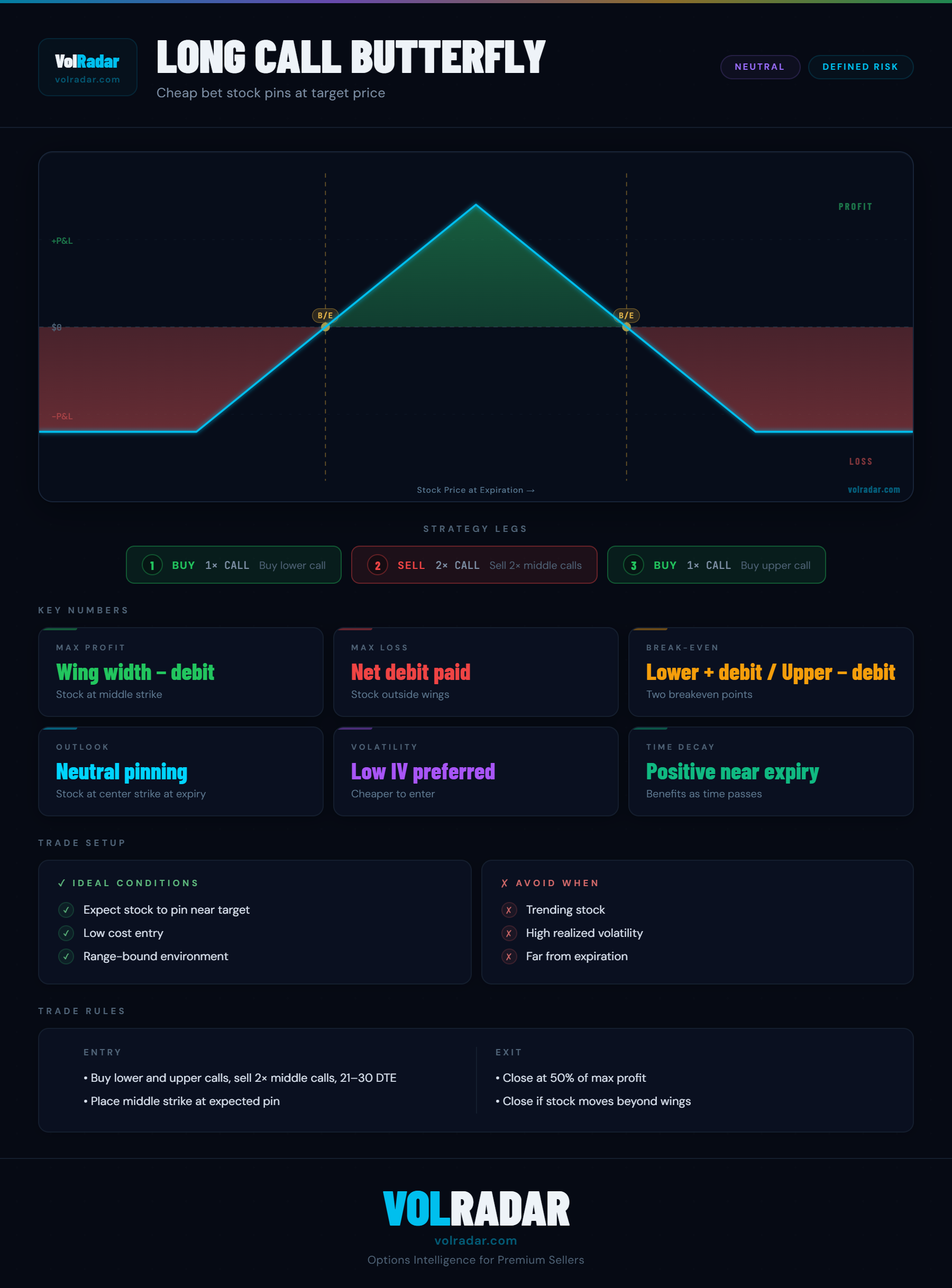
Visual ReferencePayoff structure and strike placementShowHide
Why It Matters
The structure prices a view about a level and a date, not only a direction: the payoff is highest at one strike on one expiration and falls away on either side. Compared with buying a single call, the three short calls lower the cost, and the two long calls at the top strike keep the loss above the highest strike limited to the debit. The trade-off is a narrow peak and six contracts to trade, each with its own bid-ask spread and commissions.
How It Works
With calls, label the four equally spaced strikes A, B, C and D from lowest to highest. The position is long one A call, short three C calls and long two D calls; strike B is skipped. All six calls share one expiration. At expiration the value of the spread follows from the three legs. Below A every call expires worthless and the loss is the debit paid. Between A and C the single long call gains $1 for every $1 rise in the underlying, so the spread peaks at C, where it is worth C - A. Between C and D the three short calls outweigh the one long call, so the spread loses $2 of value for every $1 rise. Above D the two long D calls offset that slope and the spread is worth zero, so the loss is again the debit. Maximum profit is (C - A) minus the debit; the break-even points are A plus the debit and D minus half the debit. Because the profit peaks at C, which sits above the lowest strike, a call Christmas tree placed with A near the current price expresses a view that the underlying will rise modestly to a specific level by expiration. A put version mirrors the structure below the current price: one long put at the highest strike, three short puts two strikes lower and two long puts at the lowest strike.
Example
Hypothetical, illustrative prices. A stock trades at $100 and strikes are listed every $5. Buy one 100 call for $4.00, skip the 105 strike, sell three 110 calls for $1.10 each and buy two 115 calls for $0.55 each, all with the same expiration. Net debit: $4.00 - (3 x $1.10) + (2 x $0.55) = $1.80 per share, or $180 for the spread at 100 shares per contract. At expiration: at $110 the spread is worth $10.00 and the profit is $10.00 - $1.80 = $8.20 per share ($820); at $101.80 or at $114.10 it breaks even; at $100 or below, or at $115 or above, it is worth nothing and the loss is the $180 debit.
Common Mistakes
Reading the profit zone as a plateau: profit rises to a single peak at the short strike and falls on both sides of it. Changing the spacing without re-checking the payoff: the loss above the top strike stays at the debit only when the lowest strike is two widths below the short strike and the top strike one width above it; with a second skipped strike above the short strike, the loss above the top strike grows to the debit plus two strike widths. Ignoring early assignment: the three short calls are American-style on most equities, and assignment risk rises before an ex-dividend date. Confusing it with a standard 1-2-1 butterfly, which uses three equally spaced strikes and peaks in the middle.
Comparison
A standard long call butterfly buys one call at the lowest strike, sells two at the middle strike and buys one at the highest, with equal spacing, so its peak sits at the middle strike and its payoff is symmetric. The Christmas tree skips a strike below the short strike and sells three calls instead of two, which moves the peak further from the lowest strike and makes the payoff asymmetric: it rises by $1 per $1 up to the short strike and falls by $2 per $1 above it. Fidelity's strategy guide describes Christmas tree spreads as having lower profit potential but also lower risk than skip-strike butterfly spreads.
Is the market paying premium sellers today?
The SPY Premium Window study tracks when systematic option selling has historically been compensated — recomputed daily from market close. Free to read, no account needed.
Frequently Asked Questions
What is the maximum profit and loss of a Christmas tree butterfly?
The maximum loss is the net debit paid, which is lost if the underlying finishes at or below the lowest strike or at or above the highest strike. The maximum profit is the distance between the lowest strike and the short strike minus the debit, reached if the underlying finishes exactly at the short strike.
Where are the break-even points?
For the call version there are two: the lowest strike plus the net debit, and the highest strike minus half the net debit. The upper break-even uses half the debit because the spread loses $2 of value for every $1 rise between the short strike and the highest strike.
How is a Christmas tree butterfly different from a regular butterfly?
A regular butterfly is 1-2-1 across three equally spaced strikes and peaks at the middle strike. A Christmas tree is 1-3-2 across four equally spaced strikes with one skipped below the short strike, so its peak is two strike widths above the lowest strike and its payoff is lopsided.
Does a Christmas tree butterfly carry early assignment risk?
Yes, when the options are American-style, as most US equity options are. The three short calls can be assigned before expiration, and the risk rises just before an ex-dividend date. An assignment leaves a short stock position until it is closed or covered.
General references
General references for this topic area, not citations for the specific figures above. VolRadar is not affiliated with these organizations.
The information about Christmas Tree Butterfly above is for educational purposes only and is not financial advice. Read our full investment disclaimer.
Understand options faster.
One term, one worked example, one real ticker. Every Sunday. No jargon.
One email per week, no drip campaigns · Unsubscribe anytime