Loading...
Strategies
Long Put Condor — Options Strategy Explained
Long Put Condor: A four-strike, same-expiration put strategy: buy the highest and lowest strikes, sell the two middle strikes, with limited profit and loss.
By Aigars PilmanisLast updated
Educational content. Not financial, investment, tax, or legal advice. Options involve risk and are not suitable for all investors. How we write & review this glossary.
Read the full guide
Long Put Condor — Range-Bound Profit Using Put Options Only
A long put condor buys and sells four puts at different strikes — profit zone in the middle, defined risk on the wings. How it mirrors the long call condor and when traders pick puts over calls.
Read the guide→A long put condor is a four-leg options strategy built only with puts of the same expiration: buy one put at the highest strike, sell one put at each of two middle strikes, and buy one put at the lowest strike. It is usually opened for a net debit and has limited profit and limited loss; its maximum profit at expiration occurs when the underlying settles between the two short strikes.
The position
Structure
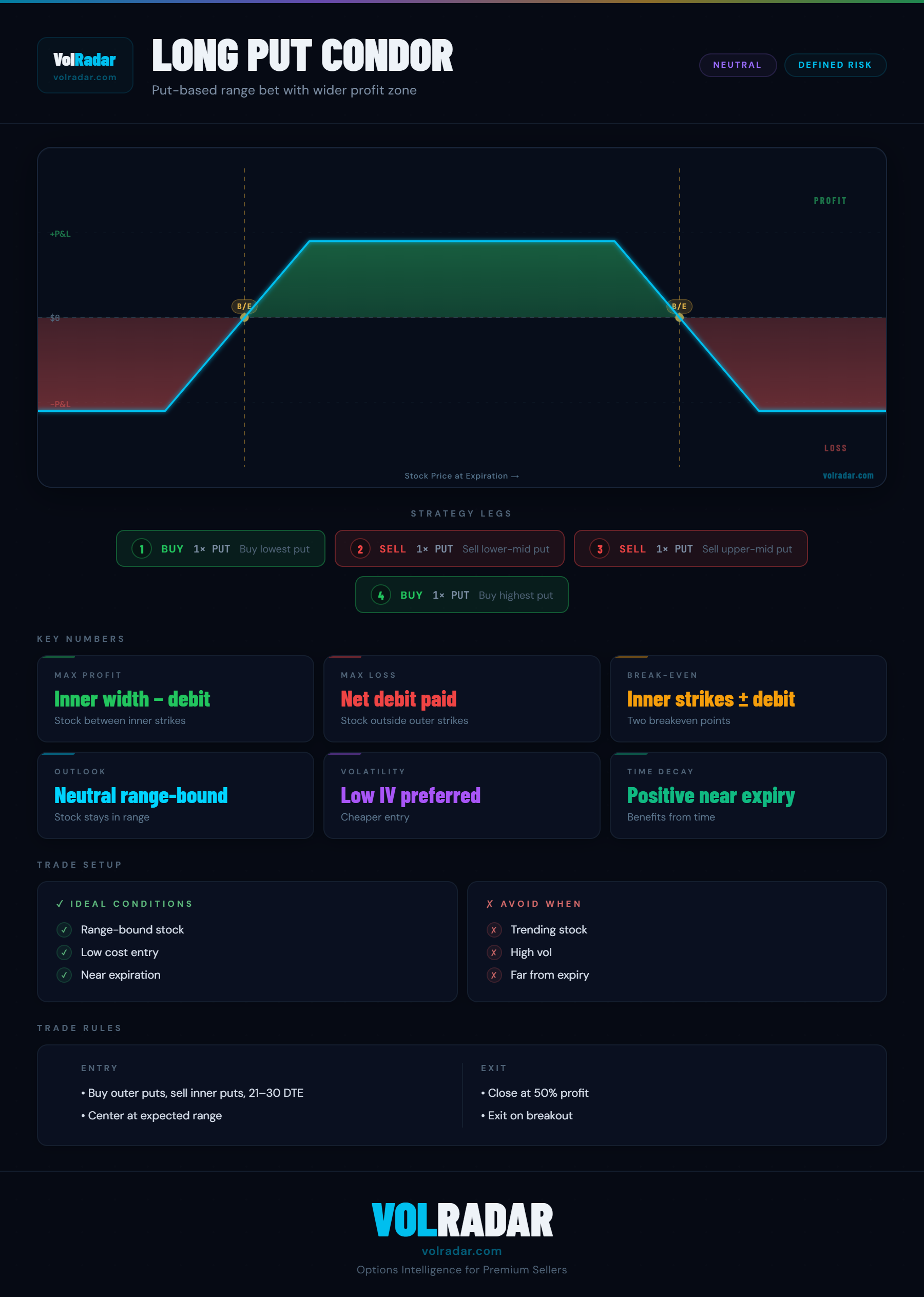
A long put condor buys one higher-strike put, sells one put at each of two middle strikes, and buys one lower-strike put, all in the same expiration.
- Direction
- Neutral
- Drives outcome
- Same payoff as a long call condor, built with puts.
- Risk type
- Defined risk
VolRadar Lens
On paper the put and call versions of a condor have the same expiration payoff when the outer wings are equally wide, but American-style short puts that go deep in the money can be assigned early, so the two are not interchangeable in practice.
Visual ReferencePayoff structure and strike placementShowHide
Why It Matters
The long put condor expresses a view that the underlying will stay within a range, with a known maximum loss. All other things equal, time passing helps the position when the underlying sits between the short strikes, while a rise in implied volatility in that zone hurts it. With American-style options, a short put can be assigned at any time, and if the underlying settles between the lowest long strike and the short strikes at expiration, assignment can leave an unhedged long stock position until the next session.
How It Works
With strikes K1 < K2 < K3 < K4, the position is long the K4 put, short the K3 and K2 puts and long the K1 put, all with the same expiration. When the two outer wings are equally wide (K4 − K3 = K2 − K1), the value at expiration is zero above K4 and below K1 and equals that wing width between K2 and K3. Maximum profit is the wing width minus the net debit; maximum loss is the net debit, reached at or above K4 or at or below K1. The two breakevens are K4 minus the net debit and K1 plus the net debit. Dollar amounts are per-share prices times the contract multiplier (100 for standard US equity options), before commissions on four legs. Because the payoff at expiration matches that of a long call condor with the same strikes and equal wings, the two differ mainly in quoted prices, transaction costs and early-assignment risk on the short legs.
Example
Hypothetical, with the underlying at $580 and standard 100-share contracts: buy one $590 put at $11.50, sell one $580 put at $5.20, sell one $570 put at $1.80 and buy one $560 put at $0.60, all with the same expiration. Net debit = $11.50 + $0.60 − $5.20 − $1.80 = $5.10, or $510 per condor. Each wing is $10 wide, so the maximum value at expiration is $10.00 and the maximum profit is $10.00 − $5.10 = $4.90, or $490, if the underlying settles between $570 and $580. The maximum loss is the $510 debit at or above $590 or at or below $560. Breakevens are $590 − $5.10 = $584.90 and $560 + $5.10 = $565.10, before commissions.
Common Mistakes
Assuming the maximum loss can never exceed the debit when the wings are unequal or when assignment leaves a stock position overnight. Forgetting the multiplier and the four sets of commissions. Treating the long put condor and the short iron condor as the same trade: one uses only puts and is opened for a debit, the other combines a put credit spread and a call credit spread for a credit.
Is the market paying premium sellers today?
The SPY Premium Window study tracks when systematic option selling has historically been compensated — recomputed daily from market close. Free to read, no account needed.
Frequently Asked Questions
How do you calculate the maximum profit of a long put condor?
With equally wide wings, the maximum profit is the distance between the highest strike and the higher short strike minus the net debit paid, reached when the underlying settles between the two short strikes. In the example, $10.00 − $5.10 = $4.90 per share, or $490 per condor with a 100-share multiplier.
What is the maximum loss and where are the breakevens?
With equally wide outer wings, the maximum loss is the net debit paid plus commissions, reached at or above the highest strike or at or below the lowest strike, and the breakevens are the highest strike minus the debit and the lowest strike plus the debit. With unequal wings these figures change.
How does a long put condor differ from an iron condor?
A long put condor uses four puts and is normally opened for a net debit. An iron condor combines a put credit spread and a call credit spread and is opened for a net credit. Both have limited profit and loss, but their cash flows, margin treatment and assignment exposure differ.
General references
General references for this topic area, not citations for the specific figures above. VolRadar is not affiliated with these organizations.
The information about Long Put Condor above is for educational purposes only and is not financial advice. Read our full investment disclaimer.
Understand options faster.
One term, one worked example, one real ticker. Every Sunday. No jargon.
One email per week, no drip campaigns · Unsubscribe anytime