
What is a long put condor?
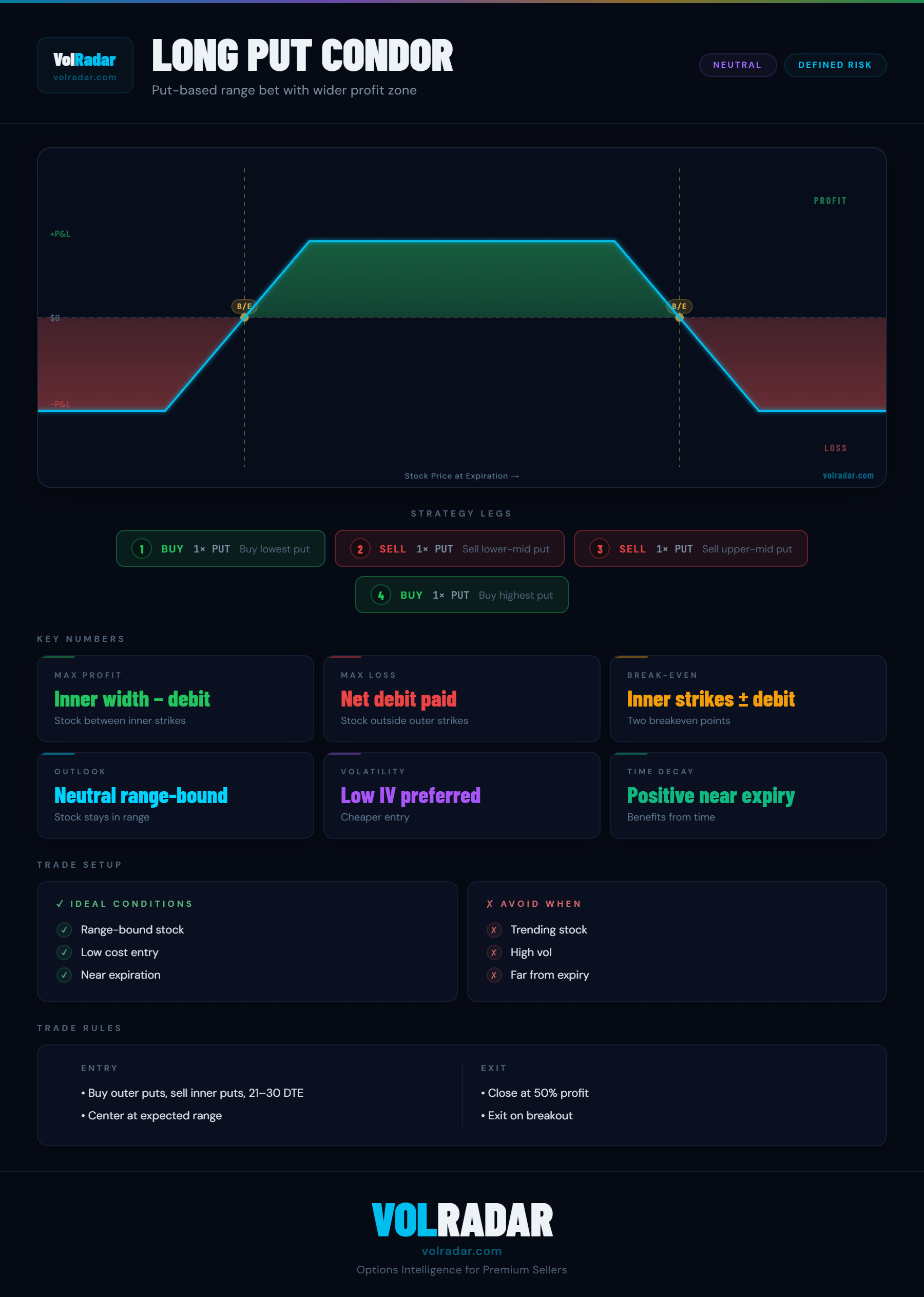
A long put condor uses four strikes with put options: buy 1 put at the highest strike, sell 1 put at the second strike, sell 1 put at the third strike, buy 1 put at the lowest strike. The position profits if the stock stays between the two short strikes at expiration. The payoff profile is identical to a long call condor at the same strikes — by put-call parity, the two structures are equivalent.
Choosing between call and put condors
The long put condor and long call condor at the same strikes are theoretically identical. In practice, skew and liquidity differences make one cheaper than the other. When put skew is low (unusual), the put condor might be cheaper. In normal markets with elevated put skew, call condors often have a smaller net debit. Always compare both to select the more efficient structure.
When to use a long put condor
Use a long put condor in range-bound markets when IV is high and the inner spread premium more than covers the outer wing costs. Place the inner short strikes at the expected support and resistance levels where the stock is likely to consolidate. The debit paid should be minimized relative to the profit zone width — aim for at least a 2:1 reward-to-risk ratio before entering.
Risk and reward
Max profit is the inner spread width minus the net debit, realized when the stock stays between the short strikes at expiration. Max loss is the net debit paid. The risk-to-reward is similar to a butterfly but with a wider plateau — the condor gives a slightly larger range for maximum profit at the cost of a smaller peak P&L per dollar at risk. Compare both structures before selecting.