Loading...
Mechanics
Midpoint Price — Options Order Mechanics Explained
The midpoint price is the average of the best bid and the best offer: (bid + offer) ÷ 2.
By Aigars PilmanisLast updated
Educational content. Not financial, investment, tax, or legal advice. Options involve risk and are not suitable for all investors. How we write & review this glossary.
The midpoint price is the average of the best bid and the best offer at a given moment: (best bid + best offer) ÷ 2. It is used as a reference price, for example to measure execution quality, but it is not itself a quoted price.
Video explainer5:42
Watch: Midpoint Price Explained
5:42 walkthrough — definition, mechanics, worked example, and common mistakes for Midpoint Price.
What to remember from this video
The midpoint price is the 'great compromise' in financial markets, representing the arithmetic average of the best bid and ask; a midpoint fill can reduce trading costs relative to crossing the spread.
Key Insights From The Video
- Midpoint price is the arithmetic average of the best bid and best ask.
- Executing at the bid or ask is typically about half the quoted spread away from the midpoint, a friction cost that can add up over many trades.
- Midpoint execution can significantly reduce trading costs over time.
- Hidden pegged orders and dark pools often use midpoint matching.
Read the complete video explanation~243 words · 1 min read
The midpoint price is a widely used concept in trading. It represents the arithmetic average of the best bid and the best ask, acting as a reference point in the market. This price can be calculated continuously throughout the trading day, using the National Best Bid and Offer (NBBO) as its benchmark. Understanding the midpoint price helps traders see the friction cost of trading at the bid or ask rather than at the midpoint.
Market orders typically cross the spread, which can accumulate into a cost over time. A midpoint fill splits the spread with the counterparty, although a midpoint limit order may not fill, or may fill when the market is moving against it. Over many trades, spread costs can be a meaningful part of total trading costs.
Midpoint matching occurs in several market mechanisms, such as hidden pegged orders and dark pool fills. These orders rest at or near the midpoint and only execute when a marketable order matches them. Institutional desks and retail brokers often utilize these mechanisms to achieve price improvement, measuring their performance against the midpoint.
The midpoint is often used as a reference for setting a limit price. Moving a limit toward the natural bid or ask generally trades price for faster execution.
Comparing the fill price to the midpoint can show whether a trade was executed passively, aggressively, or somewhere in between. This can be one input for assessing execution quality relative to the prevailing spread.
VolRadar Lens
- Definition
- The midpoint price is the arithmetic average of the best bid and the best ask at a given moment.
- Use
- The midpoint is a reference price for some hidden orders, dark pool fills, and price-improvement auctions.
The midpoint is a reference, not a quoted price: nobody is necessarily willing to trade there, so a limit order at the midpoint can stay unfilled while the quotes move away.
Why It Matters
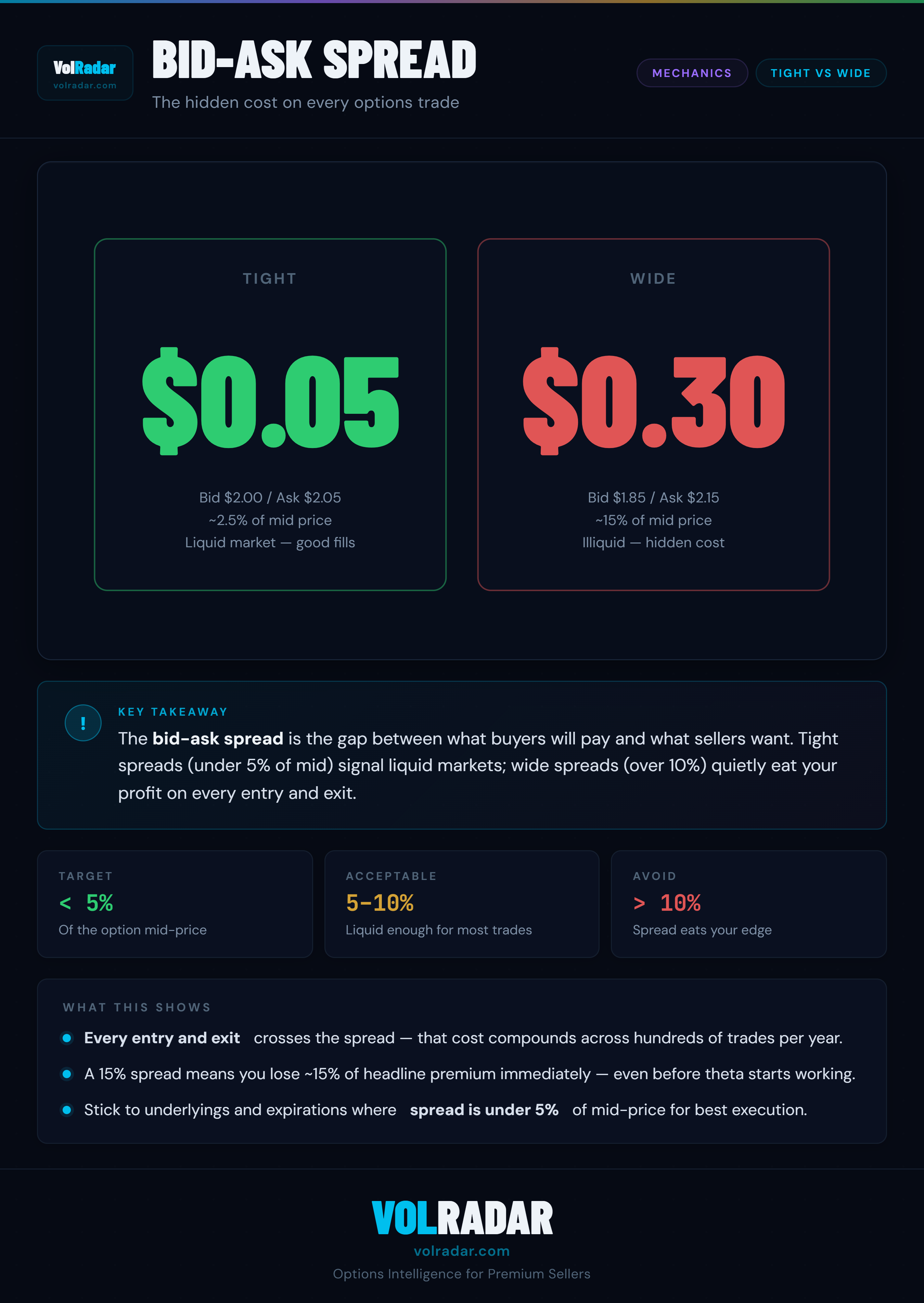
The distance between the midpoint and the price actually paid or received is a direct measure of trading cost. Buying at the offer or selling at the bid costs half the bid-ask spread relative to the midpoint; on wide option quotes, and on multi-leg orders where each leg has its own spread, that cost can be a large share of the premium. Comparing fills with the midpoint at the time of the order is also how SEC execution-quality statistics for NMS stocks measure effective spreads.
How It Works
The midpoint is usually taken from the national best bid and offer (NBBO), the best quotes across exchanges. Because it is recalculated whenever either side of the NBBO changes, it moves constantly. US execution-quality statistics for NMS stocks use it as a benchmark: the SEC's definition of an effective spread measures how far an execution price is from the midpoint of the NBBO at the time the order was received, and a buy filled below the offer or a sell filled above the bid is said to receive price improvement. For a multi-leg options order, the net midpoint is the sum of the leg midpoints with each sold leg subtracted from each bought leg, and the net natural price is found the same way from the prices at which each leg would trade immediately (offers for legs bought, bids for legs sold).
Example
Hypothetical vertical call spread, standard 100-share contracts: the lower-strike call quotes $1.20 bid / $1.30 offer (midpoint $1.25) and the higher-strike call quotes $0.55 bid / $0.65 offer (midpoint $0.60). Selling the lower strike and buying the higher strike has a net midpoint credit of $1.25 − $0.60 = $0.65 and a natural credit of $1.20 − $0.65 = $0.55. A fill at a $0.63 credit would receive $0.63 − $0.55 = $0.08 per share more than the natural price, which is $8 per spread or $40 for five spreads, before commissions and fees.
Common Mistakes
Treating the midpoint as fair value when quotes are wide, one-sided or changing quickly; it is only the center of the current quotes. Computing a spread's midpoint from stale leg quotes. Mixing per-share prices with per-contract dollars (times the contract multiplier, 100 for standard US equity options). Assuming a midpoint limit order will fill; it is not a quote that anyone has committed to.
Frequently Asked Questions
How do you calculate the midpoint price?
Add the best bid and the best offer and divide by two. An option quoted $1.20 bid and $1.30 offer has a midpoint of $1.25; with a 100-share multiplier that is $125 per contract.
Does the midpoint always represent fair value?
No. It is the center of the current best quotes. When quotes are wide, stale or one-sided, or the underlying is moving fast, trades can occur well away from the displayed midpoint, and recent trades or updated quotes can say more about where the market is.
How is the midpoint of a multi-leg options order calculated?
Take each leg's midpoint, add the midpoints of the legs you buy and subtract those of the legs you sell. The result is the net debit or credit at the midpoint. The net natural price uses offers for bought legs and bids for sold legs, so the combined bid-ask width is the sum of the leg widths.
General references
General references for this topic area, not citations for the specific figures above. VolRadar is not affiliated with these organizations.
Visual ReferenceVisual reference for Midpoint PriceShowHide
The information about Midpoint Price above is for educational purposes only and is not financial advice. Read our full investment disclaimer.
Understand options faster.
One term, one worked example, one real ticker. Every Sunday. No jargon.
One email per week, no drip campaigns · Unsubscribe anytime