Loading...
Mechanics
Qualified Covered Call — Options Order Mechanics Explained
A qualified covered call is an exchange-traded call on stock you hold that passes IRS tests, such as more than 30 days to expiration and not deep in the money, so it escapes the tax straddle rules.
By Aigars PilmanisLast updated
Educational content. Not financial, investment, tax, or legal advice. Options involve risk and are not suitable for all investors. How we write & review this glossary.
A qualified covered call is a call option written on stock the writer holds that meets the tests in US Internal Revenue Code section 1092(c)(4): among them, it trades on a national securities exchange, is granted more than 30 days before expiration and is not deep in the money. A straddle made only of qualified covered calls and the optioned stock is not treated as a straddle for tax purposes, so the straddle loss-deferral and holding-period rules do not apply to it.
VolRadar Lens
- Definition
- A qualified covered call is an IRS-defined short call against long stock that does not by itself create a tax straddle; an in-the-money qualified call can still suspend the holding period of shares not yet held long-term.
- Use
- Tax treatment matters. Selling deep-ITM or very short-dated calls on long stock can fail the qualification tests and suspend the holding period.
Qualification is decided on the day the call is written, from the previous close and the strikes listed that day, so the same strike can pass one week and be deep in the money the next after the stock has moved.
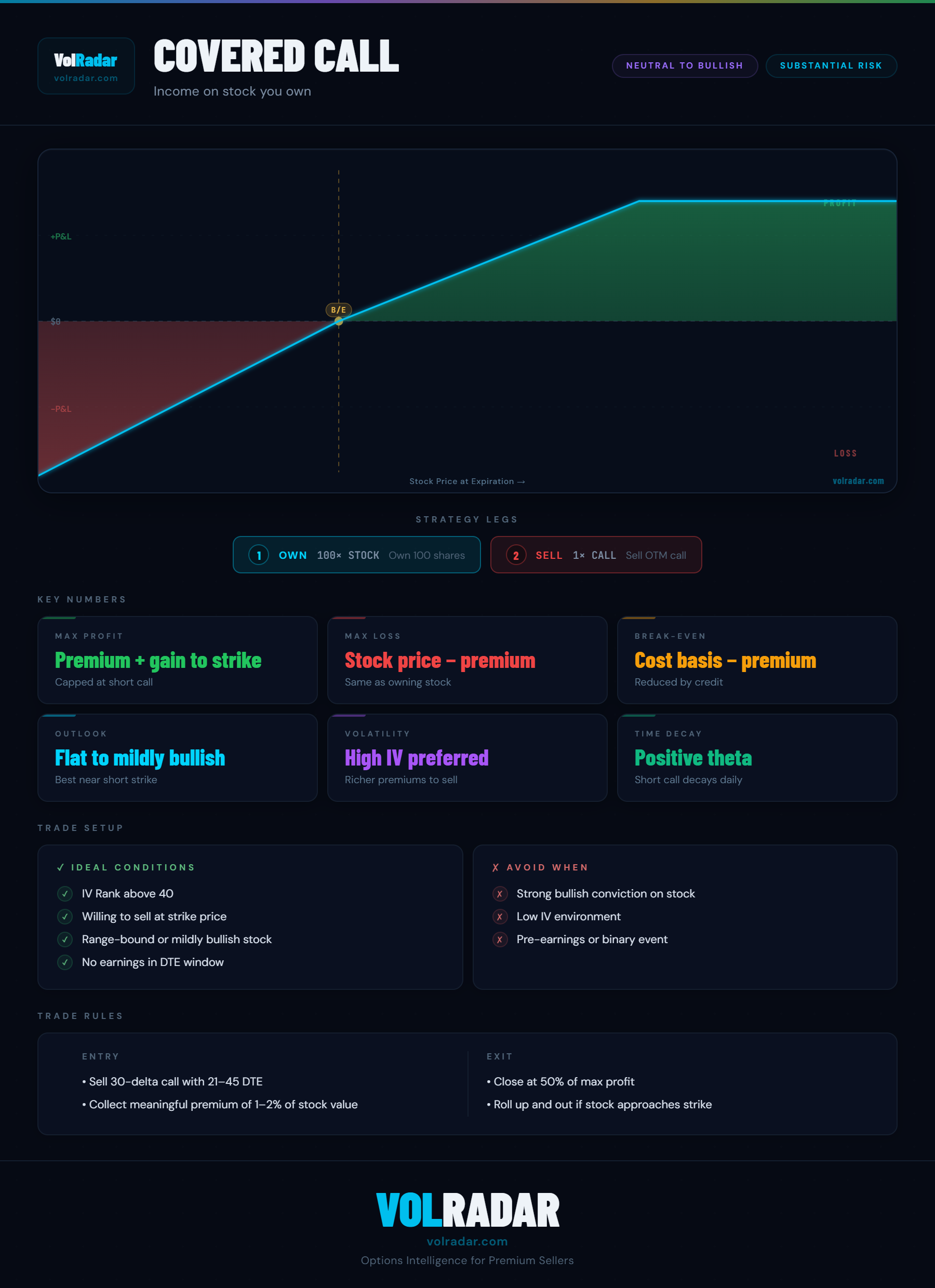
Visual ReferenceVisual reference for Qualified Covered CallShowHide
Why It Matters
Stock plus a call written against it can form a straddle under the tax rules. If the covered call does not qualify, the straddle rules apply: a loss on one leg can be deferred while there is unrecognized gain on the other, and if the stock had been held for one year or less when the straddle began, its holding period starts over no earlier than the day the straddle ends. That can turn a gain that was on its way to long-term treatment into a short-term gain. Qualifying removes those effects, apart from the holding-period pause for an in-the-money qualified call. Tax results depend on individual facts, so Publication 550 and a tax professional are the reference for a specific position.
How It Works
IRS Publication 550 lists the conditions. The option is traded on a national securities exchange or another market approved by the Treasury; it is granted more than 30 days before its expiration date; for options entered into after July 28, 2002, it is granted not more than 12 months before expiration (unless it meets term and benchmark requirements published by the IRS); it is not a deep-in-the-money option; the writer is not an options dealer writing it in the course of dealing; and gain or loss on the option is capital gain or loss. Deep in the money means a strike price below the lowest qualified benchmark (LQB). The LQB is the highest available strike price below the applicable stock price. For an option with a term of more than 90 days and a strike price above $50, the LQB is the second-highest available strike below the applicable stock price. The applicable stock price is the stock's closing price on the last trading day before the option is written, or the opening price on the day it is written if that opening price is more than 110% of the prior close. Two floors apply: if the applicable stock price is $25 or less, the LQB is treated as not less than 85% of that price; if it is $150 or less, the LQB is treated as not less than $10 below that price. A qualified covered call can still be in the money. If its strike is below the applicable stock price, the stock's holding period does not include the time the call is open, and a loss on the call is treated as long-term capital loss if gain on selling the stock at that time would have been long-term. A special year-end rule brings the straddle rules back when the call is closed or the stock is sold at a loss in one tax year, the offsetting gain falls in a later year, and the stock or call is not held for 30 days after that closing or sale.
Example
Hypothetical figures, for illustration only. A stock closed at $62.40 the day before a covered call is written, it opens below 110% of that close, and calls are listed at $55, $57.50, $60, $62.50 and $65. For a 45-day call, the LQB is $60, the highest strike below $62.40. A $60 call qualifies; it is in the money, so the stock's holding period pauses while the call is open. A $57.50 45-day call is below the LQB, so it is deep in the money and does not qualify. For a 120-day call with a strike above $50, the LQB is the second-highest strike below $62.40, which is $57.50, so a $57.50 120-day call can qualify. The $10 floor does not change these results because both benchmarks are above $62.40 - $10 = $52.40. A call written 30 days before expiration fails on term alone, since the rule requires more than 30 days.
Common Mistakes
Treating exactly 30 days to expiration as enough: the rule requires more than 30 days. Measuring deep in the money from the current price instead of the applicable stock price, which is normally the prior day's close. Forgetting that a term over 90 days with a strike above $50 moves the benchmark down to the second-highest strike below the price. Assuming every in-the-money call fails: a call at or above the LQB can qualify, but the stock's holding period pauses while it is open. Overlooking the year-end rule when the call or stock is closed near December 31.
Frequently Asked Questions
What makes a covered call qualified?
Per IRS Publication 550, the call must be traded on a national securities exchange or other approved market, be granted more than 30 days before expiration (and generally not more than 12 months), not be deep in the money, not be written by an options dealer in its dealing activity, and produce capital gain or loss.
What is the lowest qualified benchmark?
It is the highest available strike price below the applicable stock price, which is usually the prior day's closing price. For options with more than 90 days to expiration and a strike above $50, it is the second-highest strike below that price. A call with a strike below the benchmark is deep in the money and does not qualify.
Does an in-the-money qualified covered call affect the holding period?
Yes. If the strike is below the applicable stock price, the holding period of the stock does not include the time you are the writer of the call. The call still qualifies, so the other straddle rules do not apply.
What happens if a covered call is not qualified?
The stock and the call can be treated as a straddle. Losses may be deferred while there is unrecognized gain in the offsetting position, and for stock held one year or less when the straddle began, the holding period begins no earlier than the date the straddle ends.
General references
General references for this topic area, not citations for the specific figures above. VolRadar is not affiliated with these organizations.
The information about Qualified Covered Call above is for educational purposes only and is not financial advice. Read our full investment disclaimer.
Understand options faster.
One term, one worked example, one real ticker. Every Sunday. No jargon.
One email per week, no drip campaigns · Unsubscribe anytime