Loading...
The difference between expected execution price and actual fill price. Caused by market movement, wide spreads, and low liquidity.
⚡
Key takeawayThe invisible tax on every options trade. Use limit orders, trade liquid underlyings, avoid market orders.
💡 Why It Matters
Slippage is the invisible tax on every options trade — the gap between expected and actual fill price. On wide-spread options or during volatile moments, slippage can eat 10-20% of your expected premium. It directly reduces your edge.
⚙ How It Works
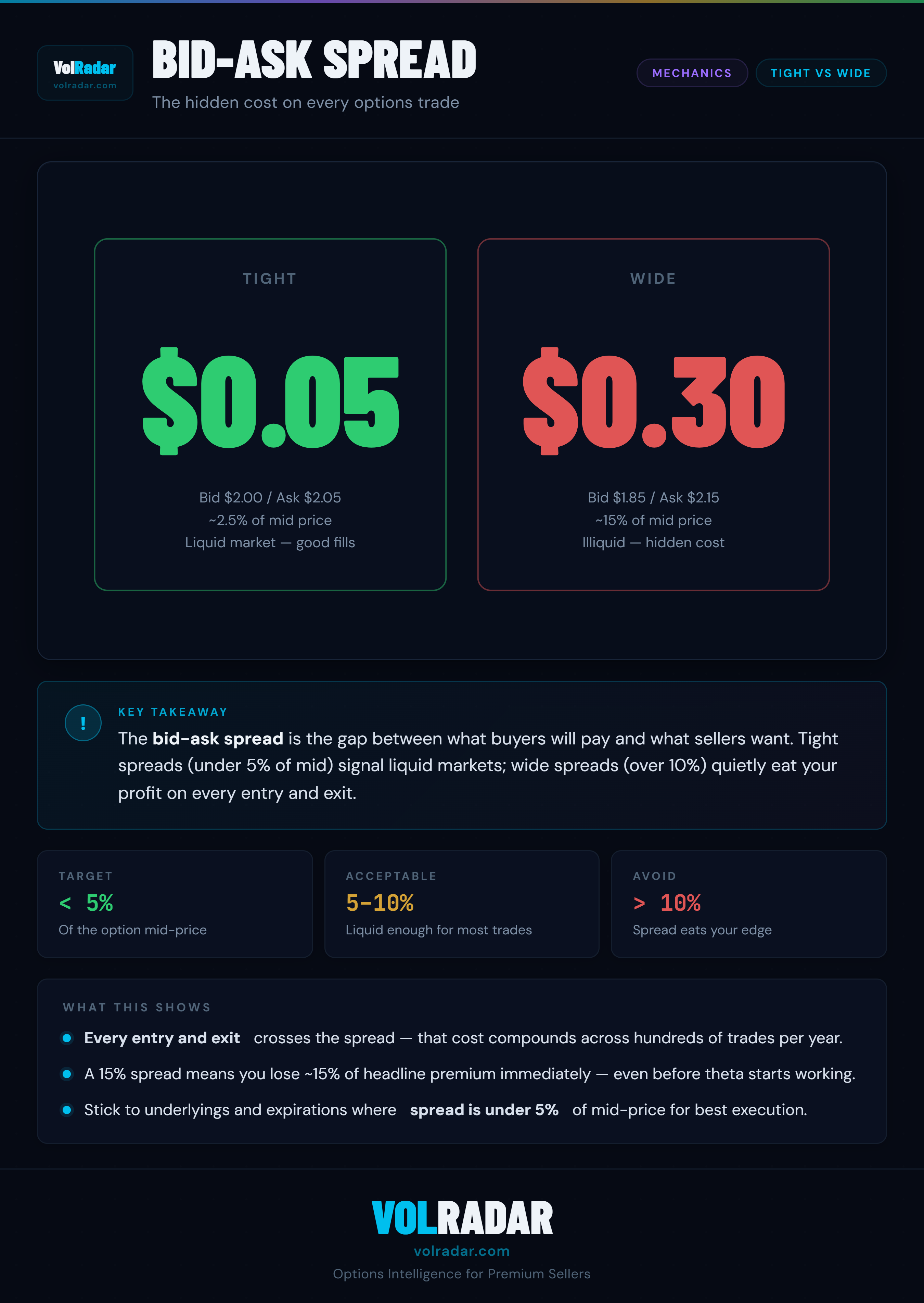
Slippage occurs from: (1) market movement between decision and execution, (2) wide bid-ask spreads forcing you to cross, (3) large orders moving the market, (4) fast markets during news events. Slippage is always in the adverse direction — you sell lower and buy higher than expected.
📋 Example
You target selling a put at $3.00 (mid price). By the time you submit and fill, you get $2.88. Slippage: $0.12 per share ($12 per contract). On a $1.50 credit spread, that $0.12 slippage reduces your premium by 8%. Over 50 trades per year, slippage costs you $600.
⚠ Common Mistakes
Not accounting for slippage in backtests. Every backtest that uses mid prices overstates real returns. Deduct $0.05-$0.15 per leg from expected fills for realistic performance estimation. Also: trading during market open (9:30-10:00am) when spreads are widest.
❓ FAQ
What is Slippage?
The difference between expected execution price and actual fill price. Caused by market movement, wide spreads, and low liquidity.
Why does Slippage matter for premium sellers?
The invisible tax on every options trade. Use limit orders, trade liquid underlyings, avoid market orders.
How does Slippage work?
Slippage occurs from: (1) market movement between decision and execution, (2) wide bid-ask spreads forcing you to cross, (3) large orders moving the market, (4) fast markets during news events. Slippage is always in the adverse direction — you sell lower and buy higher than expected.
What are common mistakes with Slippage?
Not accounting for slippage in backtests. Every backtest that uses mid prices overstates real returns. Deduct $0.05-$0.15 per leg from expected fills for realistic performance estimation. Also: trading during market open (9:30-10:00am) when spreads are widest.
Related Terms
60/40 Tax Treatment
The favorable tax split for Section 1256 contracts: 60% of gains are taxed at the long-term capital gains rate and 40% at the short-term rate, regardless of ...
Adjusted Option
An option whose terms have been modified due to a corporate action — stock split, special dividend, merger, or spinoff.
All-or-None Order
An order that must fill completely or not at all, but unlike FOK, it can wait in the book for a complete fill rather than canceling immediately.
American-Style Option
An option that can be exercised by its holder at any time from listing until expiration.
This is not financial advice. Read our full investment disclaimer.