Loading...
Strategies
Strip — Options Strategy Explained
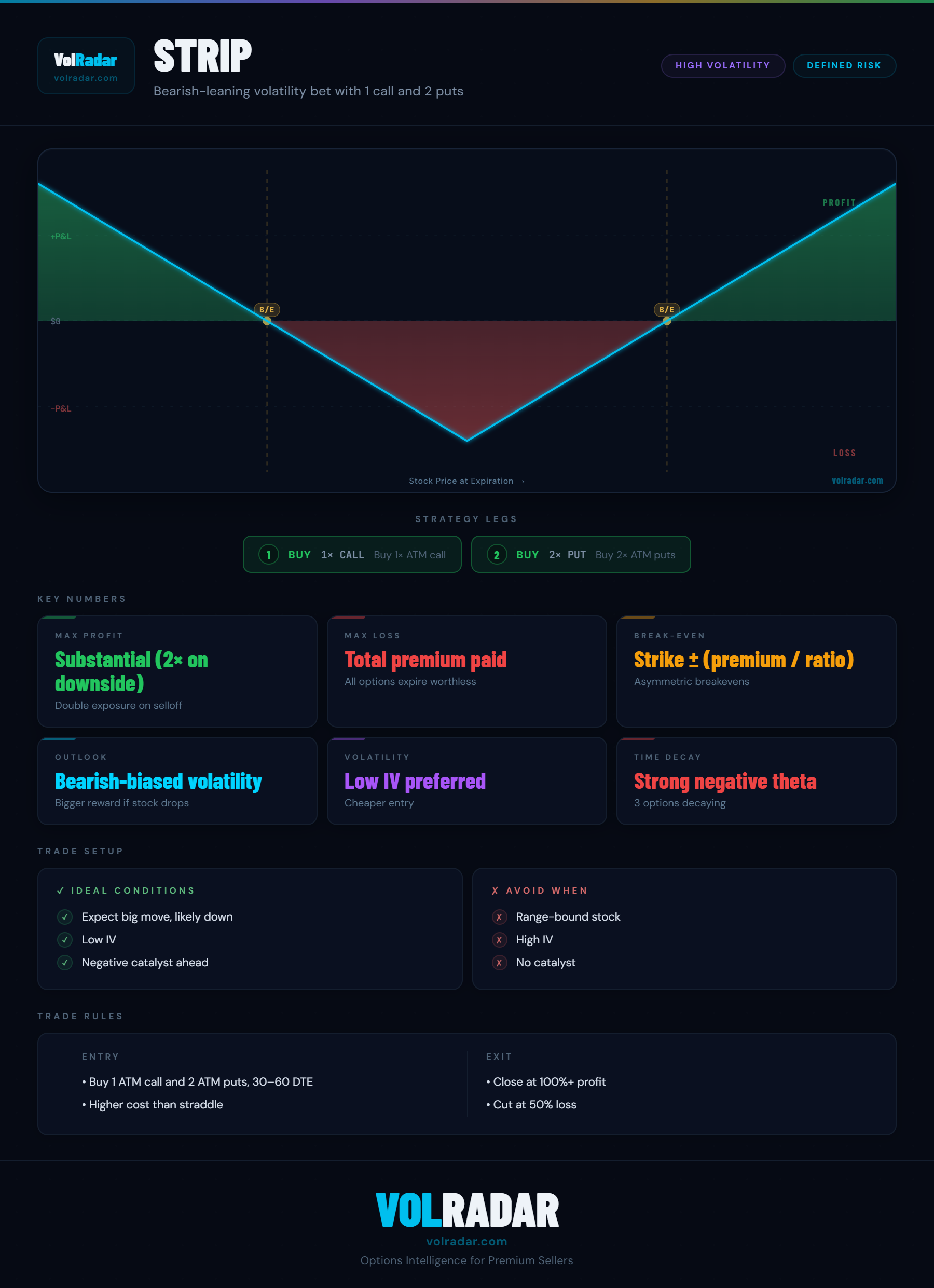
A strip buys two puts and one call at the same strike and expiration: a straddle tilted toward a bearish move.
By Aigars PilmanisLast updated
Educational content. Not financial, investment, tax, or legal advice. Options involve risk and are not suitable for all investors. How we write & review this glossary.
Read the full guide
Strip Options Strategy — Bearish Volatility Play with Extra Put
A strip buys 1 ATM call and 2 ATM puts at the same strike — a straddle skewed bearish. Why traders use it before negative-catalyst events and how the cost compares to a standard straddle.
Read the guide→Video explainer5:39
Watch: Strip Explained
5:39 walkthrough — definition, mechanics, worked example, and common mistakes for Strip.
What to remember from this video
A strip strategy is like a straddle but tilted bearish, with double puts for increased downside exposure.
Key Insights From The Video
- A strip involves buying two puts and one call at the same strike and expiration.
- Two puts give the position about twice the put-side payoff slope below the strike at expiration, before the premium paid is recovered.
- A single call adds payoff above the strike at expiration, but net profit requires a move beyond the upper breakeven.
- Breakevens differ from a standard straddle's because of the additional put and higher premium.
- Rising implied volatility, with other inputs held constant, tends to benefit the strip because it is long vega on all three legs.
Read the complete video explanation~274 words · 1 min read
The strip strategy is a bearish-biased long straddle. It involves buying two puts and one call at the same strike price and expiration date. This setup provides double exposure to the downside while maintaining single-call coverage for potential upside moves.
By doubling up on the puts, traders are heavily weighting their bet toward a decline in the underlying asset's price. Below the strike at expiration, each dollar of downside adds about twice the payoff of a single put, thanks to the two puts, before the premium paid is recovered.
In the event of a surprise rally, the single call adds payoff above the strike. While the call doesn't provide the same leverage as the puts, it adds payoff dollar-for-dollar above the strike, with net profit only above the upper breakeven.
A key advantage of the strip is its long vega position on all three legs. This means that when implied volatility rises, often coinciding with market drops, the value of the position tends to increase, other inputs held constant.
The tradeoff for this strategy is the higher premium paid for three option legs, changing the breakevens compared with a standard straddle. A significant market move is required to make the trade profitable.
In practice, if a stock is trading at 100, a trader would buy two 100 puts and one 100 call. If the stock price falls, the puts generate accelerated profits. If the stock rises, the call captures the upside, albeit with smaller gains.
The strip contrasts with the strap strategy, which is bullish-biased with double calls. Both strategies are directional straddles, placing a bet on the direction in which volatility will resolve.
The position
Structure
A strip buys two puts and one call at the same strike
- Direction
- Bearish
- Drives outcome
- A move either way, with twice the put exposure on the downside.
- Risk type
- See structure
VolRadar Lens
A strip needs a large move to pay off; the most it can lose is the debit, lost in full if the underlying finishes exactly at the strike. It costs more than a straddle at the same strike, so both breakevens need a meaningful move.
Why It Matters
A strip expresses a view that a big move is coming and that it is more likely to be down than up, while keeping some payoff if the move is up. The asymmetry is visible in the breakevens: the lower one sits half the debit below the strike, the upper one a full debit above it.
How It Works
Buy two puts and one call, all at strike K and the same expiration; total debit D = 2 × put premium + call premium. At expiration: below K, each put is worth K − S, so P&L = 2(K − S) − D, and the lower breakeven is K − D/2. Above K, only the call pays, so P&L = (S − K) − D, and the upper breakeven is K + D. At exactly K all three options expire worthless and the loss is the full debit. All three legs are long options, so the position is long vega and loses value from time decay if the underlying does not move. The mirror image, two calls and one put, is a strap.
Example
Hypothetical: stock at $100. Buy two $100 puts at $4.00 and one $100 call at $4.00; debit = $12.00 ($1,200). Lower breakeven = $100 − $12/2 = $94; upper breakeven = $100 + $12 = $112. At expiration: at $85, P&L = 2 × $15 − $12 = $18 per share ($1,800); at $115, P&L = $15 − $12 = $3 ($300); at $100, the loss is the full $1,200.
Common Mistakes
Treating it as a cheap bearish bet: it costs more than a straddle at the same strike. Holding through a known event without accounting for implied volatility falling afterwards, which lowers the value of all three long options. Using the straddle breakeven formula; the extra put changes the lower breakeven to K − D/2. Confusing a strip with a strap (two calls, one put).
Is the market paying premium sellers today?
The SPY Premium Window study tracks when systematic option selling has historically been compensated — recomputed daily from market close. Free to read, no account needed.
Frequently Asked Questions
What is a strip in options?
A position that buys two puts and one call at the same strike and expiration. It profits from large moves and gains twice as fast on a decline.
What are the breakevens of a strip?
With strike K and total debit D: lower breakeven K − D/2, upper breakeven K + D, at expiration and before commissions.
What is the maximum loss on a strip?
The total debit paid, reached if the underlying finishes exactly at the strike at expiration.
What is the difference between a strip and a strap?
A strip has two puts and one call (tilted to a decline); a strap has two calls and one put (tilted to a rally).
How does implied volatility affect a strip?
All three legs are long options, so a rise in implied volatility helps and a fall hurts, other things equal. A drop in implied volatility after an event can offset part of the gain from the move.
General references
General references for this topic area, not citations for the specific figures above. VolRadar is not affiliated with these organizations.
Visual ReferencePayoff structure and strike placementShowHide
The information about Strip above is for educational purposes only and is not financial advice. Read our full investment disclaimer.
Understand options faster.
One term, one worked example, one real ticker. Every Sunday. No jargon.
One email per week, no drip campaigns · Unsubscribe anytime