
What is a strip options strategy?
A strip buys 1 ATM call and 2 ATM puts at the same strike and expiration. The double puts give the position a bearish bias — if the stock falls sharply, the two puts contribute twice as much profit as a single put. If the stock rallies, only the single call profits. The strip costs more than a straddle (three options vs two) but provides asymmetric exposure favoring a downward move.
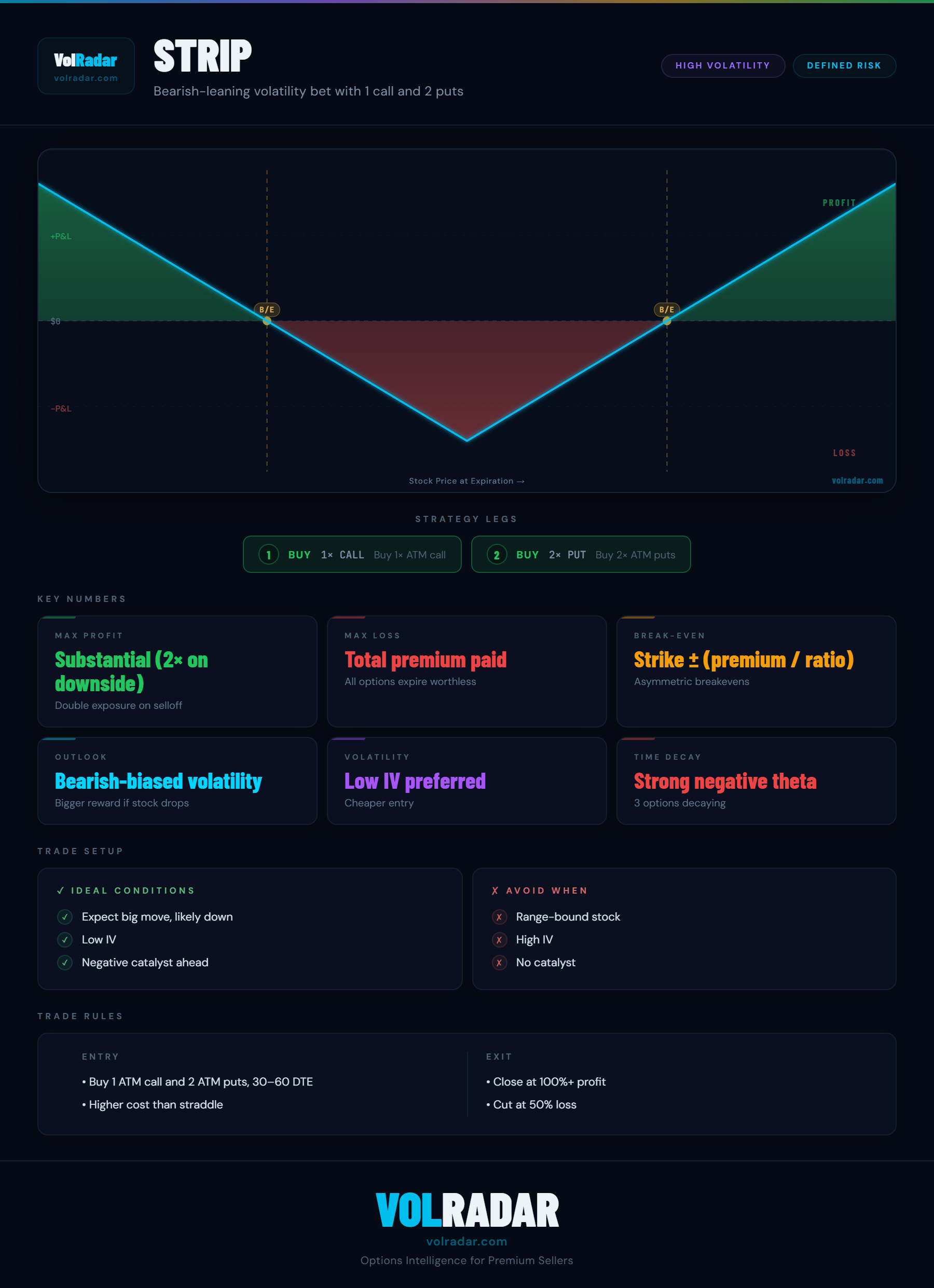
Strip vs straddle
A straddle has equal profit potential in both directions (symmetric V-shape). A strip has a steeper profit slope on the downside and a standard slope on the upside (asymmetric). Use a strip over a straddle when you are biased toward a downward move but cannot completely rule out an upward move. The strip costs roughly 50% more than the straddle for the extra put.
When to use a strip
Strips are appropriate before events where a negative outcome is more likely but a positive outcome is still possible — for example, before FDA decisions on drugs where approval is uncertain but rejection is more probable. The strip captures full upside profit while doubling the downside gain. Use when IV is low to limit the cost of the three-option structure.
Risk and time decay
Max loss is the total premium paid for all three options. Three options means three times the theta decay of a single option — the strip decays faster than a straddle. Enter with sufficient time (45+ DTE) to allow the anticipated move to occur. Close when profit target is reached or when the catalytic event has passed and the thesis is no longer valid.