
What is a strap options strategy?
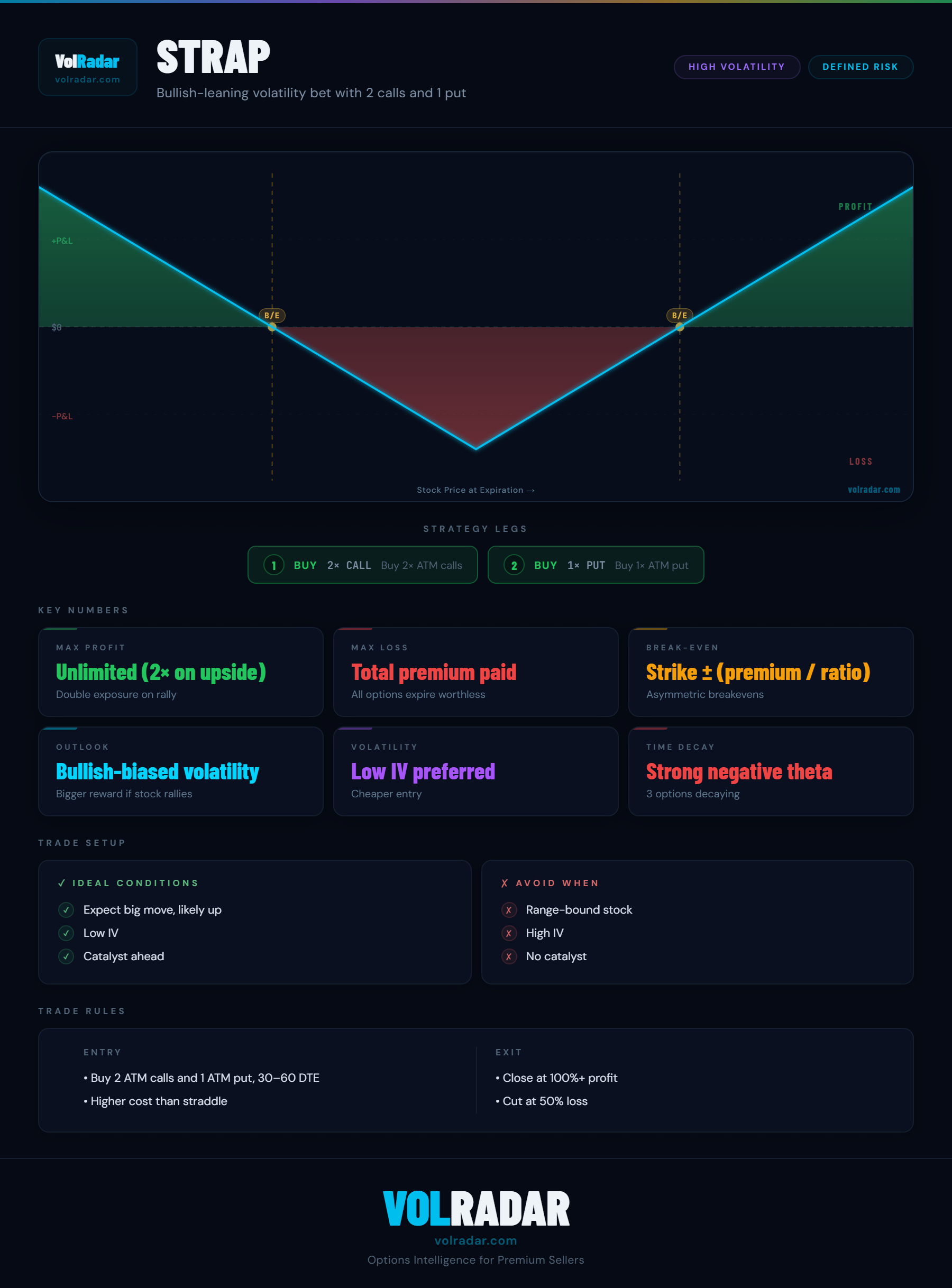
A strap buys 2 ATM calls and 1 ATM put at the same strike and expiration. The double calls give the position a bullish bias — if the stock rallies sharply, the two calls contribute twice as much profit as a single call. If the stock falls, only the single put profits. The strap is the bullish mirror of the strip, and it is the appropriate choice when you expect a large move biased to the upside.
Strap vs strip vs straddle
Straddle: equal profit on moves in either direction. Strip: extra profit on downside moves (bearish bias). Strap: extra profit on upside moves (bullish bias). All three require a large move to overcome the premium paid. Choose based on your directional view: no bias → straddle; bullish bias → strap; bearish bias → strip.
When to use a strap
Use a strap before events where a positive outcome is more likely but a negative outcome cannot be ruled out — product launches, earnings beats, regulatory approvals with favorable likelihood. The strap captures full downside protection while doubling the upside gain. Enter with low IV to minimize cost. As with all long volatility strategies, the stock must move significantly to overcome the premium paid.
Risk and time decay
Max loss is the total premium paid for all three options. Three options means accelerated time decay — the strap loses value faster than a straddle in stagnant markets. Close at a predetermined profit target rather than holding to expiration. If the expected move does not occur within 50% of the DTE, close the position to avoid continued theta decay eroding the remaining value.