
What is a long call?
A long call option gives the buyer the right — but not the obligation — to purchase 100 shares of a stock at the strike price before expiration. You pay a premium to buy this right. If the stock rises above the breakeven price (strike plus premium paid), the call gains value. If the stock stays flat or falls, the option loses value and can expire worthless — limiting the loss to the premium paid.
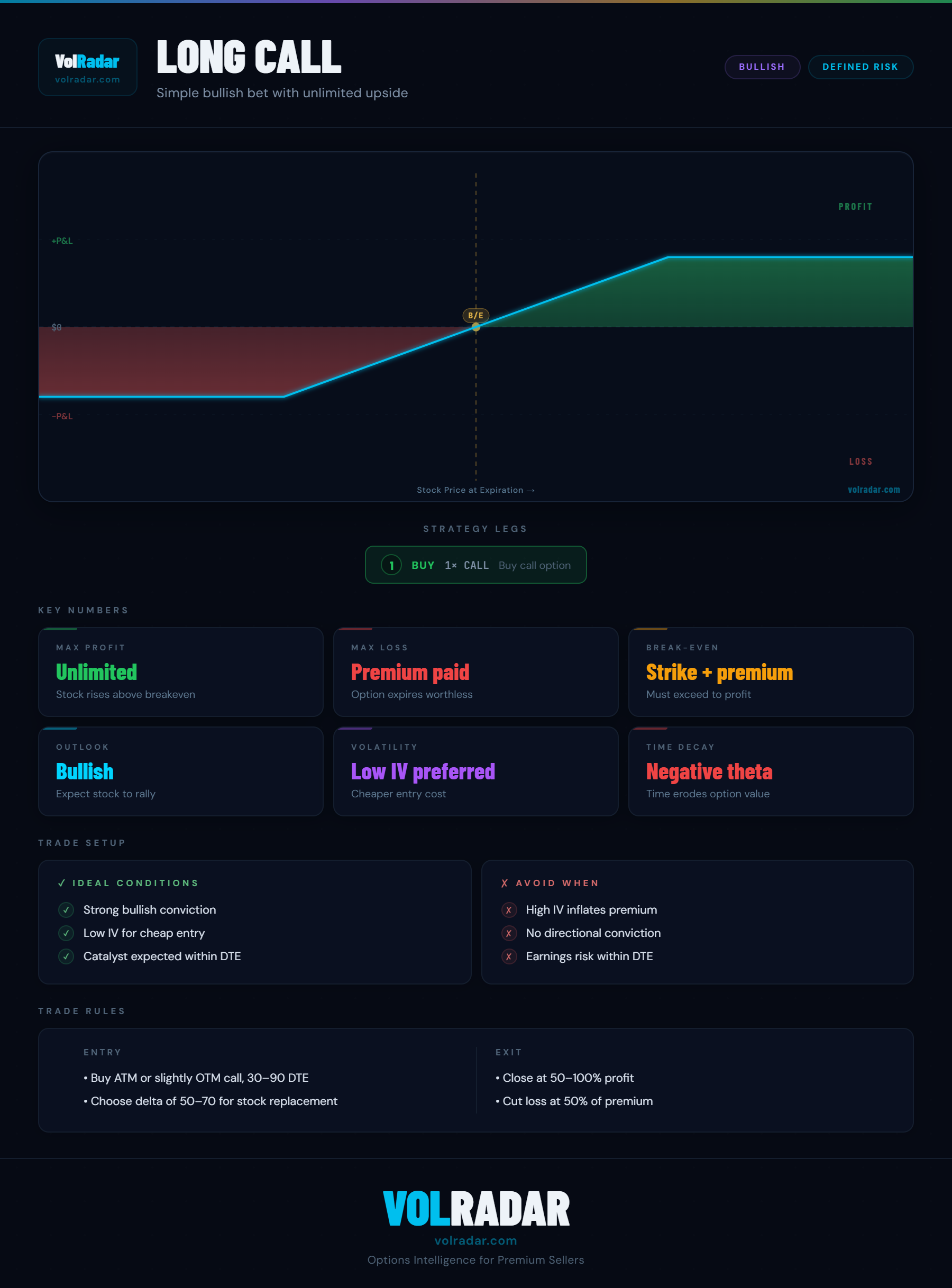
Long call setup and mechanics
Choose a strike price — ATM (at-the-money) for maximum sensitivity, OTM for more leverage with lower cost, ITM for lower leverage with less time decay risk. Choose an expiration — longer DTE gives more time for the trade to work but costs more. The delta of a long call tells you how much the option value moves per $1 move in the stock: a 50-delta call moves $0.50 for every $1 stock move.
When to buy calls
Long calls work best when you expect a significant upward move and implied volatility is low — buying options is most efficient when IV Rank is below 30. Buying calls in high IV environments is expensive and requires a large move just to break even. Use long calls for directional trades around catalysts, breakouts above resistance, or when you want leveraged upside with defined risk. The bull call spread is a cost-reduced alternative.
Risk and time decay
Max loss is the premium paid. Max profit is theoretically unlimited. The biggest risk besides direction is time decay (theta) — long options lose value every day, with decay accelerating in the final 30 days. To manage theta risk, avoid buying options with less than 30 DTE unless you have a near-term catalyst. Consider taking profits at 50–100% gain rather than holding to expiration.