
What is a bull call spread?
A bull call spread (also called a call debit spread) buys a call option at a lower strike and sells a call option at a higher strike on the same expiration. The premium collected from the sold call partially offsets the cost of the bought call. The result is a lower-cost bullish position with capped profit. It is most effective when the stock is moderately bullish and implied volatility is low.
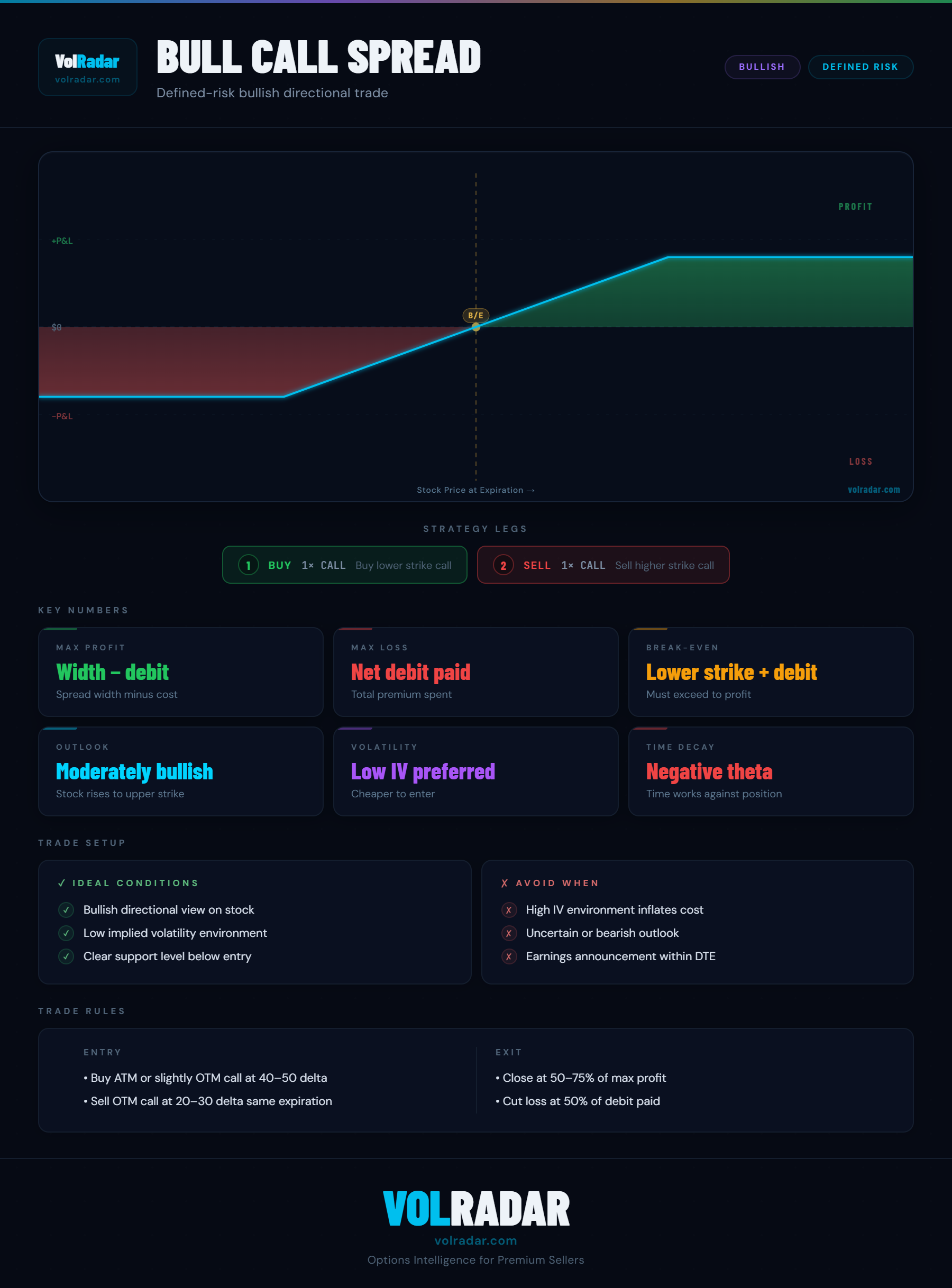
How to set up a bull call spread
Buy a call at or slightly OTM (e.g., 40–50 delta). Sell a call at a higher strike where you expect the stock to reach (e.g., 20–30 delta). The net debit is the maximum loss. Example: $100 stock, buy the $100 call for $4.00, sell the $105 call for $1.75, net debit $2.25. Max profit is $2.75 (spread width $5 minus debit $2.25), max loss is $2.25, breakeven is $102.25.
Bull call spread vs buying a single call
A long call has unlimited upside but costs more and decays faster. A bull call spread reduces cost and time decay (the short call offsets theta) but caps the upside. In low IV environments, bull call spreads are preferred because you pay less premium and need the stock to move less to profit. In high IV, the short call collects more credit, making the spread more efficient.
Risk and management
Max loss is the net debit paid. Max profit is the spread width minus the debit. Breakeven is the long call strike plus the net debit. Consider closing at 50% of max profit rather than waiting for full profit — time decay works against you as the position approaches expiration. If the stock moves strongly in your favor, you can also close early to lock in gains before gamma risks increase.