
What is a bull put spread?
A bull put spread (also called a put credit spread) sells a put option at one strike and buys a put option at a lower strike on the same expiration. You collect the difference in premium as a net credit. The position profits if the stock stays above the short put strike through expiration. Risk is fully defined — you can lose at most the spread width minus the credit collected.
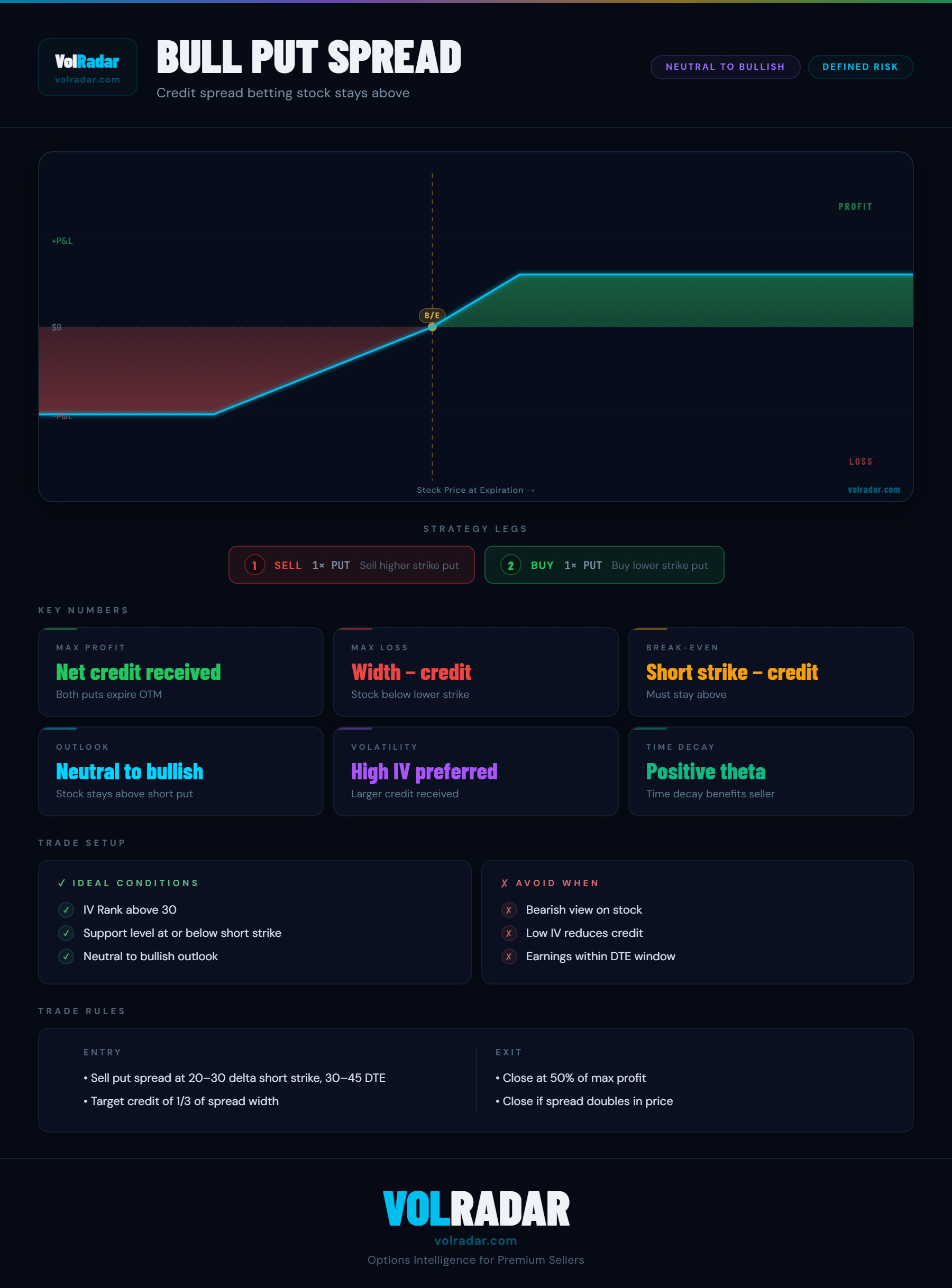
How to set up a bull put spread
Sell a put at approximately 15–20 delta (outside the 1 standard deviation range). Buy a put 3–5 strikes lower to cap risk. Collect at minimum one-third of the spread width as premium. Example: $100 stock, sell the $90 put, buy the $85 put, collect $1.75 on a $5-wide spread. Max profit is $175, max loss is $325, breakeven is $88.25. Enter at 45 DTE for maximum time decay.
When to use a bull put spread
Use bull put spreads when IV Rank is above 40, the stock has a bullish or neutral trend, and there are no earnings within the DTE window. The VolRadar scanner filters for these conditions automatically — look for a Weather Score of at least 65 combined with a positive RV Ratio on the put side. Avoid bull put spreads when the stock is in a downtrend or breaking major support levels.
Risk, reward, and management
Max profit equals the net credit collected. Max loss equals the spread width minus credit. Target 50% of max profit as the close trigger (do not hold to expiration to avoid gamma risk). If the stock moves against the position, close at 2x the original premium collected as a stop-loss. The bull put spread is the put-side component of an iron condor — adding a bear call spread on the other side creates the full four-legged structure.