
What is a bear call spread?
A bear call spread (also called a call credit spread) sells a call option at one strike and buys a call option at a higher strike on the same expiration. You collect the net premium difference as a credit. The position profits if the stock stays below the short call strike through expiration. Risk is capped — you cannot lose more than the spread width minus the premium collected.
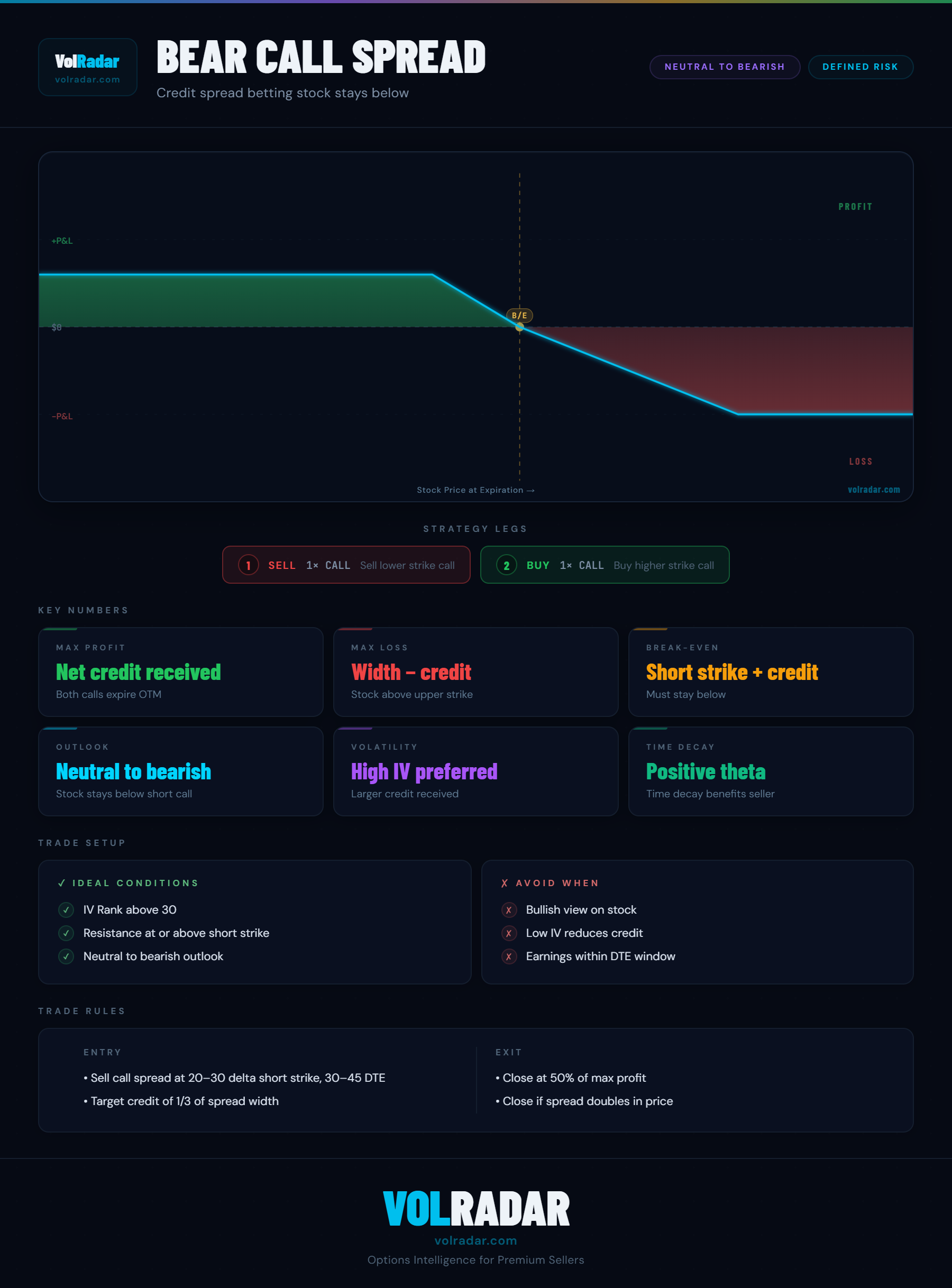
How to set up a bear call spread
Sell a call at approximately 15–20 delta (above the 1 standard deviation range). Buy a call 3–5 strikes higher to cap risk. Collect at minimum one-third of the spread width as premium. Example: $100 stock, sell the $110 call, buy the $115 call, collect $1.75 on a $5-wide spread. Max profit is $175, max loss is $325, breakeven is $111.75. Enter at 45 DTE and manage at 50% of max profit.
Bear call spread vs bull put spread
Both are credit spreads with defined risk, but the bear call spread is positioned above the stock (bearish bias) while the bull put spread is below the stock (bullish bias). Combined on the same expiration, they form an iron condor. When trading a bear call spread alone, you have a directional view that the stock will stay below the short call — or at least not rally through it.
Risk and management
Max profit is the net credit collected. Max loss is the spread width minus the credit. Manage at 50% of max profit and close at 2x the credit as a loss limit. The key risk is a sudden upside breakout — gap-up moves on news or earnings can push the stock through both strikes. Avoid bear call spreads near support levels that, if broken to the upside, could trigger a squeeze.