Loading...
Strategies
Call Credit Spread — Options Strategy Explained
A call credit spread sells a lower-strike call and buys a higher-strike call on the same stock and expiration for a net credit.
By Aigars PilmanisLast updated
Educational content. Not financial, investment, tax, or legal advice. Options involve risk and are not suitable for all investors. How we write & review this glossary.
Call Credit Spread vs Covered Call
Call Credit Spread sells a call and buys a higher-strike call to cap the upside risk, requiring no stock ownership. Covered Call sells a call against 100 shares already owned. The spread is a capital-efficient bearish-to-neutral bet; the covered call is a short call written against long stock.
| Feature | Call Credit Spread | Covered Call |
|---|---|---|
| Underlying requirement | No stock needed, fully defined-risk spread | Must own 100 shares per contract |
| Market bias | Neutral to mildly bearish | Neutral to mildly bullish |
| Capital needed | Maximum loss at expiration (width minus credit) is a common reference point; actual margin varies by broker and account type | Full cost of 100 shares per contract |
| Max loss | Width minus credit, defined at entry | Share downside below cost basis minus premium |
| Max profit | Net credit collected | Premium plus appreciation up to the short call strike |
| Used to express | A neutral-to-bearish view with the loss capped by a long call | A short call against shares already held |
Key trade-off
A call credit spread reaches its maximum profit at expiration if price finishes below the short call strike, and the long call caps the loss at the width minus the credit, without owning shares. A covered call sells the same kind of call against 100 shares, so the shares carry the downside and the call caps the upside.
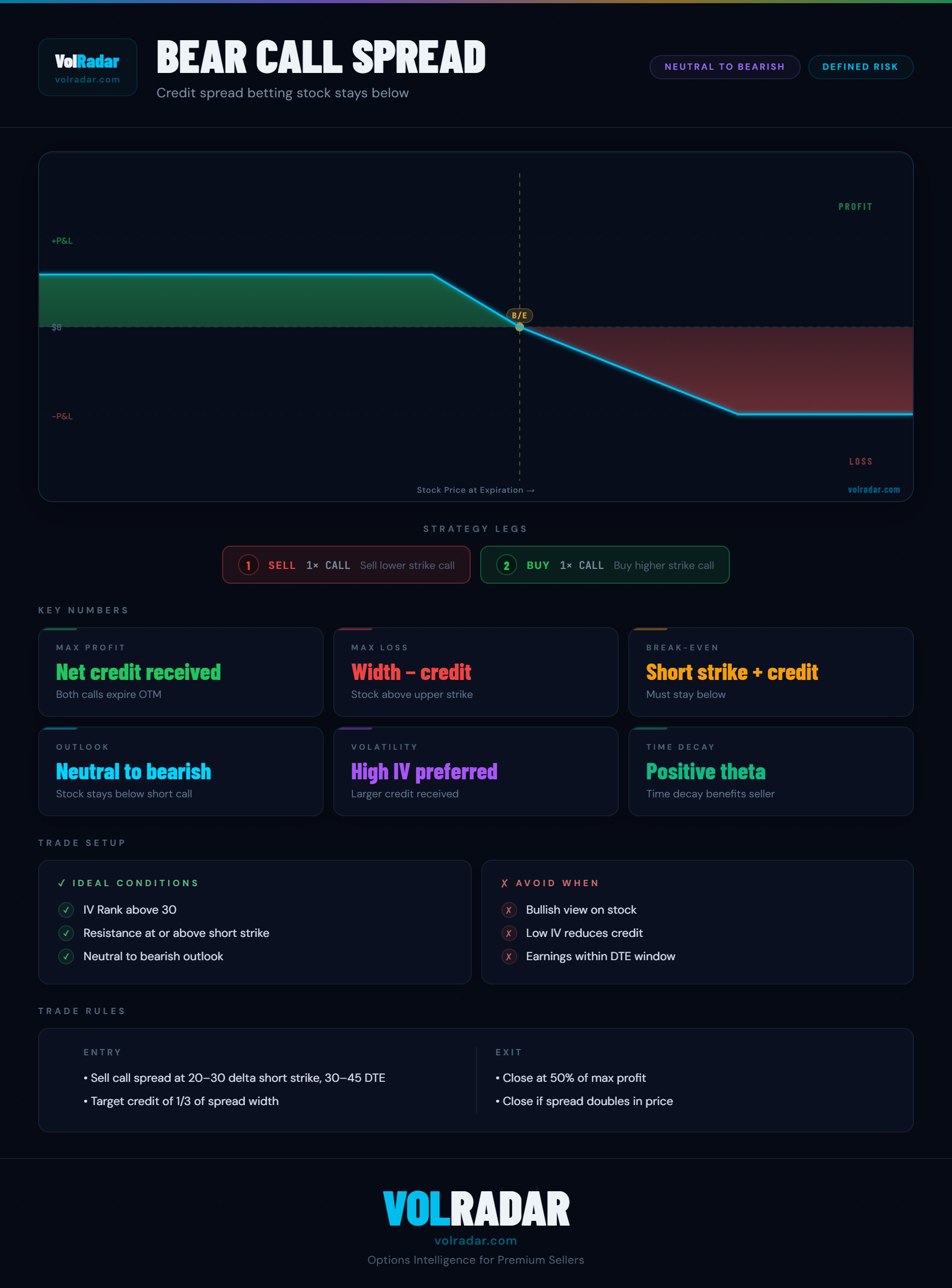
A call credit spread is a vertical spread that sells a call and buys another call with a higher strike on the same stock and expiration, for a net credit. It is also called a bear call spread. The credit is the maximum gain, kept in full if the stock is at or below the short strike at expiration; the maximum loss, the strike width minus the credit, applies if the stock is at or above the long strike.
The position
Direction
Neutral to bearish
- Max profit
- Net credit received
- Max loss
- Spread width minus credit
- Risk type
- Defined risk
VolRadar Lens
Choosing the two strikes fixes the width, and the net credit actually received then sets both limits: with the other strike held fixed, a lower short strike or a higher long strike brings in more credit but does not lower, and usually raises, the most that can be lost.
Visual ReferencePayoff structure and strike placementShowHide
Why It Matters
The call credit spread is the bearish-to-neutral counterpart of the put credit spread: it generally profits if the stock holds steady or declines. Compared with selling a call on its own, whose loss on a rally is unlimited, the long call caps the loss, at the cost of a smaller credit. A bear put spread on the same two strikes has the same profit and loss profile once the cost of carry is taken into account; the difference is timing, because the call credit spread collects cash up front and may pay out later, while the bear put spread pays up front. Adding a put credit spread with the same expiration below the stock turns a call credit spread into an iron condor, which profits if the stock stays between the two short strikes.
How It Works
Sell a call and buy a call with a higher strike, on the same underlying and with the same expiration; the short call is usually out of the money or near the money. Because the lower-strike call costs more, the trade opens for a net credit: credit = short call premium minus long call premium. At expiration, if the stock is at or below the short strike, both calls expire worthless and the full credit is kept. Between the two strikes the short call has intrinsic value, so the result is the credit minus that intrinsic value, and the breakeven is the short strike plus the credit. At or above the long strike the loss stops growing, because the long call offsets further losses on the short call: the maximum loss is the strike width minus the credit. Dollar amounts are per-share figures times the contract multiplier (100 for standard US equity options). The passage of time generally helps the position, and a change in implied volatility usually has only a modest net effect because the two calls partly offset each other, although which leg moves more depends on where the stock trades relative to the strikes.
Example
Hypothetical: a stock trades at $100. A trader sells the $105 call for $2.10 and buys the $110 call for $0.90, same expiration, for a net credit of $2.10 - $0.90 = $1.20 per share, or $120 per contract with a 100 multiplier. Maximum gain: $120, if the stock is at or below $105 at expiration. Maximum loss: ($110 - $105 - $1.20) x 100 = $380, if the stock is at or above $110. Breakeven: $105 + $1.20 = $106.20. If the stock ends at $108, the short call is worth $3.00 and the long call nothing, so the result is $1.20 - $3.00 = -$1.80 per share, a $180 loss per contract, before commissions.
Common Mistakes
Reading the credit as the expected profit: it is the maximum gain, and any finish above the short strike, or a close before expiration, keeps less. Treating the defined loss as small: the maximum loss is the strike width minus the credit and is often larger than the maximum gain. Forgetting early assignment: an in-the-money short call can be assigned on any business day before expiration, most often just before an ex-dividend date; an assigned call writer must deliver the stock plus the dividend, and covering the assignment with the long call can mean holding a short stock position for one business day because assignment notices arrive with a delay. Ignoring expiration risk: if the stock closes near the short strike on the last trading day, it may not be known until after expiration whether the short call was assigned.
Is the market paying premium sellers today?
The SPY Premium Window study tracks when systematic option selling has historically been compensated — recomputed daily from market close. Free to read, no account needed.
Frequently Asked Questions
How is a call credit spread structured across two strikes?
It sells a call at a lower strike, usually closer to the stock price, and buys a call at a higher strike with the same expiration. The trade collects a net credit at entry. The full credit is kept if the stock is at or below the short strike at expiration, and the maximum loss is the strike width minus the credit, known when the trade fills.
When is a call credit spread bearish-to-neutral?
At expiration, the full credit is kept at or below the short strike, part of it is kept up to the breakeven (short strike plus credit), and losses begin only above the breakeven, growing until the long strike, where the maximum loss applies. Before expiration, a falling stock and the passage of time generally help the position and a rise hurts it, so a sharp upside move is the main risk.
What is the break-even on a call credit spread?
Break-even at expiration equals the short call strike plus the net credit received. Below this level the trade makes money; above it, losses grow until the stock reaches the long strike, where the maximum loss applies. A call credit spread and a bear call spread are the same position, so the calculation is identical.
How does a call credit spread compare with a naked short call?
A naked short call has unlimited loss if the stock rises. In a call credit spread the long call caps that loss at the strike width minus the credit. The trade-off is the long call's cost, which reduces the credit collected.
Can a call credit spread be assigned before expiration?
Yes. Standard US equity options are American-style, so the short call can be assigned on any business day before expiration, and assignment becomes more likely when the call is in the money and the stock is about to go ex-dividend. An assigned call writer must deliver the stock plus the dividend; the long call can be exercised to cover the shares, but assignment notices arrive with a delay, which can leave a short stock position for one business day.
General references
General references for this topic area, not citations for the specific figures above. VolRadar is not affiliated with these organizations.
The information about Call Credit Spread above is for educational purposes only and is not financial advice. Read our full investment disclaimer.
Understand options faster.
One term, one worked example, one real ticker. Every Sunday. No jargon.
One email per week, no drip campaigns · Unsubscribe anytime